
QRU: radio meaning and how to report an incident
Q Code in practice · security
QRU, in Brazilian usage, means an incident, problem or update. Saying “sem” (no) before the code means there is nothing to report. The official ITU list has a similar meaning: “Have you anything for me?” and “I have nothing for you.”
Updated on · ABC Mais Telecom technical team, Motorola Solutions and Hytera two-way radio sales and rental.
What does QRU mean on the radio?
In the ITU list (ITU-R M.1172), the code asks “Have you anything for me?” and answers “I have nothing for you.” It was a way of checking for outstanding messages between two stations before ending a contact.
In Brazil, the code acquired the meaning of an incident or problem. “Sem QRU” (no QRU) is one of the most common patrol responses, reporting that nothing has happened at that location. This operational custom varies between companies: some use the code only for incidents, others for any update from a post. Define it in the procedure.
| Use | Question | Answer |
|---|---|---|
| Official (ITU) | Have you anything for me? | I have nothing for you. |
| Patrol | “Any updates in sector 4?” | “Sector 4, no QRU.” |
| Incident | “What happened at reception?” | “Person without a badge at reception.” |
| Shift handover | “Outstanding issues from the shift?” | “Gate 2 sticking; maintenance notified.” |
QRU in practice: 3 complete conversations
Each conversation shows the exchange using codes, followed immediately by the same message in plain language. Use it as a team training script.
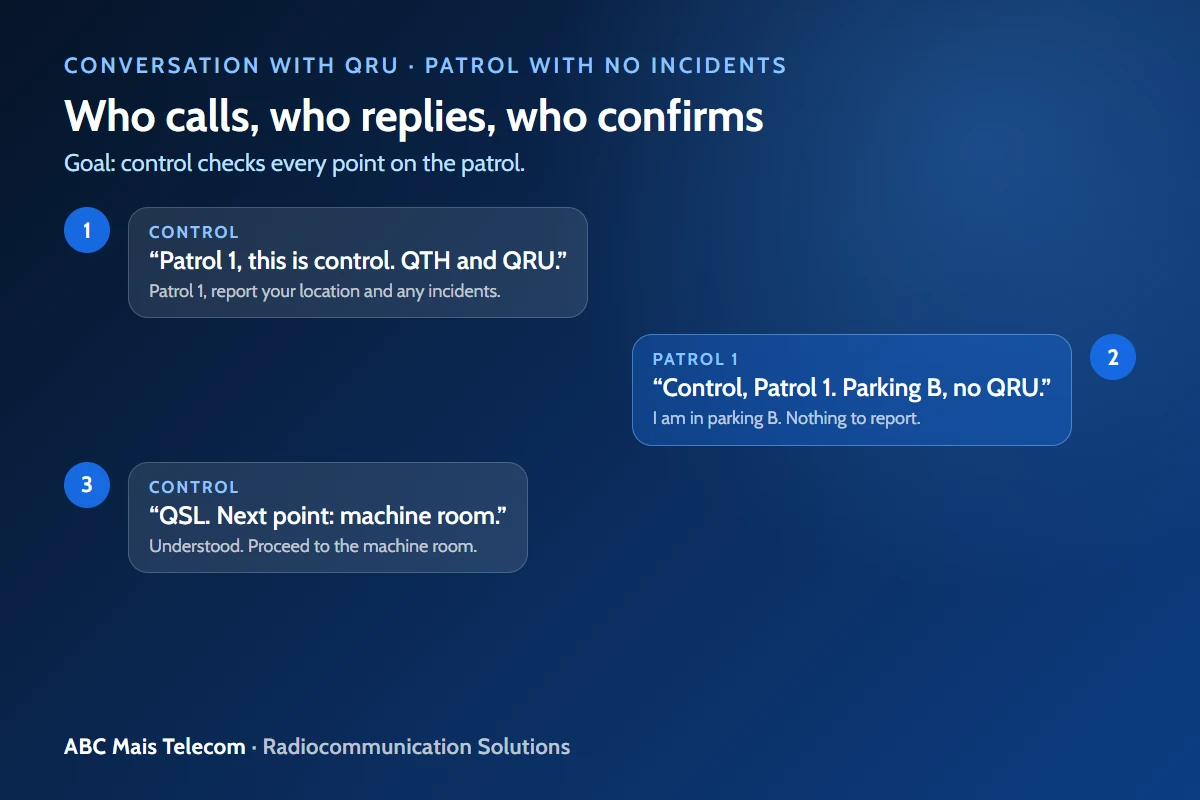
Patrol with nothing to report
Objective: control checks every patrol location.
- Control
“Patrol 1, this is control. QTH and QRU.”
In plain language: Patrol 1, state your location and whether there is any incident. - Patrol 1
“Control, Patrol 1. Parking lot B, no QRU.”
In plain language: I am in parking lot B. There is nothing to report. - Control
“QSL. Next location: machine room.”
In plain language: Understood. Proceed to the machine room.
Incident at reception
Objective: report, request backup and close the incident.
- Gatehouse 1
“Control, Gatehouse 1. QRU at reception: person without a badge insisting on entry.”
In plain language: Control, there is a problem at reception: a person without a badge wants to enter. - Control
“QSL. Keep the person at reception. Patrol 2, backup at reception.”
In plain language: Understood. Do not let them in. Patrol 2, go to reception. - Patrol 2
“QSL, Patrol 2 proceeding to reception.”
In plain language: Understood, I am on my way to reception. - Gatehouse 1
“Control, QRU closed. Visitor registered and escorted.”
In plain language: Control, resolved. The visitor has been registered and is being escorted.
Shift handover
Objective: ensure the next shift knows what remains outstanding.
- Post 3 (outgoing)
“Supervisor, Post 3 signing off. Shift QRU: burnt-out light in corridor B and gate 2 sticking.”
In plain language: Supervisor, I am leaving. Two problems remain: the corridor B light and gate 2. - Post 3 (incoming)
“QSL. Post 3 taking over with both issues noted.”
In plain language: Understood. I have taken over the post and noted both problems. - Supervisor
“QSL. Maintenance already notified.”
In plain language: Understood. Maintenance already knows.
4 ready-to-use QRU phrases
Replace the names with your team’s locations and call signs. Before each transmission, state who the message is for and who is speaking.
- Patrol 1
“Control, Patrol 1. Sector 4, no QRU.”
Patrol location with nothing to report. - Gatehouse
“Control, QRU at the gatehouse: delivery without an invoice.”
Announce the incident and describe it. - Security officer
“Control, QRU in parking lot B: car with headlights on, plate Bravo, Romeo, Alfa, two, Echo, one, nine.”
Incident with the license plate spelled out. - Security officer
“Control, QRU closed at dock 3.”
Report that the situation has been resolved.
How to use QRU without ambiguity
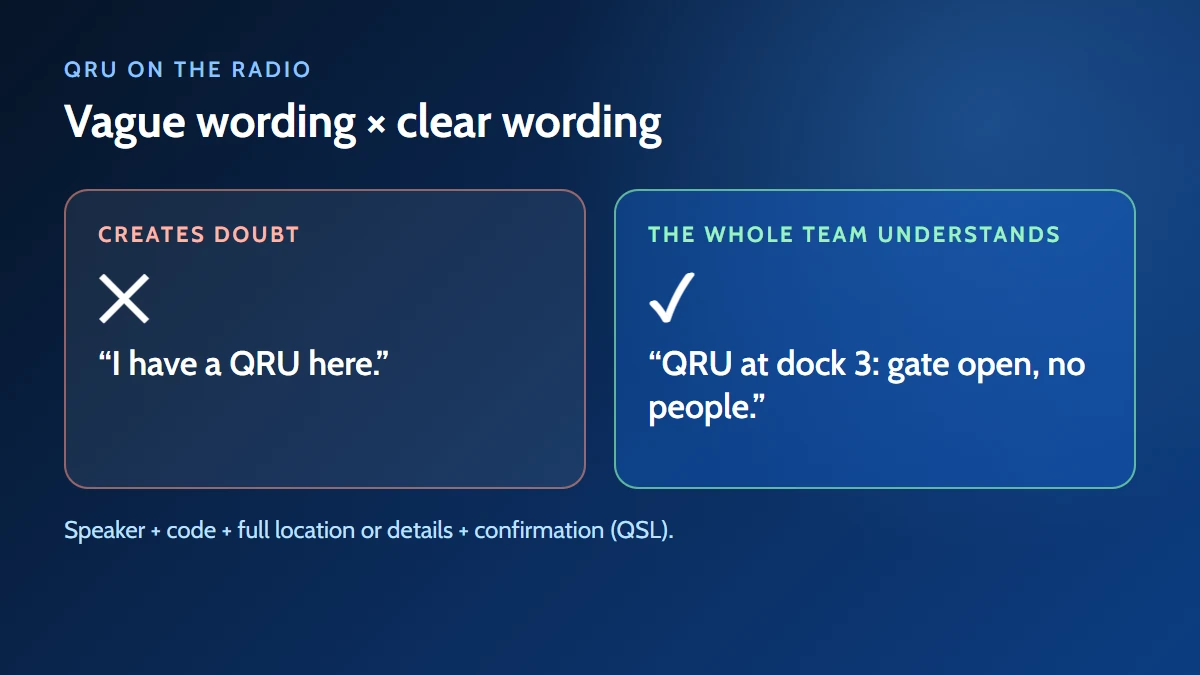
- State the type, location and situation. “Dock 3: gate open, nobody present.” The listener understands what and where it is.
- A nothing-to-report response also needs a location. “Sector 4, nothing to report” is better than “all normal” because it confirms where you are.
- Report when the incident is closed. Saying the incident is closed frees control and the people providing backup.
- Record it in the logbook. Every incident reported on the radio goes into the logbook with the time, location and action taken.
- In an emergency, use no code. Fire, injury or intrusion: say “emergency,” the location and what is happening.
Common QRU mistakes
- Only saying “I have a QRU.” Control cannot tell whether it is urgent. State the type and location in the same transmission.
- Forgetting to report closure. Backup waits unnecessarily and control cannot close the log entry.
- Saying everything is normal without being at the location. Answering from memory hides problems. Check on site.
- Exposing personal data. Full names, residents’ unit numbers and identity documents should not be transmitted on an open channel.
QRU in different operations
- Site security Patrols respond with the location and situation; incident reports include type, location and situation.
- Gatehouse and access control Deliveries, unregistered visitors and suspicious vehicles require objectively worded reports.
- Events Queues, arguments, people feeling unwell and forgotten objects are reported by sector.
- Logistics and industry Open gate, damaged cargo and unauthorized dock access: report with the license plate and dock.
- Residential complexes Noise, leaks and unauthorized contractors: a brief report, with details off the channel.
10-minute training at shift change
Short, frequent sessions work better than one long class a year. This script fits into a shift handover.
- Verification patrol. At shift change, control calls each post: location and situation, or the incident.
- A report in 15 seconds. Each security officer describes a simulated incident with its type, location and situation, in no more than 15 seconds.
- Closure. Simulate an incident and require a closure report including the time.
- From radio to logbook. Compare what was said on the radio with the written record and add anything missing.
Post procedure template
Copy and adapt this for your company’s operating procedure. It defines how the whole team uses the code, including new arrivals.
| Item | Suggested wording |
|---|---|
| Adopted meaning | QRU = incident or update; “sem” (no) + code = nothing to report. |
| When to use it | Patrol, shift handover and any abnormal situation. |
| Message format | Type + location + situation: “QRU at dock 3: gate open.” |
| When not to use it | A real emergency: say “emergency,” the location and what is happening. |
| Closure | Every incident ends with a closure report and a logbook entry. |
5 questions for team refresher training
- The patrol answered “all fine.” Is that complete?Answer: No. The location is missing: “Sector 4, nothing to report.”
- What three parts make a good report?Answer: Type, location and situation.
- How do I report that an incident has ended?Answer: Say it is closed, with the location and time.
- Can I mention the resident’s name?Answer: Avoid it. State the essentials and give details off the channel.
- Is a fire a QRU?Answer: It is an emergency: speak clearly, without codes.
QRU and related codes
| Code | Purpose | Example |
|---|---|---|
| QRU | Incident or update. | “Dock 3, gate open.” |
| QTH | Location. | “QTH: dock 3.” |
| QTR | Exact time. | “QTR 22h15.” |
| QSL | Acknowledge receipt. | “QSL, backup on the way.” |
A good incident report combines three codes: QRU (what), QTH (where) and QTR (what time), and ends with QSL from the recipient. See also the security officer code guide with a PDF pocket card and the complete Q Code table.
Frequently asked questions about QRU
What does QRU mean on the radio?
In Brazilian usage, an incident, problem or update. In the ITU list, “Have you anything for me?”.
What does “sem QRU” mean?
There is nothing to report at the post or patrol location.
Is QRU an official code?
The code exists in the ITU list, referring to outstanding messages. The “incident” meaning is a Brazilian custom.
How do I report an incident by radio?
Identify the speaker, type, location and situation: “Control, Post 2. Dock 3: gate open.”
What is the difference between QRU and QTC?
In many teams, the first means an incident and the second a message. Record which usage applies in your company’s procedure.
Does every incident go into the logbook?
Yes. Record the time, location, what happened and the action taken.
Is “QRU negativo” the same as “sem QRU”?
Yes, it is another expression used by some teams. Choose one and use it consistently.
Do patrols need to report the situation at every location?
That is safest: the location and “no QRU” at each point show that the patrol passed and everything was normal.
Sources consulted
Are incident reports taking too long to reach control? ABC Mais Telecom rents two-way radios for site security, gatehouses and events, with use of Anatel-licensed frequencies already included in the rental.
See security radio rentalRental WhatsAppPrefer to buy? Radios for security