
QSL: radio meaning and how to acknowledge a message
Q Code in practice · security
QSL means message received on the radio, equivalent to “understood.” This code confirms that you heard and understood the message. In private security, this acknowledgement closes the exchange: control knows the instruction arrived. For a critical message, repeat the key detail before acknowledging.
Updated on · ABC Mais Telecom technical team, Motorola Solutions and Hytera two-way radio sales and rental.
What does QSL mean on the radio?
In the international ITU list (Recommendation ITU-R M.1172), the code asks “Can you acknowledge receipt?” and answers “I acknowledge receipt.” It originated in radiotelegraphy, when each message needed acknowledgement so the station knew it had arrived in full. Its official and everyday meanings are almost identical.
In Brazil, QSL has become synonymous with “understood” among security, gatehouse, events and transport teams, and in amateur radio. Variations such as “QSL total” and “QSL, positivo” are local customs, outside the ITU list. In amateur radio, the name also refers to the card two stations exchange to confirm a contact.
| Use | Question | Answer |
|---|---|---|
| Official (ITU) | Can you acknowledge receipt? | I acknowledge receipt. |
| Security and gatehouse | “Visitor cleared for block C. Confirm.” | “Received, block C.” |
| Critical message | “Backup to dock 3. Confirm.” | “QSL, backup to dock 3.” |
| Amateur radio | “I am sending the confirmation card.” | A card confirming the completed contact. |
QSL in practice: 3 complete conversations
Each conversation shows the exchange using codes, followed immediately by the same message in plain language. Use it as a team training script.
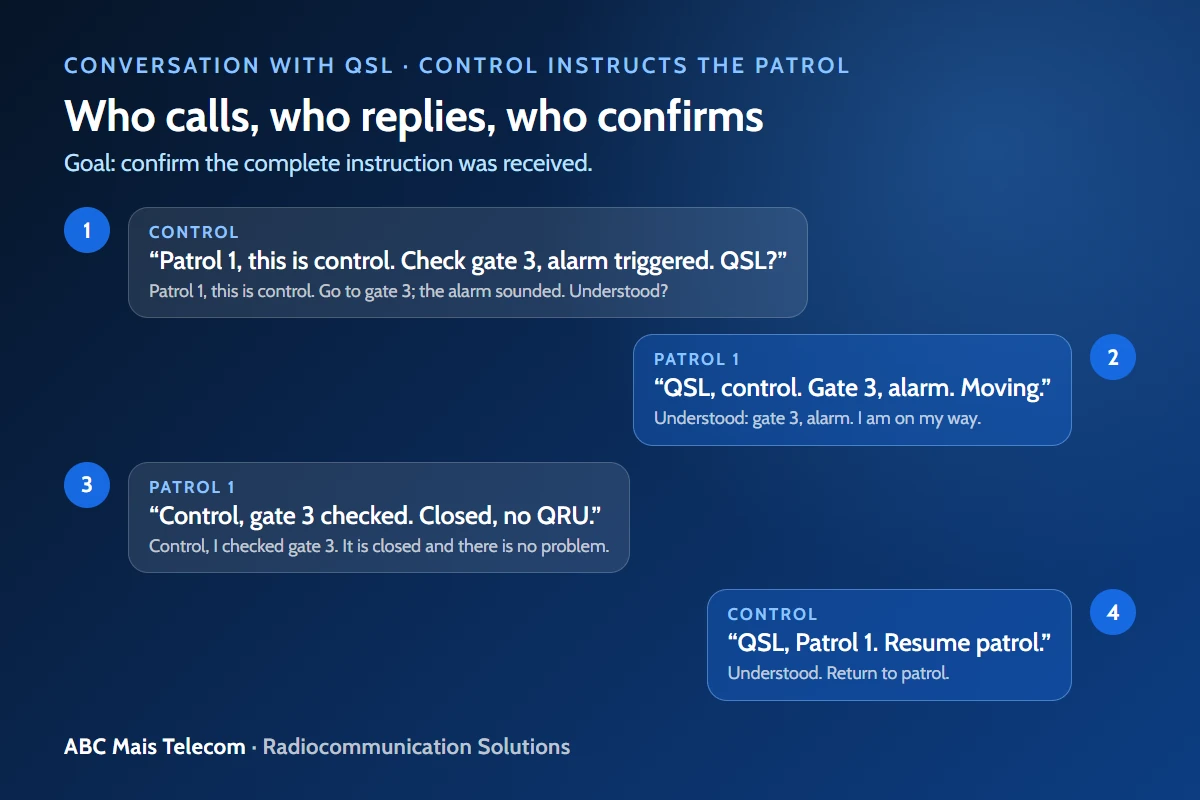
Control instruction during patrol
Objective: confirm that the complete instruction arrived.
- Control
“Patrol 1, this is control. Check gate 3, alarm activated. QSL?”
In plain language: Patrol 1, this is control. Go and check gate 3; the alarm sounded. Understood? - Patrol 1
“QSL, control. Gate 3, alarm. On my way.”
In plain language: Understood: gate 3, alarm. I am on my way. - Patrol 1
“Control, gate 3 checked. Closed, no QRU.”
In plain language: Control, I checked gate 3. It is closed and there is no problem. - Control
“QSL, Patrol 1. Resume patrol.”
In plain language: Understood. Return to patrol.
Gatehouse clearance
Objective: avoid admitting the wrong person.
- Supervisor
“Gatehouse 1, maintenance technician Marcos is cleared for block C.”
In plain language: Gatehouse 1, you may admit maintenance technician Marcos to block C. - Gatehouse 1
“Received. Technician Marcos, maintenance, block C.”
In plain language: Understood: maintenance technician Marcos is going to block C. - Supervisor
“Correct.”
In plain language: That is correct.
A message cut off at an event
Objective: do not acknowledge what you did not hear.
- Coordination
“South entrance, close the…”
In plain language: The message is cut off. - South entrance
“Coordination, message cut off. Repeat.”
In plain language: Coordination, the message was incomplete. Please repeat. - Coordination
“South entrance, close turnstile 2 and direct people to turnstile 4.”
In plain language: South entrance, close turnstile 2 and send the public to turnstile 4. - South entrance
“QSL. Turnstile 2 closed, public directed to 4.”
In plain language: Understood. Turnstile 2 is closed and people are going to 4.
5 ready-to-use QSL phrases
Replace the names with your team’s locations and call signs. Before each transmission, state who the message is for and who is speaking.
- Patrol 2
“QSL, control.”
Simple acknowledgement of a routine message. - Gatehouse
“QSL. Visitor Ana, company Beta, block C.”
Confirm by repeating the important details. - Security officer
“QSL, backup on the way to parking lot B.”
Acknowledge a request for backup with the location. - Control
“QSL to all. Have a good shift.”
Close the general call at the start of the shift. - Security officer
“QSL, but I am with a visitor. QRX two minutes.”
Acknowledge and request a wait.
How to use QSL without ambiguity
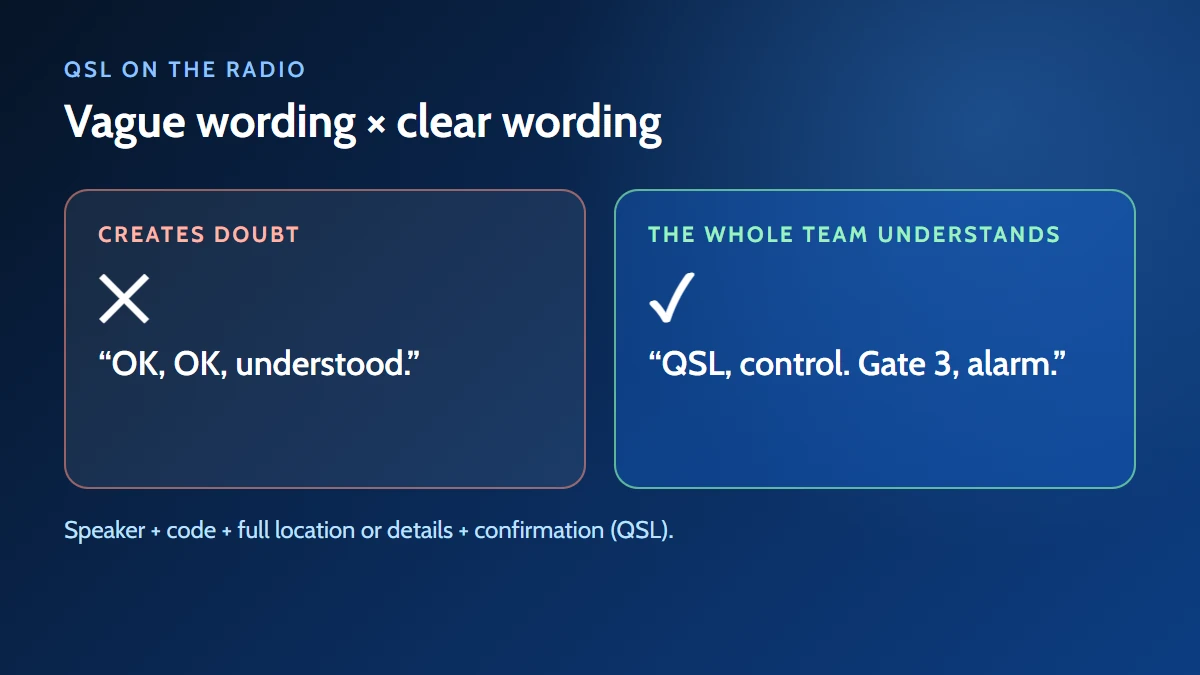
- Only acknowledge once you understand everything. If part is missing, ask for a repeat. Acknowledging “out of politeness” causes mistakes.
- Repeat the critical detail. For a location, name, license plate, time or quantity, repeat the detail with the acknowledgement: “QSL, dock 3.”
- Reply with your call sign. Identifying who acknowledged avoids ambiguity when several posts share one channel.
- Do not acknowledge for another post. Each recipient acknowledges for themselves. “I think they heard” is not an acknowledgement.
- Acknowledge corrections too. When a message is corrected, acknowledge the new version with the correct detail.
Common QSL mistakes
- Acknowledging without hearing the message. Automatic acknowledgement is the most common cause of missed radio instructions.
- Responding with a button click. Pressing PTT without speaking confirms nothing to someone far away.
- Acknowledging a critical message without the key detail. For backup, emergencies or clearance, repeat the location or name.
- Requesting acknowledgement without saying what to confirm. Without specifying what needs acknowledgement, responses become inconsistent.
QSL in different operations
- Site security Movement instructions and requests for backup end with an acknowledgement and the location repeated.
- Gatehouse and access control Visitor clearance is only valid after acknowledgement including the name and destination.
- Events Each sector involved acknowledges opening or closing an access point, one at a time.
- Logistics and industry Loading and unloading instructions are acknowledged with the dock and license plate.
- Residential complexes Gatehouse notices about deliveries, moves and contractors are acknowledged before clearance.
10-minute training at shift change
Short, frequent sessions work better than one long class a year. This script fits into a shift handover.
- A three-part instruction. Control gives an instruction with a location, action and time. Each post acknowledges by repeating all three parts.
- A deliberately cut-off message. The supervisor stops mid-transmission. The correct response is to request a repeat, not acknowledge.
- Acknowledgement by call sign. During the general call, each post acknowledges with its own call sign in the agreed order.
- Logbook review. Compare radio instructions with the shift log and check whether anything was acknowledged but not carried out.
Post procedure template
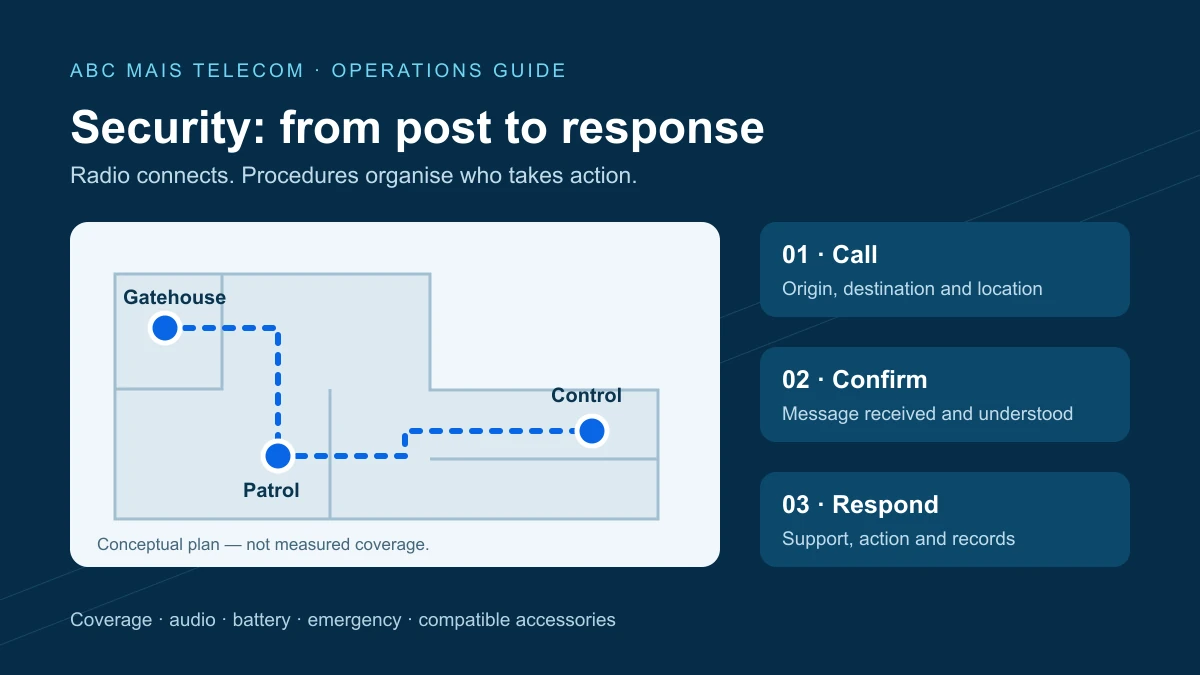
Copy and adapt this for your company’s operating procedure. It defines how the whole team uses the code, including new arrivals.
| Item | Suggested wording |
|---|---|
| Adopted meaning | QSL = message received and understood. |
| When to use it | At the end of every message addressed to the post, after understanding it in full. |
| Reply format | Code + call sign; for a critical message, repeat the location, name or time. |
| When not to use it | If the message is cut off or unclear: request a repeat. |
| Required acknowledgement | Backup, emergencies and clearance: acknowledgement with the key detail repeated. |
5 questions for team refresher training
- The message was cut off. Can I acknowledge it?Answer: No. Request a repeat.
- How do I acknowledge a request for backup?Answer: By repeating the location with the acknowledgement.
- Does acknowledging mean I agree?Answer: No. It means I received and understood the message.
- Who acknowledges a call to three posts?Answer: Each post, with its own call sign.
- Which code corrects a message already sent?Answer: QTA.
QSL and related codes
| Code | Purpose | Example |
|---|---|---|
| QSL | Acknowledge receipt. | “Received, dock 3.” |
| QAP | Be listening. | “QAP on channel 1.” |
| QRX | Ask someone to wait. | “QRX two minutes.” |
| QTA | Cancel the last message. | “QTA on the last message: gate 2.” |
After QSL, anyone needing time uses QRX (wait); to correct information already sent, use QTA (cancel). The code QAP indicates who is listening. See also the security officer code guide with a PDF pocket card and the complete Q Code table.
Frequently asked questions about QSL
What does QSL mean on the radio?
It means message received and understood. It is a short way to say “understood.”
Is QSL an official code?
Yes. It is in the ITU Q Code list with the meaning of acknowledging receipt. Variations using “total” and “positivo” are Brazilian customs.
What is a QSL card?
In amateur radio, it is the card stations exchange to confirm a completed contact.
What is the difference between QSL and QAP?
QAP says you are listening. The other code confirms that you received a message.
Can I answer QSL to any message?
Acknowledge when the message is addressed to you and fully understood. If anything is missing, request a repeat.
Does QSL mean I will carry out the instruction?
It means you received it. If you cannot comply, acknowledge and explain why.
What does “QSL total” mean?
A local custom meaning “fully understood.” It has the same effect as a simple acknowledgement and is absent from the ITU list.
Do two button clicks count as acknowledgement?
Some groups agree on this signal, but it is not standard and may not reach everyone. Prefer a spoken acknowledgement.
Sources consulted
Does your team need more radios to keep everyone listening? ABC Mais Telecom rents two-way radios for site security, gatehouses and events, with use of Anatel-licensed frequencies already included in the rental.
See security radio rentalRental WhatsAppPrefer to buy? Radios for security