
QRX: radio meaning (wait) and how to request a pause
Q Code in practice · security
QRX means wait. On the radio, “stay QRX” asks the other person to wait, and “QRX two minutes” says how long. In security, the code is used when someone cannot yet respond or act: they are with a visitor, in a place with no signal or checking information.
Updated on · ABC Mais Telecom technical team, Motorola Solutions and Hytera two-way radio sales and rental.
What does QRX mean on the radio?
In the ITU list (ITU-R M.1172), QRX asks “when will you call me again?” and answers “I will call you again at… hours.” Thus, the official meaning already includes a promise to call back at a stated time. Brazilian usage simplified it to “wait” or “stand by.”
This detail makes a practical difference: a wait with no duration leaves the other person unsure whether to wait a minute or half an hour. That is why good practice in security teams is to state the time and who will return the call.
| Use | Phrase | What it means |
|---|---|---|
| Official (ITU) | “I will call at 15 hours.” | I will call you again at 15 hours. |
| Security | “QRX two minutes.” | Wait two minutes; I will call. |
| Request | “Stand by.” | Wait on the channel until another call. |
| Answer | “QSL, standing by.” | Understood, I will wait. |
QRX in practice: 3 complete conversations
Each conversation shows the coded message followed by the same message in plain language. Use it as a training script with your team.
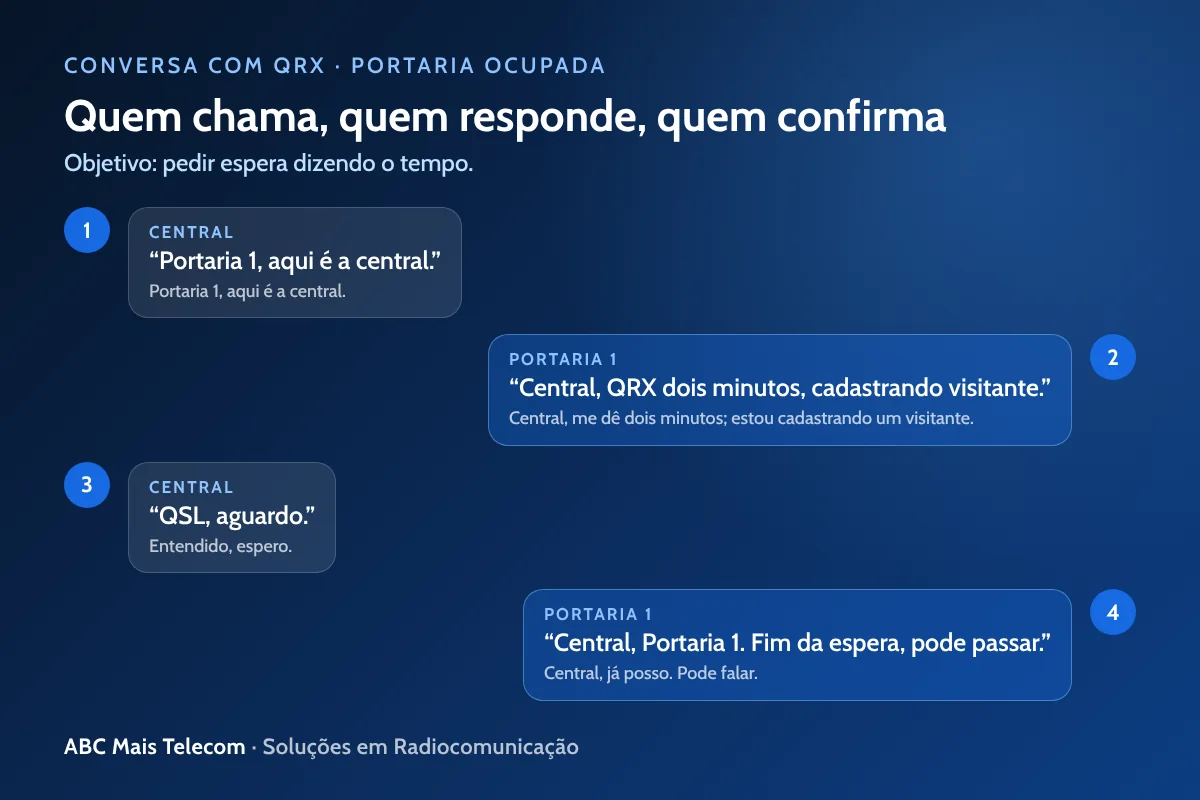
Busy gatehouse
Goal: request a pause while stating the time.
- Control center
“Gatehouse 1, this is control.”
In plain language: Gatehouse 1, this is control. - Gatehouse 1
“Control, QRX two minutes, registering a visitor.”
In plain language: Control, give me two minutes; I am registering a visitor. - Control center
“QSL, standing by.”
In plain language: Understood, I will wait. - Gatehouse 1
“Control, Gatehouse 1. Wait over, go ahead.”
In plain language: Control, I can now. Go ahead.
Basement without signal
Goal: agree on the return call before entering a dead spot.
- Patrol 2
“Control, Patrol 2 going down to basement 2. QRX five minutes, I will call on exit.”
In plain language: Control, I am going to basement 2. In five minutes I will call when I leave. - Control center
“QSL. If you do not call in five minutes, I will send support.”
In plain language: Understood. If you do not call in five minutes, I will send someone. - Patrol 2
“Control, Patrol 2 on the ground floor, basement normal.”
In plain language: Control, I am back on the ground floor. Basement normal.
Holding an action at an event
Goal: prevent opening before the order.
- Coordination
“North Entrance, wait for the order to open.”
In plain language: North Entrance, wait for the order to open. - North Access
“QSL, gate closed until another call.”
In plain language: Understood, the gate stays closed until you call. - Coordination
“North Entrance, wait over. You may open.”
In plain language: North Entrance, you may open.
7 ready-to-use phrases with QRX
Replace the names with your team’s locations and call signs. Before each message, say who it is for and who is speaking.
- Gatehouse
“Control, QRX two minutes, I am registering a visitor.”
Busy assisting someone. - Control center
“Patrol 1, stand by at the gate until the vehicle arrives.”
Instructing someone to wait at a point. - Patrol 2
“Control, wait, I will go up the stairs and call from the third floor.”
Location change with an agreed return call. - Supervision
“Post 4, QRX on relief, the guard is on the way.”
Shift change delay. - Event
“North Entrance, wait for coordination before opening.”
Hold an action until the order. - Control center
“Patrol 3, is the wait over? Report the situation.”
Follow up on a long wait. - Security guard
“Control, QRX over. Patrol 2 ready in sector 5.”
Report that the wait is over.
How to use QRX without causing doubt
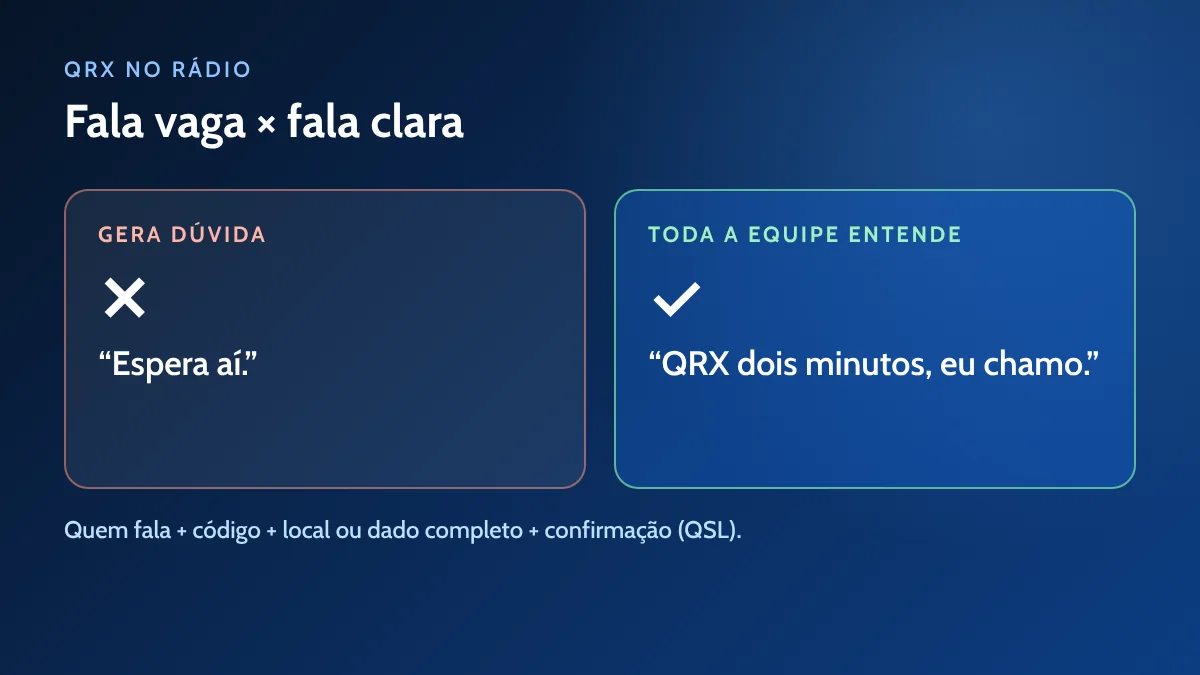
- State the time. “QRX two minutes” is better than just “QRX.”
- Say who will call back. “I will call” or “wait for control to call.”
- Agree on the return call before areas without signal. Basements, stairs and cold rooms may lose communication. Report before entering.
- Do not request a pause in an emergency. If the situation is serious, report the essentials immediately, even briefly.
- End the wait. When finished, report that the wait is over.
Common mistakes with QRX
- Requesting a pause without a time. Control does not know when to call again.
- Forgetting to end it. The person waiting remains stopped.
- Requesting a pause in an emergency. Emergencies do not wait: state the essentials.
- Occupying the channel while waiting. While you wait, the channel should remain free for other posts.
QRX in each type of operation
- Property security: Patrols report before entering basements, stairs and areas without signal and agree on the return call.
- Gate staff and access control: The gatekeeper requests a pause while registering a visitor or checking a tax invoice.
- Events: Teams hold gate opening or admission of the public until coordination gives the order.
- Logistics and industry: The dock requests a pause while finishing unloading before receiving the next truck.
- Condominiums: The gatehouse requests a pause while confirming with the resident over the intercom.
10-minute training at shift change
Short, frequent training works better than one long annual class. This script fits into service handover.
- Define standard times. For example: one, two or five minutes. This makes control’s tracking easier.
- Practice the area without signal. Each patrol reports before entering the basement and calls on exit.
- Test “no return call.” If the patrol does not call within the agreed time, control activates the company’s procedure.
- Review at the end of the shift. How many waits exceeded the agreed time? Why?
Template for the post procedure
Copy and adapt it for your company’s operating procedure. The text defines code usage for the whole team, including new arrivals.
| Item | Suggested text |
|---|---|
| Adopted meaning | QRX = wait; whoever requests the pause states the time and who will call back. |
| When to use | Assistance in progress, information checks and entry into an area without signal. |
| Message format | “QRX two minutes, I will call.” |
| When not to use | In an emergency: report the essentials immediately. |
| Required confirmation | QSL from the person who will wait and a report when the wait ends. |
5 questions for team refresher training
- Is it correct to request a pause without a time?Answer: No. State the time: “QRX two minutes.”
- The patrol is going to a basement without signal. What should it report?Answer: The location, the time and that it will call on exit.
- What if the patrol does not call within the agreed time?Answer: Control follows the company’s procedure, which may include sending support.
- Who can use the channel during the wait?Answer: Other posts; the wait should not occupy the channel.
- How do you end the wait?Answer: By reporting that the wait is over, with the information or readiness report.
QRX and similar codes
| Code | When to use | Example |
|---|---|---|
| QRX | Wait. | “QRX two minutes.” |
| QRV | Ready to act. | “Ready, leaving.” |
| QRL | I am busy. | “Busy, I will call shortly.” |
Often comes with QRV (ready) and QAP (listening). See the everyday list in the guide security guard code with PDF card.
Frequently asked questions about QRX
Does QRX mean “wait”?
Yes, in Brazilian usage. In the ITU standard it means “I will call you again at… hours.”
What is the difference between QRX and QAP?
One is waiting; the other is listening. Someone waiting normally continues listening.
How long does a QRX last?
The time you state. That is why you should always say: “QRX two minutes.”
How do I end the wait?
Call the person who was waiting and say the wait is over, with the information or by reporting that you are ready.
Are QRX and QRL the same thing?
No. QRL means “I am busy”; the other asks someone to wait and promises a return call.
Can I request QRX from control?
You can, provided it is not an emergency and you state the time.
Can control request QRX from a post?
Yes, for example to hold an action until confirmation. It must also say when it will call again.
Does a long wait disrupt the channel?
If the conversation remains idle on the channel, yes. Agree on the return call and free the channel for other posts.
Sources consulted
Is your operation’s channel always busy? ABC Mais Telecom rents two-way radios for property security, gatehouses and events in the state of São Paulo, with the use of Anatel-licensed frequencies already included in the rental.
See rental for securityRental WhatsAppPrefer to buy? Radios for security
