
QTH: radio meaning and how to report your location
Q Code in practice · security
QTH means location on the radio: it is the code used to ask or report where a person, team or incident is. In private security, “report your QTH” means “where are you now?” A good answer is a point the whole team recognizes, such as “north guard booth” or “dock 3.”
Updated on · ABC Mais Telecom technical team, Motorola Solutions and Hytera two-way radio sales and rental.
What does QTH mean on the radio?
Q Code originated in radiotelegraphy to shorten frequent questions and answers. In the ITU international list (recommendation ITU-R M.1172), QTH asks “what is your position in latitude and longitude, or according to another indication?” and answers “my position is…”. The meaning of position is the same in official and everyday use.
In Brazil, guards, gate staff, event teams and amateur radio operators use the code more broadly: team location, incident address and even a home address (“residential QTH”). The code is short, but the answer must be precise. Vague locations delay support and make the control center ask again, occupying the channel.
| Use | Question | Answer |
|---|---|---|
| Official (ITU) | What is your position? | My position is (latitude and longitude or another indication). |
| Security and gate staff | Report your QTH. | Guard booth 2, service gate. |
| Incident | Where is the incident? | Dock 3, by the scale. |
| External address | Provide the client’s address. | Street, number, neighborhood and a visible landmark. |
QTH in practice: 3 complete conversations
Each conversation shows the coded message followed by the same message in plain language. Use it as a training script with your team.
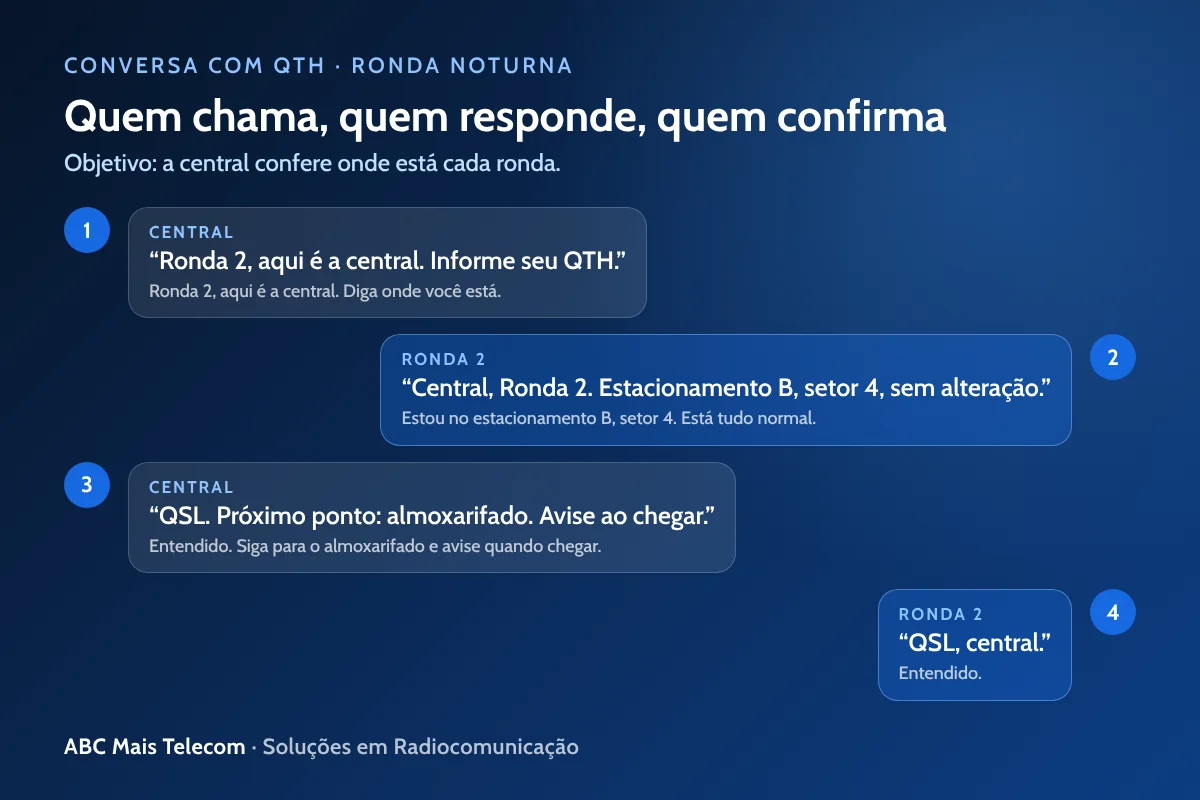
Night patrol
Goal: the control center checks each patrol’s location.
- Control center
“Patrol 2, this is Control. Report your QTH.”
In plain language: Patrol 2, this is Control. Tell me where you are. - Patrol 2
“Control, Patrol 2. Parking lot B, sector 4, all normal.”
In plain language: I am in parking lot B, sector 4. Everything is normal. - Control center
“QSL. Next point: stores. Report on arrival.”
In plain language: Understood. Go to stores and report when you arrive. - Patrol 2
“QSL, Control.”
In plain language: Understood.
Incident at the dock
Goal: send support to the exact point.
- Security guard
“Control, Post 4. Unauthorized person at dock 3, by the scale.”
In plain language: Control, this is Post 4. There is an unauthorized person at dock 3, near the scale. - Control center
“Repeat the location.”
In plain language: Repeat where it is. - Security guard
“Dock 3, by the scale, near the side gate.”
In plain language: Dock 3, near the scale and side gate. - Control center
“QSL. Support is on the way to your QTH, estimated arrival two minutes.”
In plain language: Understood. Support is on the way to you and will arrive in about two minutes.
Event with an audience
Goal: locate where the queue has grown.
- Coordination
“Access, this is Coordination. Where is the longest queue?”
In plain language: Access team, where is the longest queue? - North Access
“Coordination, longest queue at the North gate, turnstile 2.”
In plain language: The longest queue is at the North gate, turnstile 2. - Coordination
“QSL. Support team, move to the North gate, turnstile 2.”
In plain language: Understood. Support team, go to the North gate, turnstile 2.
8 ready-to-use QTH phrases
Replace the names with your team’s locations and call signs. Before each message, say who it is for and who is speaking.
- Control center
“Patrol 2, this is Control. Report your QTH.”
Routine check during patrol. - Patrol 2
“Control, Patrol 2. Parking lot B, sector 4, all normal.”
Answer with location and status in the same message. - Gatehouse
“Supervision, this is the gatehouse. Visitor heading to block C reception.”
Report the destination of someone who entered. - Control center
“Support team, move to dock 3, by the scale.”
Sending support with a landmark. - Security guard
“Control, incident in the second-floor corridor, next to the emergency stairs.”
Incident: point + physical landmark. - Supervision
“Post 1, confirm your QTH before shift change.”
Check before handover. - Event
“Access, this is Coordination. What is the QTH of the longest queue?”
Crowd coordination at events. - Control center
“Repeat the QTH, I only heard ‘block’.”
Requesting repetition when a message is cut off.
How to use QTH without ambiguity
- Use standardized names. Guard booths, gates, docks, blocks and floors need the same names on the post map, in the incident log and over the radio.
- Go from general to specific. First the area (parking lot B), then the point (sector 4) and, if needed, the landmark (next to the fire hydrant).
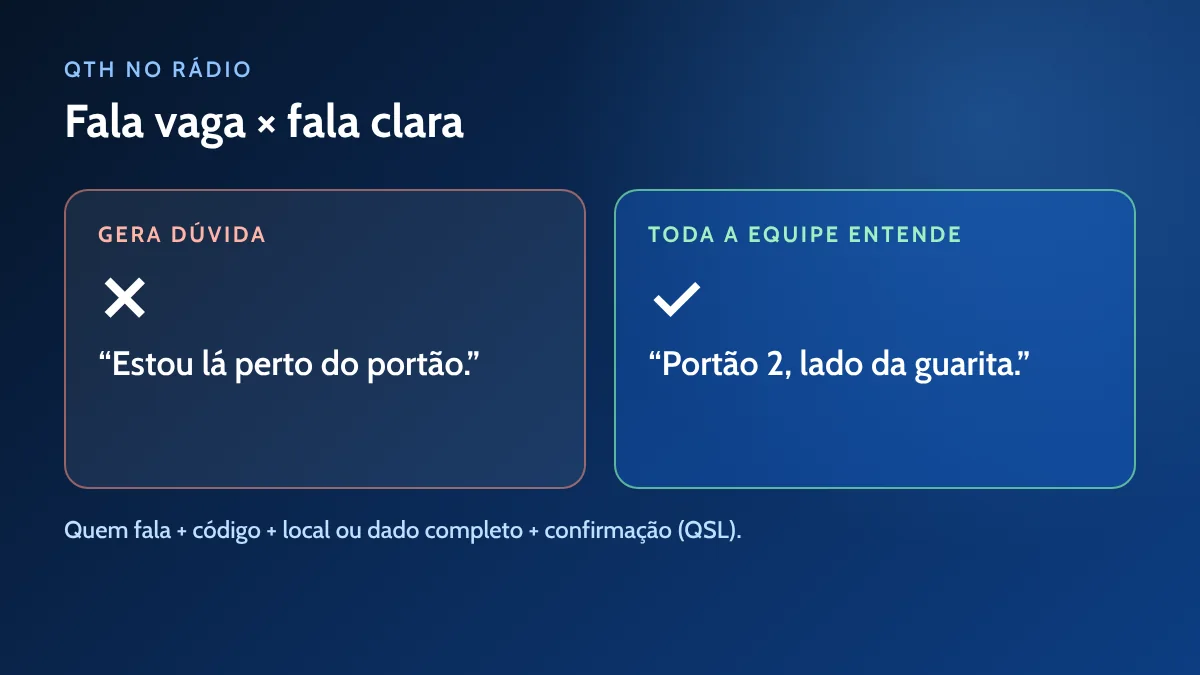
- Avoid “here” and “there.” To someone listening over the radio, these words identify no location.
- Spell out anything confusing. Vehicle plates, acronyms and street names should be spelled using the phonetic alphabet (Alfa, Bravo, Charlie…).
- Ask for confirmation. When support is moving, the receiver repeats the location and only then replies QSL.
Common QTH mistakes
- Answering only “I am in the area.” The control center needs a point, not a region. State the sector and a landmark.
- Using different names for the same place. “Back gate,” “gate 3” and “kitchen gate” for the same gate confuse staff arriving for their shift.
- Reporting the location before identifying the speaker. Start with identification: “Control, Patrol 2…”. Listeners then know where the information comes from.
- Dictating an external address from memory. Read it from the record and spell out the street name if in doubt.
QTH in each type of operation
- Property security: The control center follows patrols point by point and knows each guard’s location when an incident occurs.
- Gate staff and access control: Gate staff report where visitors have been admitted, and hosts know where to meet them.
- Events: Coordination locates queues, medical assistance points and emergency exits by each sector’s name.
- Logistics and industry: Docks, warehouse aisles and production lines receive names and numbers so support arrives quickly.
- Condominiums: Blocks, towers, garages and common areas have fixed names; residents’ units need not be stated alongside their names.
10-minute training at shift change
Short, frequent training works better than one long annual class. This script fits into service handover.
- Create the location map. List all points with unique names: guard booths, gates, docks, blocks, floors and common areas.
- Do a QTH round. At shift change, the control center calls each post and asks its location. Each responds with an area and point.
- Simulate an incident. A supervisor describes a difficult point (basement, stairway, back of the warehouse) and measures how long support takes to understand.
- Adjust the names. Every place that required repetition gets a clearer name on the post map.
Template for the post procedure
Copy and adapt it for your company’s operating procedure. The text defines code usage for the whole team, including new arrivals.
| Item | Suggested text |
|---|---|
| Adopted meaning | QTH = team or incident location. |
| When to use | Patrols, support movement, incidents, shift changes and directing visitors. |
| Response format | Area + point + landmark, using names from the post map. |
| When not to use | When contacting firefighters, SAMU or police: give the full address without codes. |
| Required confirmation | The receiver repeats the location before QSL when movement is involved. |
5 questions for team refresher training
- The patrol replied “I am in the parking area.” Is that sufficient?Answer: No. The point is missing: sector, space or landmark.
- What is the correct response order?Answer: From general to specific: area, point and landmark.
- How should a vehicle plate or acronym be given alongside the location?Answer: Spell it with the phonetic alphabet.
- Who confirms the location in a request for support?Answer: Whoever is going there, repeating the location before QSL.
- What if the location has no name on the map?Answer: Use a fixed physical landmark, then propose a map name after the shift.
QTH and similar codes
| Code | Answers | Example |
|---|---|---|
| QTH | Where are you? | “Gate 2.” |
| QTI | Where are you going? (heading or destination, in Brazilian use) | “Stores.” |
| QRB | How far away are you? | “About 200 meters from Control.” |
In the ITU table, QTI refers to true heading and QRB to the approximate distance between stations. In many Brazilian teams, QTI has come to mean “destination.” If your company uses both, record this in the post procedure. Also see the security guard codes with a pocket PDF card and the complete Q Code table.
QTH frequently asked questions
Does QTH mean an address?
It means position or location. In Brazilian usage, it also means an address, such as “residential QTH.” In security, it most often refers to the team’s location.
Is QTH an official code?
Yes. It is in the ITU Q-code list meaning position. Using it for a “home address” is a Brazilian custom.
How should you answer “what is your QTH?”
State the area and point, from general to specific: “parking lot B, sector 4.” If there is an incident, include the situation in the same message.
Can radios show location automatically?
Some digital radios with GPS, connected to a dispatch system, send their position to the control center. This depends on the model and contracted system. Clear speech remains necessary.
What is the difference between QTH and QTI?
The first says where you are; QTI, in Brazilian usage, says where you are going.
Can I give a resident’s address over the radio?
Avoid personal data on open channels. Use the unit number or the landmark agreed by the company.
What is the difference between location and address?
Location is a point within the site (gate, dock, floor). An address is the street, number and neighborhood, used for outside arrivals.
Can condominium radios use the same standard?
Yes. Give blocks, towers and garages fixed names and always use the same ones over the radio.
Sources consulted
Does your security team need more radios at the post? ABC Mais Telecom rents two-way radios for property security, gatehouses and events in the state of São Paulo, with the use of Anatel-licensed frequencies already included in the rental.
See rental for securityRental WhatsAppPrefer to buy? Radios for security
