

QRV: radio meaning (ready and available) and ready-to-use phrases
Q Code in practice · security
QRV means ready or available to act. Saying “I am QRV” means you can take on the task now. It differs from QAP, which means only “listening.” In security, the code confirms the team can provide support, open a gate or start a patrol.
Updated on · ABC Mais Telecom technical team, Motorola Solutions and Hytera two-way radio sales and rental.
What does QRV mean on the radio?
In the ITU list (ITU-R M.1172), QRV asks “are you ready?” and answers “I am ready.” Brazilian use retained that meaning and expanded it to “available” and “at your disposal.” Hence “available for the next request” and “team QRV” are common phrases at gatehouses, patrols and events.
The code’s value is distinguishing two situations: hearing the radio and being able to act. A guard may be QAP on the channel but not ready because they are escorting a visitor or handling an incident. Stating this clearly avoids sending requests for support to someone who cannot go.
| Code | Means | Example |
|---|---|---|
| QAP | Listening, attentive to the channel (Brazilian usage). | “I remain QAP on channel 2.” |
| QRV | Ready or available to act. | “Ready to cover post 3.” |
| QSL | Message received and understood. | “QSL, moving to post 3.” |
| QRX | Wait, hold on a moment. | “QRX two minutes, I am with a visitor.” |
QRV in practice: 3 complete conversations
Each conversation shows the coded message followed by the same message in plain language. Use it as a training script with your team.
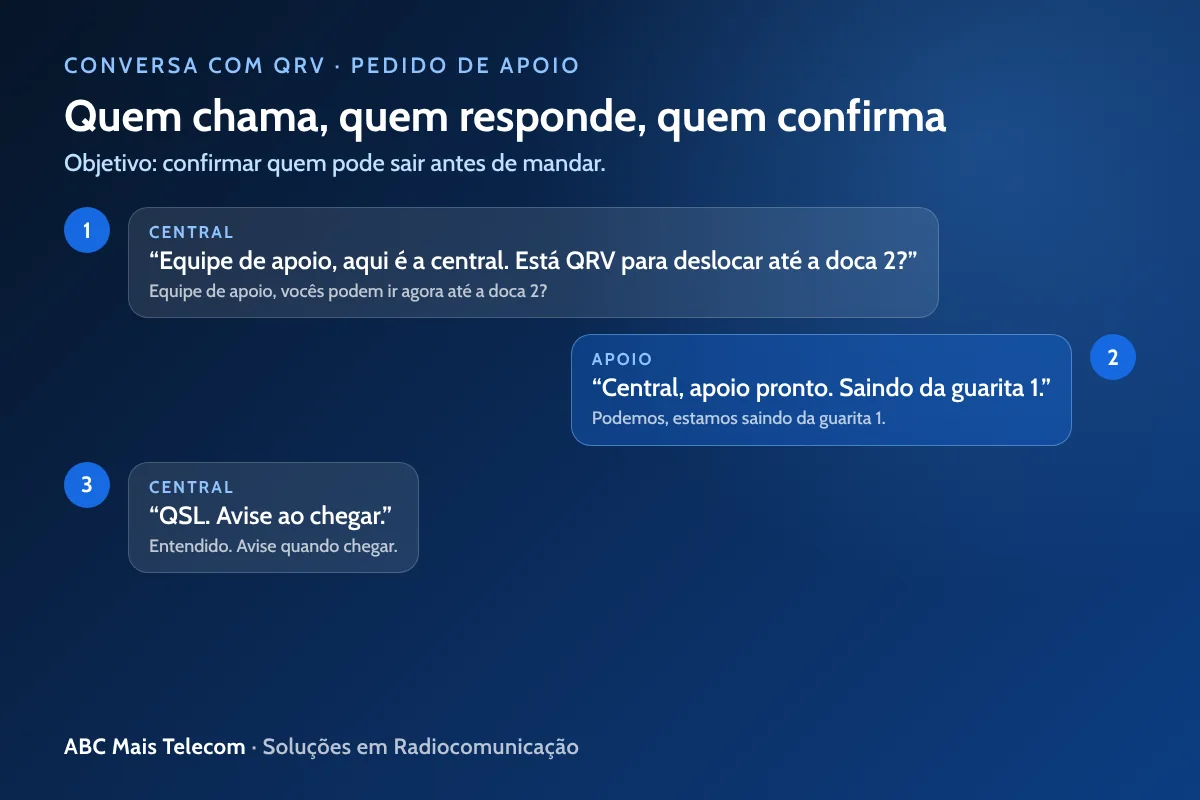
Request for support
Goal: confirm who can go before sending them.
- Control center
“Support team, this is Control. Are you QRV to move to dock 2?”
In plain language: Support team, can you go to dock 2 now? - Support
“Control, support ready. Leaving guardhouse 1.”
In plain language: We can, we are leaving guardhouse 1. - Control center
“QSL. Report on arrival.”
In plain language: Understood. Report when you arrive.
Busy post
Goal: report that you cannot act yet.
- Control center
“Patrol 3, are you available to cover post 2?”
In plain language: Patrol 3, can you cover post 2? - Patrol 3
“Control, not QRV yet. QRX five minutes, escorting a visitor.”
In plain language: I cannot yet. Give me five minutes, I am with a visitor. - Control center
“QSL. Standing by.”
In plain language: Understood. I will wait. - Patrol 3
“Control, Patrol 3 ready, heading to post 2.”
In plain language: I can now, I am going to post 2.
Event opening
Goal: open only when everyone is ready.
- Coordination
“Access teams, report whether you are ready to open.”
In plain language: Access teams, say whether you can open the gates. - South Gate
“Coordination, South Gate QRV.”
In plain language: South Gate is ready. - North Gate
“Coordination, North Gate not yet. A turnstile is missing.”
In plain language: North Gate is not ready yet; a turnstile is missing. - Coordination
“QSL. Open only with both gates ready.”
In plain language: Understood. We only open when both gates are ready.
8 ready-to-use phrases with QRV
Replace the names with your team’s locations and call signs. Before each message, say who it is for and who is speaking.
- Control center
“Support team, this is Control. Are you QRV to move to dock 2?”
Before sending someone away from a post. - Support
“Control, support QRV. Leaving guardhouse 1 now.”
Confirms they can go and are already leaving. - Patrol 3
“Control, Patrol 3 not QRV yet. QRX five minutes, escorting a visitor.”
Busy; says when they will return. - Supervision
“Post 2, report when you are ready for relief.”
Shift change. - Gatehouse
“Control, gatehouse ready to release the maintenance truck.”
Ready to carry out the release. - Event
“Coordination, South Gate team QRV to open.”
Gate opening. - Control center
“All posts, report whether you are ready for the drill at 15 hours.”
All call before training. - Security guard
“Control, Patrol 1 QRV again, incident closed.”
Available again.
How to use QRV without causing doubt
- Only say ready when you can leave. If you still need to lock the guardhouse or hand over the post, say QRX and the estimated time.
- Repeat the essential part of the order. For a risk-related or access task, repeat the destination before confirming.
- Report when you become available again. After closing an incident, report “QRV again.”
- Separate listening from availability. Someone who is QAP may not be ready. State the difference.
Common mistakes with QRV
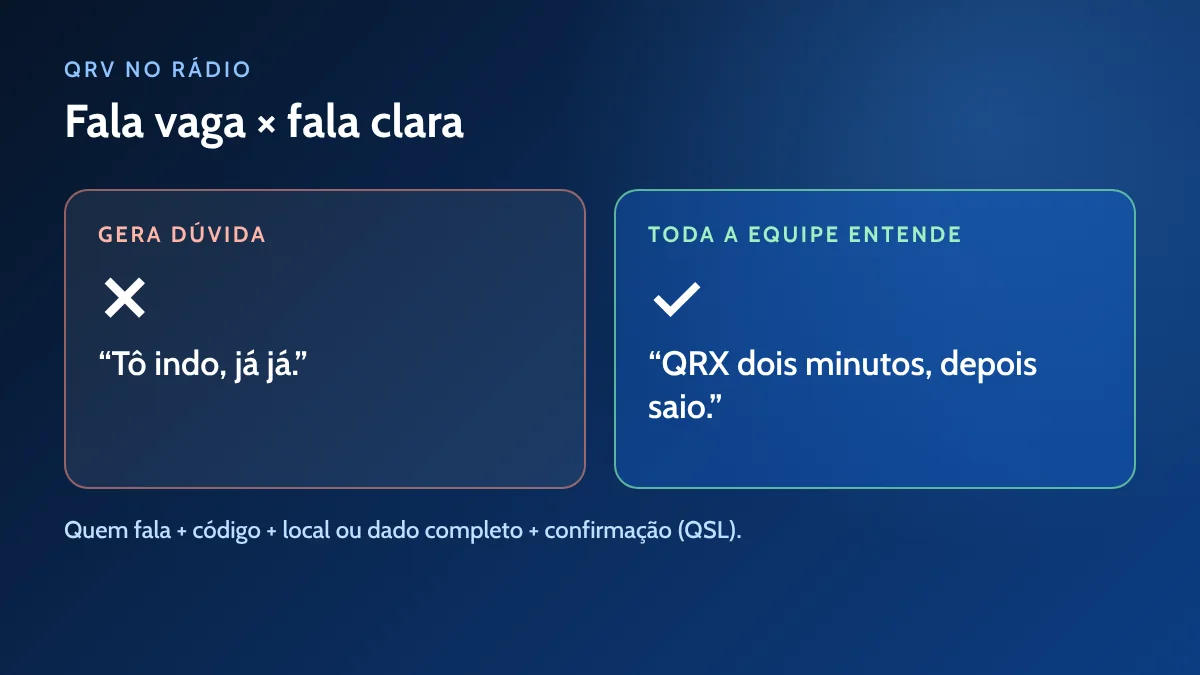
- Saying ready when you are not. Leaving a post unsecured creates another problem. Request QRX and say how much time you need.
- Confusing QRV with QSL. QSL confirms that you understood. The other confirms that you can act.
- Not reporting when you become available again. Control continues to think you are busy and calls another post.
- Replying for another post. Each post reports its own availability.
QRV in each type of operation
- Property security: Control only sends support after knowing who is ready to leave without leaving a post uncovered.
- Gate staff and access control: The gatekeeper reports when they can handle the next access authorization or when they are with a visitor.
- Events: Gates open only when all access teams are ready.
- Logistics and industry: Receiving staff report when they are ready at the dock, and dispatch only sends the truck afterward.
- Condominiums: The caretaker reports when they can handle a call in a common area.
10-minute training at shift change
Short, frequent training works better than one long annual class. This script fits into service handover.
- Agree on the three replies. Ready, wait (QRX) and I cannot (negative), always with the reason.
- Perform the readiness call. At shift change, control asks who is ready; each post replies in one sentence.
- Simulate a support request. Two posts receive the same request; only one can leave. Practice the reply from the one that stays.
- Review response time. Note the time from the question to “ready, leaving.”

Template for the post procedure
Copy and adapt it for your company’s operating procedure. The text defines code usage for the whole team, including new arrivals.
| Item | Suggested text |
|---|---|
| Adopted meaning | QRV = ready or available to carry out the task now. |
| When to use | Support requests, relief, gate opening, access authorization and return after an incident. |
| Response format | “Ready, leaving guardhouse 1” or “not yet, QRX five minutes.” |
| When not to use | If you still need to hand over the post, lock the guardhouse or finish assisting someone. |
| Required confirmation | For a risky task, repeat the destination before saying you are ready. |
5 questions for team refresher training
- I am listening to the radio but escorting a visitor. Am I QRV?Answer: No. You are listening (QAP), but not ready.
- What should I say when I cannot leave yet?Answer: “Not yet, QRX five minutes,” with the reason.
- What should I report after closing an incident?Answer: That you are available again.
- Do QSL and QRV mean the same thing?Answer: No. QSL is “I understood”; QRV is “I can act.”
- Who reports a post’s availability?Answer: The post itself, never another post on its behalf.
QRV and similar codes
| Code | When to use | Example |
|---|---|---|
| QRV | I can act now. | “Ready, leaving.” |
| QRX | Not yet; wait. | “QRX five minutes.” |
| QAP | I am listening. | “Listening on channel 2.” |
A common sequence is: control calls, the team replies that it is listening, receives the task, acknowledges QSL and reports QRV when it can act. See QAP: meaning and examples, QRX (wait) and the security guard codes with a pocket PDF card.
Frequently asked questions about QRV
Does QRV mean “available”?
Yes, in Brazilian usage it means “ready” or “available.” In the ITU standard it means “I am ready.”
What is the difference between QRV and QAP?
QAP is listening. QRV is being ready to act. You can be listening without being ready.
How should I reply if I am not ready?
Say “not yet” and state the time with QRX: “QRX five minutes.”
Is QRV used only in security?
No. Amateur radio operators, events, logistics and maintenance also use it. The meaning agreed by the team applies.
Do I need to say QRV after QSL?
When the task is not immediate, yes: QSL shows you understood, and QRV reports that you can now act.
Is QRV an official code?
Yes. It is on the ITU list of Q codes with the meaning “I am ready.”
Should a ready team wait for the order?
Yes. Saying you are ready does not authorize action: execution starts with the order from control or coordination.
How does control track who is available?
With a simple list by post (available, busy, handling an incident), updated with each radio report.
Sources consulted
Does your team need radios ready for the next event or post? ABC Mais Telecom rents two-way radios for property security, gatehouses and events in the state of São Paulo, with the use of Anatel-licensed frequencies already included in the rental.
See rental for securityRental WhatsAppPrefer to buy? Radios for security
