
QSO: radio meaning and when to use it in operations
Q Code in practice · security
QSO means contact page or communication between stations. In amateur radio, “I made a QSO” means a complete radio conversation took place. In security teams, “make QSO with Control” requests direct contact with someone, sometimes through another means such as telephone.
Updated on · ABC Mais Telecom technical team, Motorola Solutions and Hytera two-way radio sales and rental.
What does QSO mean on the radio?
In the ITU list (ITU-R M.1172), QSO asks “can you communicate with… directly (or by relay)?” and answers “I can communicate with… directly (or by relay through…)”. Its central meaning is the possibility of contact between two stations.
Over time, amateur radio operators began calling a completed contact a QSO, which is how the term appears in logs and QSL cards. In Brazilian security and event operations, the most common meaning is “contact” or “conversation.” Exact usage varies between companies, so it is worth recording in procedures.
| Context | How it appears | Meaning |
|---|---|---|
| Official (ITU) | “QSO with station X?” | Can you communicate with station X? |
| Amateur radio operator | “I made a QSO with Portugal.” | Complete contact made. |
| Security | “Make QSO with Supervision.” | Contact Supervision directly. |
| Relay | “No direct contact, I will relay.” | One post relays another’s message. |
QSO in practice: 3 complete conversations
Each conversation shows the coded message followed by the same message in plain language. Use it as a training script with your team.
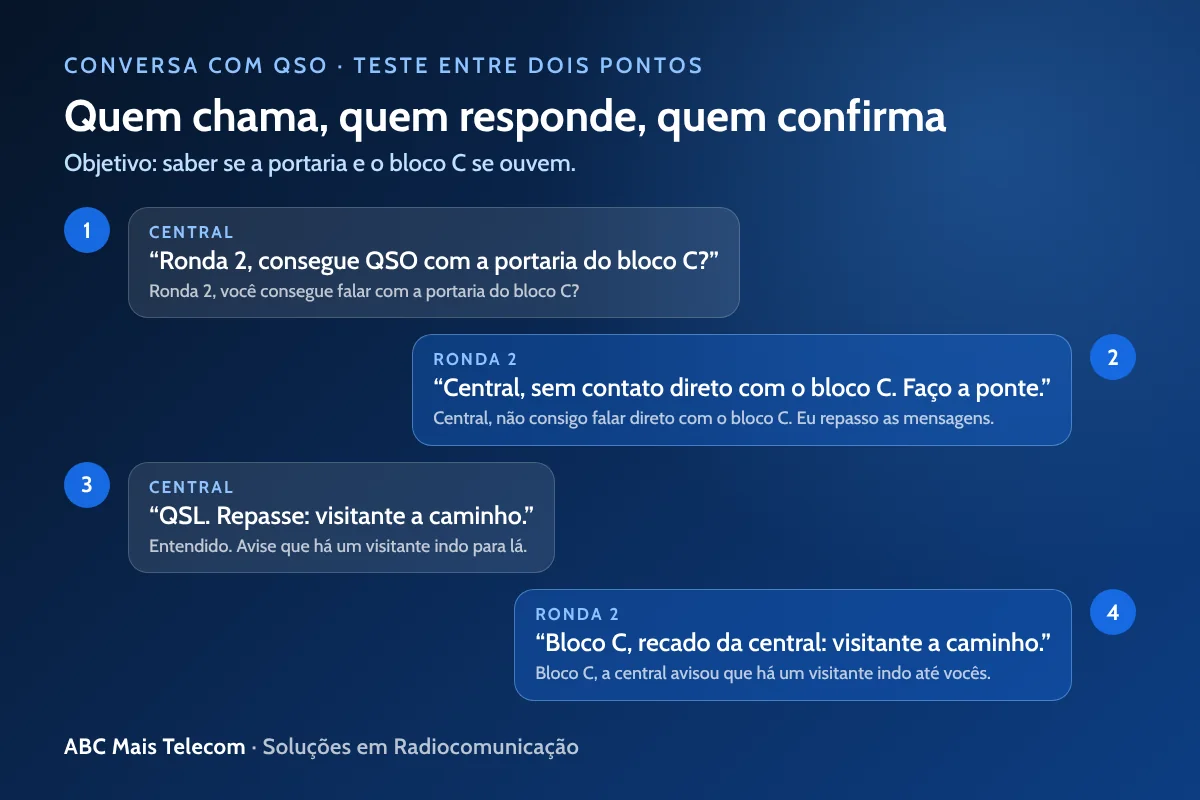
Test between two points
Goal: check whether the gatehouse and block C can hear one another.
- Control center
“Patrol 2, can you make QSO with block C’s gatehouse?”
In plain language: Patrol 2, can you speak to block C’s gatehouse? - Patrol 2
“Control, no direct contact with block C. I will relay.”
In plain language: Control, I cannot speak directly with block C. I will pass messages on. - Control center
“QSL. Relay: visitor on the way.”
In plain language: Understood. Tell them a visitor is heading there. - Patrol 2
“Block C, message from Control: visitor on the way.”
In plain language: Block C, Control says a visitor is heading to you.
Contact through another means
Goal: talk with someone who is not on the radio.
- Supervision
“Post 1, make QSO with the client by intercom and confirm access.”
In plain language: Post 1, speak to the client by intercom and confirm whether access can be granted. - Post 1
“Supervision, contact made. Access confirmed.”
In plain language: I spoke with the client. Access was confirmed.
Changing channels for a long conversation
Goal: avoid occupying the main channel.
- Coordination
“Bar team, QSO with me on channel 4.”
In plain language: Bar team, let’s talk on channel 4. - Bar team
“QSL, changing to channel 4.”
In plain language: Understood, changing to channel 4. - Coordination
“Conversation ended. Return to channel 1.”
In plain language: We are finished. Return to channel 1.
6 ready-to-use QSO phrases
Replace the names with your team’s locations and call signs. Before each message, say who it is for and who is speaking.
- Control center
“Patrol 2, can you make QSO with block C’s gatehouse?”
Testing whether two points can communicate. - Patrol 2
“Control, no direct contact with block C. I will relay.”
Relay through another post. - Supervision
“Post 1, make QSO with the client by intercom and confirm access.”
Contact through another means. - Coordination
“Bar team, QSO with me on channel 4.”
Calling someone to another channel (with QSY). - Control center
“Conversation ended, channel clear.”
Conversation finished; others may speak. - Security guard
“Control, maintenance contacted, technician on the way.”
Reporting completed contact.
How to use QSO without ambiguity
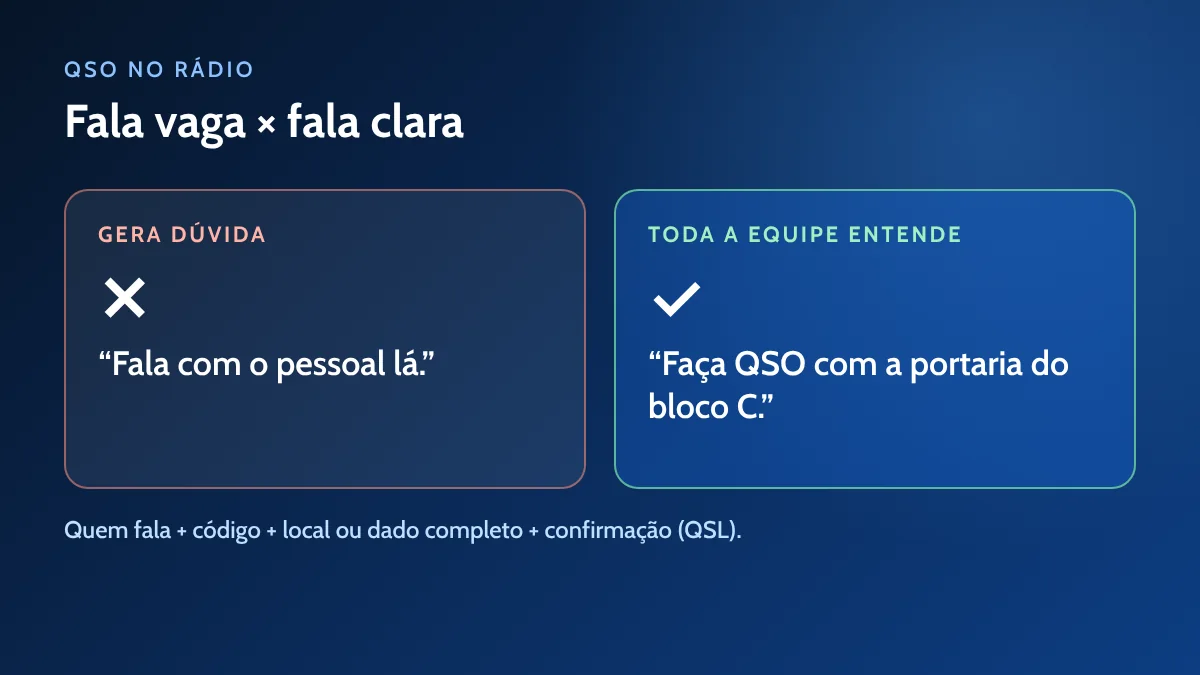
- State who the contact is with. “Make QSO with Supervision,” rather than just “make contact.”
- State when there is no direct contact. This tells Control that a relay is needed.
- Move long conversations to another channel. Agree on the channel (QSY) and return to the main channel afterward.
- End the conversation. Announce that the channel is clear.
Common QSO mistakes
- Relaying without saying so. Control thinks it spoke directly with the post.
- Long conversations on the main channel. Blocks urgent messages from other posts.
- Not recording points without communication. The problem recurs on every patrol.
- Confusing QSO with QSL. QSO is contact. QSL confirms receipt.
QSO in each type of operation
- Property security: Patrols test communication with Control in basements, stairways and the back of properties.
- Gate staff and access control: Gate staff contact the host by intercom or telephone and confirm over the radio.
- Events: Coordination moves long conversations to another channel and frees the main channel for alerts.
- Logistics and industry: Large yards use an intermediate post as a relay when two ends cannot hear one another.
- Condominiums: Building supervisors and gate staff agree on a maintenance-only channel during construction work.
10-minute training at shift change
Short, frequent training works better than one long annual class. This script fits into service handover.
- Test critical points. A patrol goes through the basement, stairways and rear areas, calling Control at each point.
- Mark where a relay is needed. Points without direct contact go on the post map.
- Practice relaying. One post relays a three-part message without losing information.
- Take the results to Supervision. If many points need relays, coverage should be assessed.
Template for the post procedure
Copy and adapt it for your company’s operating procedure. The text defines code usage for the whole team, including new arrivals.
| Item | Suggested text |
|---|---|
| Adopted meaning | QSO = contact or conversation between stations. |
| When to use | Communication tests, relay, contact through other means and conversations on separate channels. |
| Message format | “No direct contact with block C, I will relay.” |
| When not to use | To confirm receipt: that is QSL. |
| Required confirmation | The person relaying repeats the full message and confirms delivery. |
5 questions for team refresher training
- Two posts cannot hear one another. What should be done immediately?Answer: Use a third post as a relay and tell Control.
- Where should a long conversation take place?Answer: On another agreed channel, returning to the main one afterward.
- Are QSO and QSL the same?Answer: No. QSO is contact; QSL is confirmation.
- Should points without communication be recorded?Answer: Yes, on the post map, for coverage assessment.
- Who confirms delivery of a relayed message?Answer: The person who relayed it, after hearing QSL from the destination.
QSO and similar codes
| Code | Purpose | Example |
|---|---|---|
| QSO | Contact between stations. | “Contact made with the gatehouse.” |
| QSL | Confirm receipt. | “QSL, message received.” |
| QSY | Change channels. | “Changing to channel 4.” |
If relaying between posts happens frequently, coverage needs assessment, for example with a repeater. See how repeater rental to extend coverage, as well as QRA (identification) and security guard code with PDF card.
QSO frequently asked questions
Does QSO mean conversation?
In popular usage, yes: contact or conversation between stations. In the ITU standard, it means the possibility of direct or relayed communication.
What is a QSO in amateur radio?
It is a complete contact between two stations, usually logged and confirmed with a QSL card.
What is the difference between QSO and QSL?
QSO is contact. QSL confirms receipt.
No contact between two posts: what should be done?
Use a third post to relay and record the failure point. If frequent, assess coverage with a specialist.
Can I use QSO for telephone contact?
Some teams use it that way. Agree on this in procedures to avoid confusion.
Should long conversations stay on the main channel?
No. Agree on another channel and return to the main one afterward.
Is relaying between posts a permanent solution?
No. It helps immediately, but frequent communication gaps indicate coverage needs assessment.
Can different radio brands communicate?
It depends on the band, mode (analog or digital) and programming. Each case must be checked.
Sources consulted
Posts that cannot hear one another in your area? ABC Mais Telecom rents two-way radios for property security, gatehouses and events in the state of São Paulo, with the use of Anatel-licensed frequencies already included in the rental.
See rental for securityRental WhatsAppPrefer to buy? Radios for security
