
The most searched Q codes: ABC Mais Telecom ranking
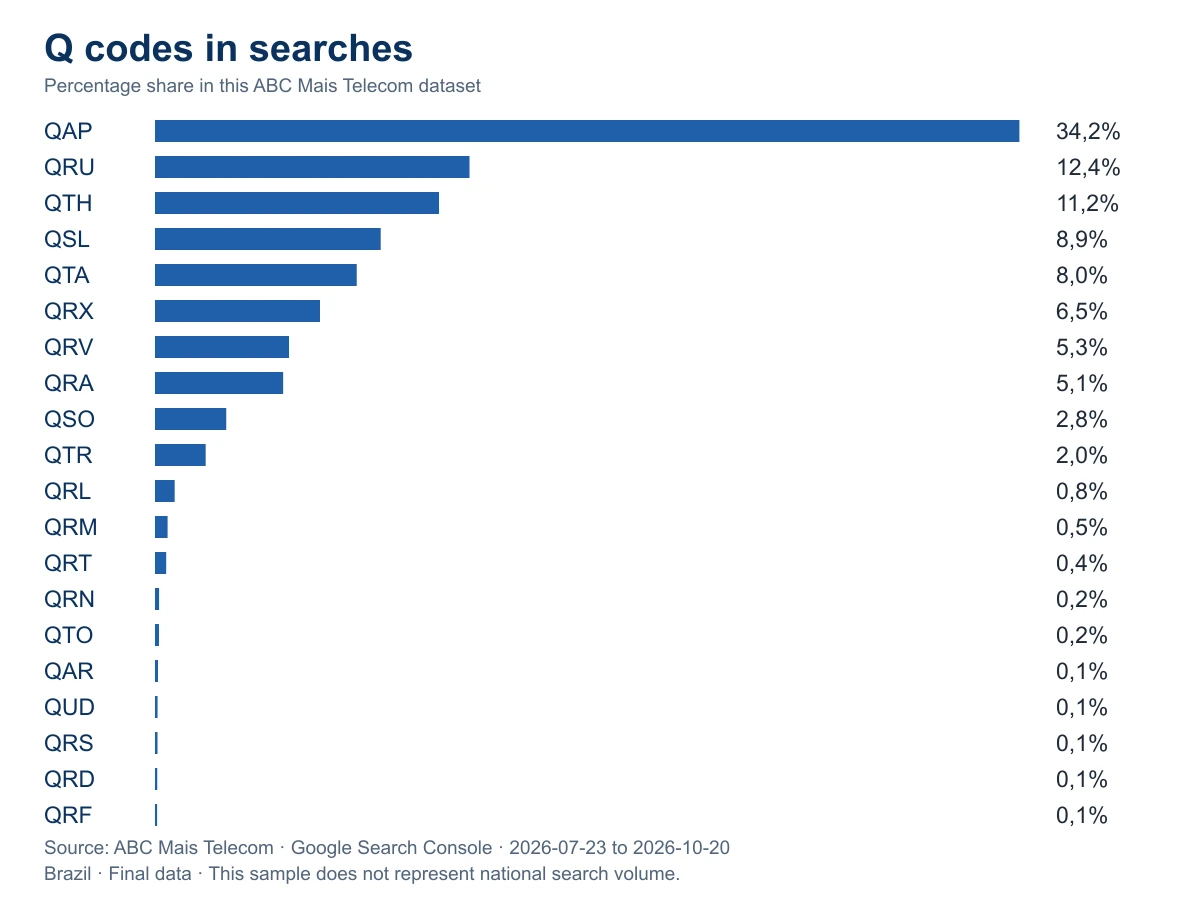
This ranking shows which Q codes appeared most frequently in searches where ABC Mais Telecom was shown on Google in Brazil between 23/07/2026 and 20/10/2026. The percentages represent each code’s share of this first-party dataset. They help explain questions about radiocommunications; they do not measure all Brazilian search demand or the number of radio users.
A search for QAP may seek a quick explanation. Another may seek a gatehouse example, a message acknowledgement or the difference between codes. Alongside the order of the codes, we therefore examined how the questions were worded. Classification considers only the terms actually present in the query.
The most searched Q codes in this dataset
Period: 23/07/2026 to 20/10/2026 · Brazil · Web Search · final Search Console data. The ranking includes only queries containing an abbreviation recognized by the verified list.
| Rank | Code | Share |
|---|---|---|
| 1 | QAP | 34,2% |
| 2 | QRU | 12,4% |
| 3 | QTH | 11,2% |
| 4 | QSL | 8,9% |
| 5 | QTA | 8,0% |
| 6 | QRX | 6,5% |
| 7 | QRV | 5,3% |
| 8 | QRA | 5,1% |
| 9 | QSO | 2,8% |
| 10 | QTR | 2,0% |
| 11 | QRL | 0,8% |
| 12 | QRM | 0,5% |
| 13 | QRT | 0,4% |
| 14 | QRN | 0,2% |
| 15 | QTO | 0,2% |
| 16 | QAR | 0,1% |
| 17 | QUD | 0,1% |
| 18 | QRS | 0,1% |
| 19 | QRD | 0,1% |
| 20 | QRF | 0,1% |
The denominator includes all valid codes found, not just the twenty shown. This selection may therefore total less than 100%. Rounded percentages may also produce a small difference in the total.
What do people want to know about these codes?
Queries containing “significado” (meaning) or “significa” (means) account for 53,56% of impressions attributed to the codes in this dataset. The wording “o que é” (what is) appears in 4,20%, while explicit references to radio or equivalent terms appear in 1,46%. These labels may overlap; the percentages should not be added as mutually exclusive categories.
The remaining 41,64% contain none of these three labels. This category includes other wordings and queries using only the abbreviation, without allowing a conclusion about the searcher’s intent. To look up the meaning and see an example phrase, the Q Code guide presents the official reference and operational adaptations in separate sections.
The labels “significado” (meaning), “o que é” (what is) and “no rádio” (on the radio) describe words present in the queries. A search may receive more than one label. A query containing only an abbreviation does not, by itself, reveal the visitor’s occupation or intention to hire a service.
What differs between security and amateur radio?
In 99,05% of attributed impressions, the queries contain none of the words used to identify security or amateur radio contexts. Explicit security terms appear in 0,95%; amateur radio terms in less than 0,01%. These are clues in the search wording, not identification of the visitor’s occupation or profile.
This distribution does not support comparing demand from security officers with demand from radio amateurs: almost the entire dataset has no specified occupational context. Nor does it show that the most searched codes are the most used at work. To interpret a radio message, check the team’s procedure and the difference between international definitions and Brazilian operational usage.
When a search mentions a security officer, gatehouse or security, there is a textual clue about context. When it mentions amateur radio, we classify that other context. Without an explicit indication, we retain “unspecified.” This avoids turning a generic abbreviation into a claim about who made the search.
How the study was conducted
Dataset: searches where the ABC Mais Telecom website appeared on Google, Brazil, 90 days. We used only final Search Console Web Search data from 23/07/2026 to 20/10/2026, filtered to pages in the Q Code cluster, including their mapped translations.
- The API request uses the “query” dimension, without adding a separate page-level extraction to a query-level extraction.
- We recognize only abbreviations from a verified list, including the Brazilian adaptations QAP and QAR. We exclude “que” from automatic attribution because it is a common Portuguese word, although QUE also exists in the international list.
- When a query contains two or more recognized codes, we divide its impressions equally between them. One attributed impression therefore does not become two.
- Share is the portion of impressions attributed to the code divided by impressions attributed to all valid codes.
- Queries anonymized or not returned by Google are excluded from the calculation. Search Console may aggregate by page when we filter URLs; the results do not represent unique people.
This sample depends on ABC’s presence and visibility in search results. It is not a national search-volume study, does not measure sales and cannot establish that a code is the most used by all Brazilian teams.
Questions about the ranking
Is this a ranking of the most used Q codes in Brazil?
No. It ranks abbreviations in searches where ABC pages appeared on Google in Brazil during the stated period. It does not measure all searches or code usage in radio operations.
What does each code’s percentage mean?
It is its share of impressions attributed to all valid codes in this sample. It is not market share, a sales rate or the proportion of professionals using the abbreviation.
Why can the chart total less than 100%?
The chart shows up to twenty codes, but the denominator includes every recognized code. Other codes outside the selection retain their share. Rounding may also slightly change the visual total.
How are searches mentioning QAP and QSL together counted?
The query’s impression is divided equally between both codes. The same rule applies to any query containing several recognized codes, avoiding duplication of the dataset.
Why was the word “que” excluded?
QUE exists in the international list, but it is also a very common Portuguese word. Including it automatically could attribute searches unrelated to the abbreviation. This conservative exclusion is documented in the method.
Does a search for a code identify a security officer or radio amateur?
No. We classify those contexts only when the query contains words indicating them. Generic queries retain an unspecified occupational context.
How is the order of codes in the ranking determined?
The order uses each code’s percentage share of attributed impressions in this sample. This ranking does not measure code usage by all Brazilian teams.
Where can I find the meanings and printable material?
See the Complete Q Code. The guide distinguishes the official reference from operational adaptations used by Brazilian teams.