
Earpieces for two-way radios: types, connectors and how to choose
Buying guide · audio accessories
The two-way radio earpiece that is right for you has the accessory code specified for your radio model and a design suited to the environment. Acoustic tubes suit security and customer-facing roles, an earpiece with an inline PTT suits everyday use, and an earmuff-style headset suits high noise levels. Choosing from a photograph is the most common mistake: two similar-looking earpieces may have different connectors and may not work with your model.
Updated on · ABC Mais Telecom technical team, supplying, renting and servicing Motorola Solutions and Hytera two-way radios.
In practice, the choice comes down to three questions: which connector the radio uses, how noisy the site is, and how the user will transmit (inline PTT, VOX or a lapel microphone). Below you will find the Motorola and Hytera compatibility table, hearing protection rules and hygiene guidance for shared earpieces.
Types of two-way radio earpiece
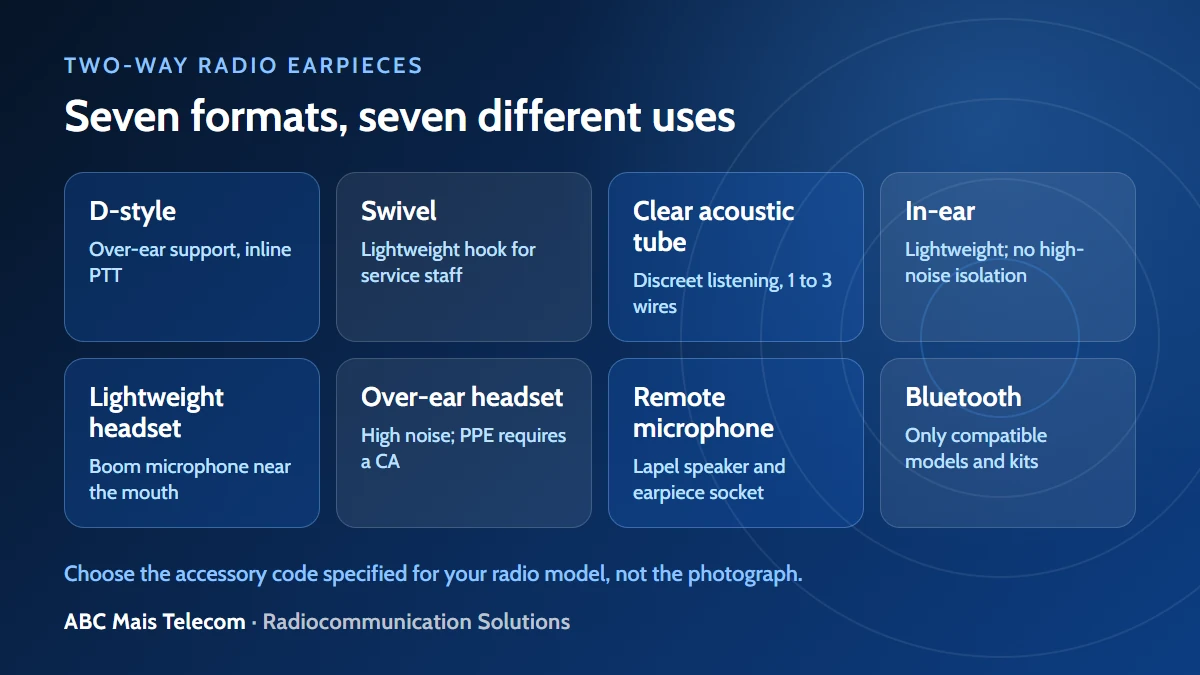
For professional radios, the term “earpiece” commonly refers to an assembly comprising an earphone, microphone and, in most cases, an inline PTT (push-to-talk) button. Its design affects comfort, discretion and speech clarity. The table covers designs found in the official Motorola Solutions and Hytera catalogues.
| Type | Design | Best suited to | Considerations |
|---|---|---|---|
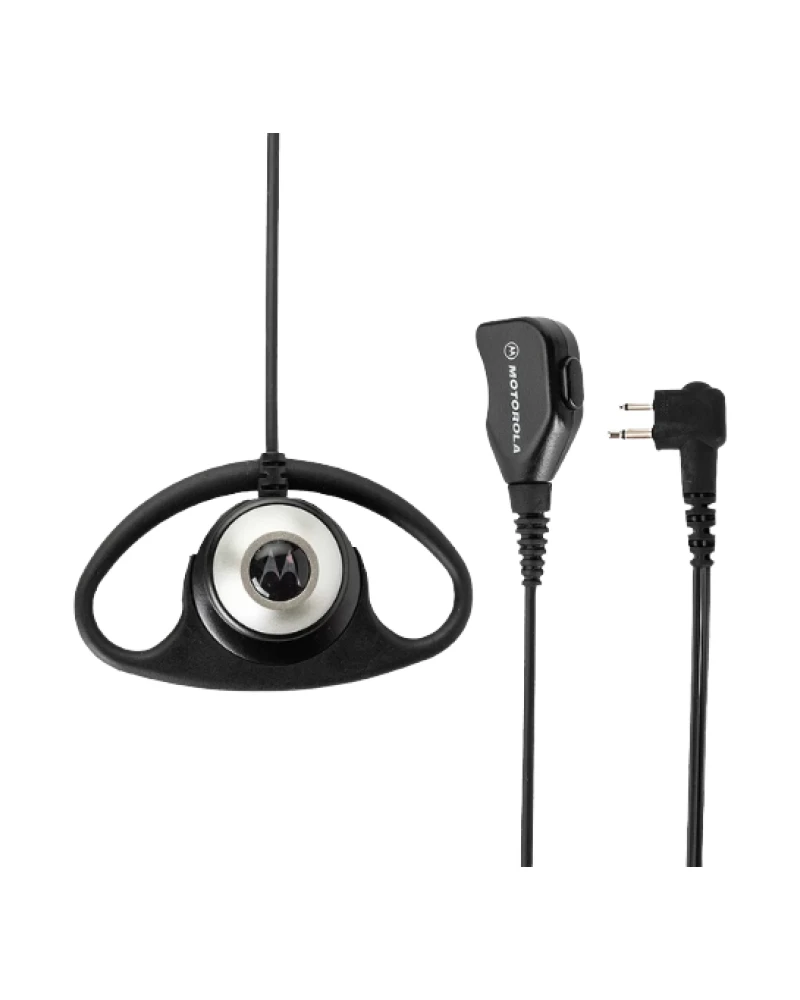
| D-style | D-shaped over-ear support, with an inline microphone and PTT | Reception, hospitality and logistics | Test comfort over long shifts |
| Swivel | Lightweight hook that swivels for the right or left ear | Customer service, events and reception | Less secure during sudden movements |
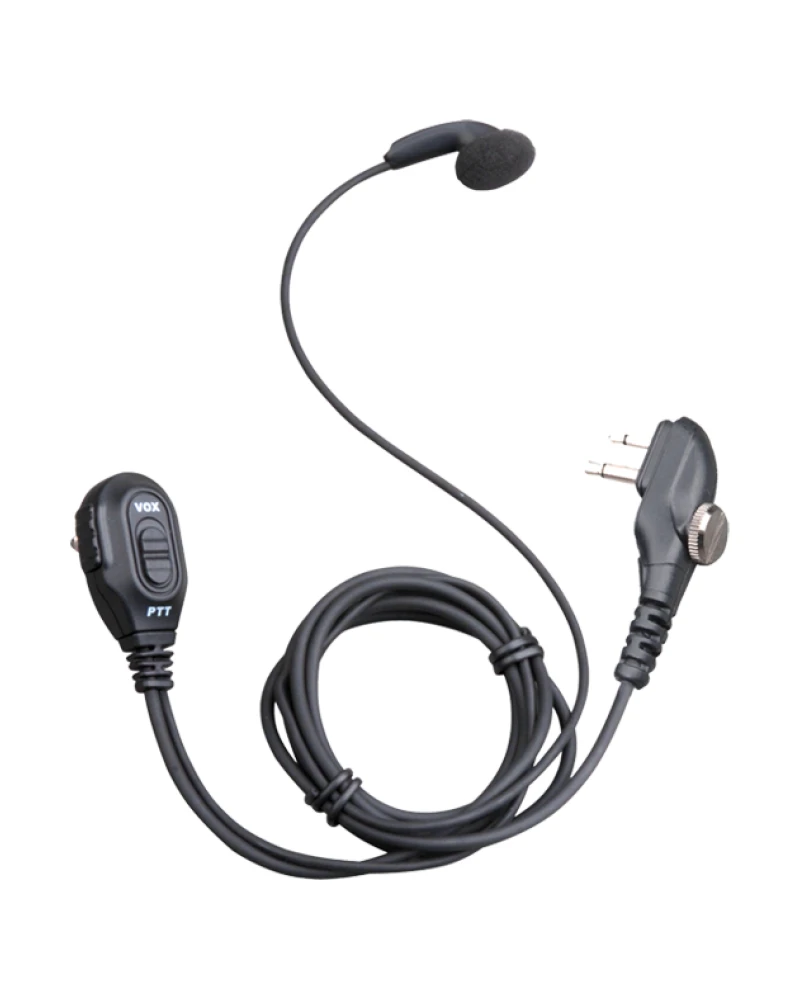
| In-ear | Ear tip inside the ear, with an inline microphone and PTT | Moderate noise and discreet use | Individual ear tip for each user |
| Acoustic tube (surveillance kit) | Translucent tube leading to the ear; 1, 2 or 3-wire versions | Security, events and public-facing work | The tube and ear tip are replaceable parts |
| Receive-only | Listening only; plugs into the remote microphone’s 3,5 mm output | Users who transmit through the lapel microphone | No microphone or PTT |
| Lightweight boom headset | Over-the-head or behind-the-head band, with a microphone near the mouth | Control rooms, yards and continuous operation | Leaves the ear unobstructed; does not provide noise protection |
| Heavy-duty earmuff-style headset | Two earcups and a noise-cancelling microphone; hard-hat versions are available | Industry, construction and machinery areas | Requires a CA to qualify as PPE in Brazil |
| Temple transducer (bone conduction) | A component resting on the temple transmits sound through vibration | Users wearing earplugs or needing to hear their surroundings | Few accessory codes per radio; check the list |
| Remote speaker microphone (lapel) | Speaker, microphone and PTT attached to clothing | Frequent talkers who keep the radio on their belt | Add a receive-only earpiece for discretion |
| Bluetooth (wireless) | Earpiece or remote microphone paired with the radio | Users who move frequently and catch cables on objects | Only for Bluetooth-equipped radios with a listed kit |
In a 1-wire surveillance kit, the earpiece, microphone and PTT share one cable. In a 2-wire kit, one cable carries the earpiece while the other combines the microphone and PTT. In a 3-wire kit, the microphone and PTT are separate: the button sits at the wrist or sleeve, and the cable is concealed under the uniform.
Bone conduction: when it is worthwhile
A temple transducer sits in front of the ear and converts radio audio into vibration. According to the MOTOTRBO accessory catalogue, this lets users hear both the radio and their surroundings and wear insert-type hearing protectors without missing calls. For Motorola’s commercial range, the catalogue lists the PMLN6541 (DEP450 and DEP250). An ear microphone also exists, picking up speech through vibration in the ear canal; ABC’s EP450 page lists the BDN6646 system.
Connectors: why an earpiece may fit but still not work
Each radio family uses a connection standard. A plug may fit, but the contact arrangement (pinout) determines whether the PTT operates, the microphone signal reaches the radio and audio plays without crackling. This is why manufacturers publish compatible accessory codes for each model. Hytera itself advises checking with the sales team before ordering.
- 2-pin connector (Motorola commercial range): two adjacent plugs on the side of the radio. This is the standard used by the DEP450, DEP250 and R2.
- Side-mounted multi-pin connector: professional radios use proprietary connectors with additional contacts for PTT, audio and features such as IMPRES. The DEP 500e series (DEP550 and DEP570) uses a different standard from the R7.
- Mini GCAI (Motorola R7): an accessory port redesigned by Motorola for the R7, with its own accessories.
- Hytera connectors: each series has its own. HP5, HP6, HP7, PD6 and X1 share one earpiece family; PD7 and PD985 use another; PD506 has its own list.
- 3,5 mm or 2,5 mm output on the remote microphone: this is not the radio’s connector. It is used to connect a receive-only earpiece.
The result: a Motorola commercial-range earpiece does not fit a DEP550, and a Talkabout kit does not work with a DTR720, despite sharing the same brand. Adapters and “universal” earpieces may solve the physical fit while introducing another problem: a PTT stuck transmitting, echo or a muted microphone. One stuck earpiece can occupy the entire fleet’s channel.
Compatibility table: Motorola and Hytera two-way radio earpieces
Codes from official catalogues and ABC product pages. Confirm the radio variant before ordering.
| Family and connector | Radios | Earpieces (example codes) |
|---|---|---|
| Motorola commercial range, 2-pin | DEP450, DEP250, R2 | PMLN6535 (D-style), PMLN6532 (swivel), PMLN6533 (in-ear), PMLN6534 (with VOX), PMLN6530 (2-wire surveillance), PMLN6538 (lightweight headset) |
| Motorola commercial range, heavy-duty use | DEP450, R2 (earmuff-style); DEP450, DEP250 (temple transducer) | PMLN6854 (behind-the-head earmuff-style, hard-hat compatible, 24 dB NRR); PMLN6541 (temple transducer) |
| Motorola SL series, proprietary connector | SL500e, SL500 | PMLN7156 (with VOX), PMLN7189 (swivel), PMLN7159 (D-style), PMLN7157 (2-wire surveillance), PMLN7158 (1-wire) |
| Motorola DEP 500e, proprietary side connector | DEP550, DEP570 | PMLN7269 (2-wire IMPRES surveillance kit) |
| Motorola R7, Mini GCAI | R7 | PMLN8341, PMLN8342 and PMLN8343 (1, 2 and 3-wire IMPRES surveillance), PMLN8295, PMLN8337; WM500 Bluetooth (PMMN4127) |
| Motorola DTR | DTR720, DTR620 | HKLN4599 (D-style), HKLN4604 (swivel), HKLN4601 (surveillance) |
| Motorola Talkabout | T400BR, T210BR | Talkabout series kits, such as 1518; IXTN4011 single-pin earpiece |
| Hytera PD5 | PD506 | ESM12 (earpiece with PTT and VOX), EHM15-A (D-style) |
| Hytera HP5, HP6, HP7, PD6, X1 | Professional DMR series | EAN24-P (acoustic tube with PTT), EHN26-P (C-style with PTT and microphone) |
| Hytera PD7, PD985, PT5 | PD7 and PT5 series | EAN23 (acoustic tube with detachable PTT) |
The EP450, from the earlier analogue generation, has its own list on its product page, including the PMMN4001 ultra-lightweight earpiece. On the R7, the RM730, RM760 and RM780 remote microphones have a 3,5 mm output for receive-only earpieces such as the PMLN7560 and PMLN8120.
Original, Mag One or third-party?
Mag One is Motorola’s entry-level range, tested and certified by the manufacturer and listed in the catalogue for hospitality, security and retail. Professional ranges offer reinforced cables, IMPRES and, on the R7, intelligent audio that adjusts volume to background noise. Third-party earpieces may work, but their pinout, PTT and cable are not guaranteed by the radio manufacturer. For a brand comparison, see Motorola or Hytera.
Two-way radio earpieces: which design suits each environment?
The same two-way radio earpiece may be ideal for hotel reception and unsuitable for a production line. Use the environment to narrow your choice.
| Environment | Recommended earpiece | Why |
|---|---|---|
| Reception, hotels and shops | Acoustic tube or in-ear | Customers cannot hear operational conversations |
| Site security and events | 2 or 3-wire surveillance kit | Discreet, with the PTT close to hand and the cable under the uniform |
| Warehouses and logistics | D-style or swivel earpiece with PTT | Secure fit while leaving the ear free to hear alarms |
| Industry, construction and machinery | Earmuff-style headset with noise cancellation | Intelligible speech in high noise levels |
| Hard hat required | Hard-hat-mounted or behind-the-head headset | Does not compete for space with the chin strap |
| Rain and outdoor areas | Remote microphone with a declared IP rating | Many basic earpieces have no IP protection |
| Control room and dispatch | Lightweight boom headset | All-shift comfort and hands-free operation |
In rain, check the accessory’s protection, not just the radio’s: the R7’s RM730, RM760 and RM780 remote microphones are rated IP68, whereas Hytera’s ESM12 does not declare an IP rating. In an explosive atmosphere, the earpiece must also be certified for the area.
Inline PTT, VOX or Bluetooth?
Inline PTT is the professional standard: the user decides when to transmit. Button position matters: chest height on a 1 or 2-wire earpiece, hand or sleeve on a 3-wire kit, and lapel on a remote microphone. If the team wears gloves, test while wearing them.
VOX (voice-activated transmission) frees up hands, but noise, coughing or nearby conversation can open the channel. The PMLN6534 has an inline VOX switch for changing modes. Use it only after adjusting sensitivity at the site.
Bluetooth removes the cable, but requires a Bluetooth-equipped radio and a manufacturer-listed kit. The R7 has Bluetooth 5.2 and lists the WM500 remote microphone (PMMN4127); the SL500e has built-in Bluetooth. Hytera’s EHW08 uses Bluetooth 4.1, with a 10 m range and charging time of around 2,5 h. Plan earpiece charging and pairing for each unit.
Hearing protection: a radio earpiece is not a hearing protector
Under NR-15, Annex 1, the tolerance limit for continuous noise is 85 dB(A) for 8 hours. Each 5 dB increase halves the time: 90 dB(A) for 4 hours and 95 dB(A) for 2 hours. Measurement is taken close to the worker’s ear. Exposure above 115 dB(A) is not permitted without adequate protection.
- Hearing protectors are PPE. Under NR-6, PPE requires a Brazilian Certificate of Approval (CA). An ordinary radio earpiece without a CA does not replace a hearing protector.
- Catalogue attenuation figures are not a CA. The PMLN6854 headset specifies 24 dB NRR, but use as PPE in Brazil depends on the assembly’s CA.
- High volume is also noise. Prefer earcups and a noise-cancelling microphone to turning up the volume.
- Coordinate with the SESMT occupational health and safety team. A headset for noisy areas should be reviewed by occupational safety staff.
Hygiene and shared use: earpieces in fleets and rentals
An earpiece is a personal-use item. Radios can pass between shifts; ear tips should not. Motorola’s catalogue highlights quick-disconnect tubes for easier changes between shifts and offers replacement ear tips in packs and sizes P, M and G (small, medium and large).
- Clean without soaking. Motorola recommends a 0,5% detergent solution applied with a cloth and a short-bristled, non-metallic brush, followed by drying. Do not leave liquid around connectors.
- Disinfect using a cloth. Use isopropyl alcohol at 70% or higher, applied to the cloth and never directly to the accessory.
- Avoid aggressive chemicals. The same guidance advises against bleach, solvents and cleaning sprays.
- One ear tip per person. Store it labelled with the user’s name and replace it when it hardens or cracks.
With ABC’s two-way radio rental , earpieces and batteries are included in the proposal according to noise levels, shift duration and the team’s routine, with the use of Anatel-licensed frequencies already included. When requesting a quote, state how many people use each radio and agree on replacement ear tips.
Care that helps earpieces last
- Disconnect by pulling the connector, never the cable, and do not wind the cable tightly around the radio.
- If the radio crackles with only one earpiece, try another earpiece on the same radio to isolate the fault.
Crackling with every earpiece, an unresponsive PTT or a loose connector should be referred to technical support. Bring the radio and earpiece together.
Use cases by sector
Security at a shopping centre
- Problem: the public can hear incidents through the radio speaker.
- Solution: a 2-wire surveillance kit with a translucent tube and concise radio procedure, such as the security guard codes.
- What to measure: calls repeated because they were not understood and noise complaints in the corridor.
Hotels and reception
- Problem: staff with their hands occupied miss calls.
- Solution: a swivel or D-style earpiece with inline PTT.
- What to measure: response time to guest requests.
Industry with machinery noise
- Problem: the operator removes their hearing protector to hear the radio.
- Solution: an earmuff-style headset with a noise-cancelling microphone, approved by the SESMT, or a temple transducer worn with earplugs.
- What to measure: repeated messages and instances of hearing protectors being removed.
Events with temporary staff
- Problem: dozens of people receive radios on the same day without training.
- Solution: an earpiece with inline PTT, new ear tips for each person and a check at handover. See the page on two-way radios for events.
- What to measure: earpieces returned faulty and channels occupied by a stuck PTT.
Common mistakes when buying radio earpieces
- Buying by photograph or brand. Motorola earpieces that look identical can have different connectors.
- Using a mobile phone headset with an adapter. It lacks the radio’s PTT and pinout.
- Treating a radio earpiece as a hearing protector. Without a CA, it is not PPE.
- Enabling VOX in noisy areas. The channel opens unintentionally.
- Sharing ear tips between shifts. This can cause ear irritation and discourage use.
- Forgetting replacement parts. Tubes, ear tips and spare earpieces are left out of the quote.
Checklist for choosing a two-way radio earpiece
- Model and variant. Photograph the radio’s label behind the battery. “Motorola” or “Hytera” alone is not enough.
- Accessory code. Check the product page or manufacturer’s catalogue: PMLN, HKLN, ESM, EHM, EAN and similar codes.
- Environment. Define noise, discretion, hard-hat and rain requirements before choosing the design.
- Transmission method. Inline PTT, separate PTT, VOX or remote microphone.
- Who uses it and for how long. Long shifts call for comfort; shared shifts require individual ear tips.
- Real-world test. Make a call from the noisiest and most distant locations, wearing the earpiece with the uniform.
- Replacement parts. Include tubes, ear tips and a spare earpiece in the same quote as the radio.
If the fleet contains different models, keep a “radio × earpiece × code” table in the storeroom, with one connector standard per box. When buying next time, standardising the radio family reduces the number of earpiece types held in stock. ABC’s two-way radio catalogue shows the accessories for each model.
Frequently asked questions about two-way radio earpieces
Will any earpiece work with a two-way radio?
No. Each radio family uses its own connector and pinout. An earpiece may fit but fail to operate the PTT or leave the microphone muted. Order the accessory code specified for the radio model.
What is the best two-way radio earpiece?
It depends on the environment. Acoustic tubes suit security and customer-facing roles; D-style or swivel earpieces suit everyday use; earmuff-style headsets suit high noise levels. In every case, the best earpiece is one on the radio’s accessory list.
Which radio earpieces do security guards use?
Usually a 2 or 3-wire surveillance kit with a translucent acoustic tube. The audio goes directly to the guard’s ear, and the cable can be hidden under the uniform.
How does a two-way radio with an earpiece and microphone work?
The earpiece carries audio to the ear; the microphone is on the cable, lapel or boom. To speak, press the inline PTT while the radio remains on the belt.
Will a mobile phone headset or ordinary Bluetooth headset work with the radio?
Not with professional radios. A mobile phone headset lacks the radio’s PTT and pinout. Bluetooth headsets work only with Bluetooth-equipped radios and manufacturer-listed kits, such as the WM500 for the R7.
How do I identify my radio’s connector?
Use the model label and the manufacturer’s accessory list. The DEP450, DEP250 and R2 use Motorola’s commercial-range 2-pin connector; the R7, SL500e and Hytera radios have their own standards. Send ABC a photograph of the label and the team will check the code before quoting.
Is a VOX earpiece suitable for work?
It works for tasks where hands are occupied and noise levels are low. In noisy environments, VOX may open the channel unintentionally. Adjust sensitivity, test on site and keep PTT as the default.
Does a radio earpiece protect hearing?
Only if it is a hearing protector with a Certificate of Approval under NR-6. NR-15 sets a tolerance limit of 85 dB(A) for 8 hours. An ordinary radio earpiece is not PPE.
Sources consulted
- Motorola Solutions: MOTOTRBO commercial radio accessory catalogue (SL500, R2, DEP450, DEP250).
- Motorola Solutions: MOTOTRBO R7 radio accessories (Mini GCAI, IMPRES surveillance, WM500).
- Motorola Solutions: MOTOTRBO accessory catalogue for Latin America.
- Motorola Solutions: MOTOTRBO accessory catalogue, temple transducers (in English).
- Motorola Solutions, MTN-0038-20: cleaning and disinfecting radios and accessories (in English).
- Hytera: EAN24-P acoustic tube earpiece for HP5, HP6, HP7, PD6 and X1 (in English).
- Hytera: EAN23 acoustic tube earpiece for PD7, PD985 and PT5 (in English).
- Hytera: EHW08 Bluetooth earpiece with PTT (in English).
- Brazilian Ministry of Labour and Employment: NR-15, Annex 1, noise exposure tolerance limits.
- Brazilian Ministry of Labour and Employment: Regulatory Standard No. 6 (PPE and Certificate of Approval).
Need earpieces for your fleet? ABC Mais Telecom supplies and rents Motorola Solutions and Hytera two-way radios and original accessories, checks compatibility using each part’s code, and operates its own technical service centre in São Bernardo do Campo (SP).