
Two-way radios for events
Setup, registration, stage, dressing rooms, gate staff and security communicating without relying on a mobile operator’s signal. See how to use radios at each work front, which equipment to recommend and how to plan communication. For events, ABC Mais Telecom offers rental with Anatel-licensed frequencies included.
No carrier needed
direct communication, without relying on the mobile network
Groups
teams separated by channel: stage, gate staff, security
Rental
for the event period, with radios already programmed
Support
specialized technical support during the operation
Communication in the operational context
Each event team has its own pace: setup starts before the public arrives, registration draws queues, the stage depends on synchronization and security needs a clear emergency channel. Two-way radios organize these conversations into groups so each team hears what matters and coordination follows everything.
Why use radios rather than mobile phones at an event
At public events, the mobile network becomes congested precisely when teams most need to talk. Two-way radios do not depend on a mobile operator: communication is direct between devices, and the whole group hears the same message at the same time, making a difference of seconds in a security incident.
Radios are also designed for event use: press a button and speak, without dialing, waiting for someone to answer, using more than one hand or taking your eyes off the operation.
What usually matters when choosing
Battery life for the whole day.
Setup starts early and dismantling finishes late; a battery lasting through the shift avoids changes mid-operation.
Discreet earpieces.
Room staff, reception and registration need to hear without the public hearing them.
Separate channels by work front.
Stage, gate staff, cleaning and security in separate groups, with a general emergency channel.
The event area.
An enclosed exhibition hall, outdoor areas and multiple floors change the required range; in some cases, a repeater is included to cover the entire venue.
How to arrange service for your event
For events, ABC Mais Telecom offers rental: each two-way radio is programmed by work front, with Anatel-licensed frequencies included, and quantity, rental period and kit items such as spare batteries, earpieces, repeaters or body-worn cameras are tailored in the proposal. Rental periods, possible kit contents and the quote form are on the page about two-way radio rental for events and trade shows.
Two-way radios for events: recommended equipment
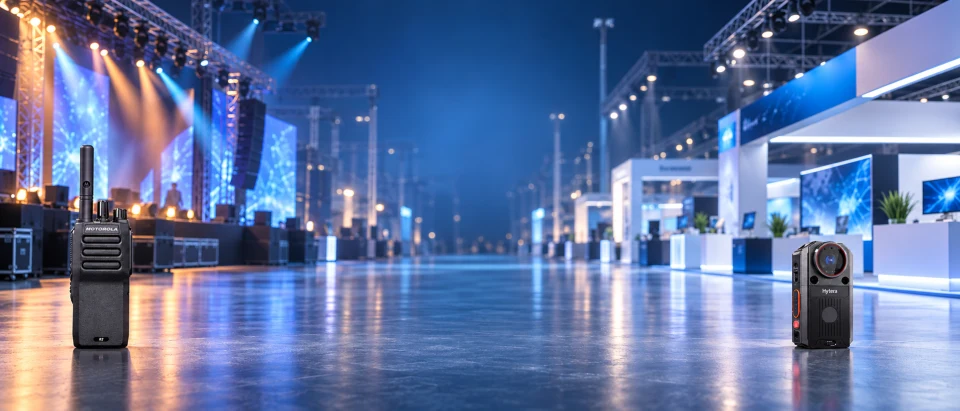
- Handheld two-way radio (HT)
Lightweight, with battery life for the shift and programmed by work front: stage, gate staff, production and security. - Repeater
Extends coverage in exhibition halls, extensive outdoor areas and multi-floor venues when the survey identifies a need. - Earpieces and audio accessories
Discreet earpieces for reception and registration, and accessories for loud environments. - Body camera
Optional for security teams needing to record incidents during the event.
How to plan two-way radios for events in 5 steps
Before requesting a quote, organize some information. It helps define each work front’s radio quantities, groups and accessories, without too many or too few devices.
1. List the work fronts that need to communicate.
Production, stage, dressing rooms, registration, gate staff, cleaning, security and emergency response teams. Each work front becomes a communication group, and coordination can monitor all groups. Also note who needs to talk with more than one work front, such as stage management and the head of security.
2. Count who needs to talk in each work front.
Radio quantities come from the people who need to transmit, rather than the total team size. Leaders and supervisors usually have radios; fixed posts can share devices between shifts.
3. Map the area and difficult points.
Basements, mezzanines, metal structures, equipment-heavy stages and extensive outdoor areas change range. A floor plan or photos of the venue help assess whether the event needs a repeater.
4. Plan batteries and charging around the schedule.
Add up the hours of use for each shift, from setup to dismantling. Spare batteries and an organized charging point prevent radios from stopping at the event’s busiest time.
5. Reserve an emergency channel.
A general group for coordination and emergencies ensures the most important call does not compete with routine team traffic.
On event day: quick checklist
- Test communication at all points before gates open.
- Label radios by work front and distribute the group list with the people responsible.
- Check charged batteries, spares and earpieces before each shift.
- Define who receives, stores and returns radios at the end.
For the complete list, see the radio rental checklist for events and the options for two-way radio rental for daily, weekly or monthly periods. Reference on radiofrequency use: Anatel.
Frequently asked questions
How many radios do I need for my event?
It depends on which work fronts need to communicate and each team’s size. Tell us the event format when requesting a quote and we will plan it together.
Do radios come programmed?
Yes. Channels and groups are programmed before delivery according to operational work fronts.
Do two-way radios need a license?
For rentals, Anatel-licensed frequencies are already included by ABC Mais Telecom: production does not need to arrange a license for the rented radios. Provide the event location and whether production will use its own radios so programming can be confirmed in the proposal.
Do you work with Motorola and Hytera?
Yes. ABC Mais Telecom is a Motorola Solutions partner and Hytera channel partner. For event rental, the team selects suitable radios according to the period, area and availability, and the kit is described in the proposal.
Digital or analog radios: which should we use at the event?
For teams assembled for an event, digital radios are usually recommended: clearer audio up to the coverage limit, more talkgroups on the same channel and better battery efficiency. Analog is still used when production or the venue already has older radios; in that case, programming is checked so devices can communicate with one another.
Can we rent just for the event days?
Yes. Rental can be daily or for the event period, including setup and dismantling days when production needs communication at those stages. For year-round event producers, weekly or monthly rental can also be agreed in the proposal.
HT radios and walkie-talkies: what is the difference for events?
An HT radio is a professional handheld two-way radio; walkie-talkie is the common name for the same type of device and often refers to license-exempt models with shorter range and fewer features. For production, security and registration, professional radios with shift-long batteries and programmed groups are recommended; rental includes Anatel-licensed frequencies.
Do rented radios work with the production team's existing radios?
They may work, but compatibility must be checked by model, frequency band, operating mode and programming. The brand alone does not guarantee communication. Send the team’s existing models before the quote so programming can be planned together.
Does everyone need an earpiece?
No. Earpieces make a difference for those working near the public, such as reception and registration, and those in loud areas, such as stage and technical crews. For other roles, audio from the radio itself is usually enough. Selection is included in the proposal, together with the radios.
What if a radio develops a problem during the event?
For rental, the kit can include maintenance, equipment replacement and spare batteries. Agree in the proposal how service will be provided during the event and who in production will centralize support requests.
How should radio returns be organized at the end?
Assign someone to collect radios, chargers and accessories from each work front and check the item list before return. A group list with the people responsible, prepared at the start of the event, makes final checks easier.
Will radios work in enclosed exhibition halls and outdoors?
It depends on the venue. Walls, metal structures, basements and distance between points affect range. With a floor plan or photos of the space, the team assesses whether radios alone are sufficient or the event needs a repeater.
How to assess two-way radios for events with official manufacturers
Choosing two-way radios for events should consider the setting, coverage and actually documented features. ABC Mais Telecom works with official Motorola Solutions and Hytera portfolios to plan two-way radios for events without trading technical precision for generic promises.


Consult the official ranges and describe your routine to select two-way radios for events using verifiable criteria.
Shall we plan communication for your operation?
Tell us how your team works, in which area and under which conditions. ABC Mais Telecom helps define the appropriate solution.
