
Two-way radio rental for events and trade shows
Two-way radio rental for events and trade shows puts production, registration, stage, security and support on the same communication system during setup, the event and teardown. ABC Mais Telecom prepares professional Motorola Solutions and Hytera radios programmed by team for the duration of the event, with the use of Anatel-licensed frequencies already included. We serve the capital, Greater São Paulo and the state’s interior; other regions according to the project.
No carrier needed
direct communication, even when the cellular network is congested
By team
stage, gatehouse, security and production in their own groups
For the period needed
daily or weekly, from setup to teardown
Anatel included
use of licensed frequencies already included in the rental
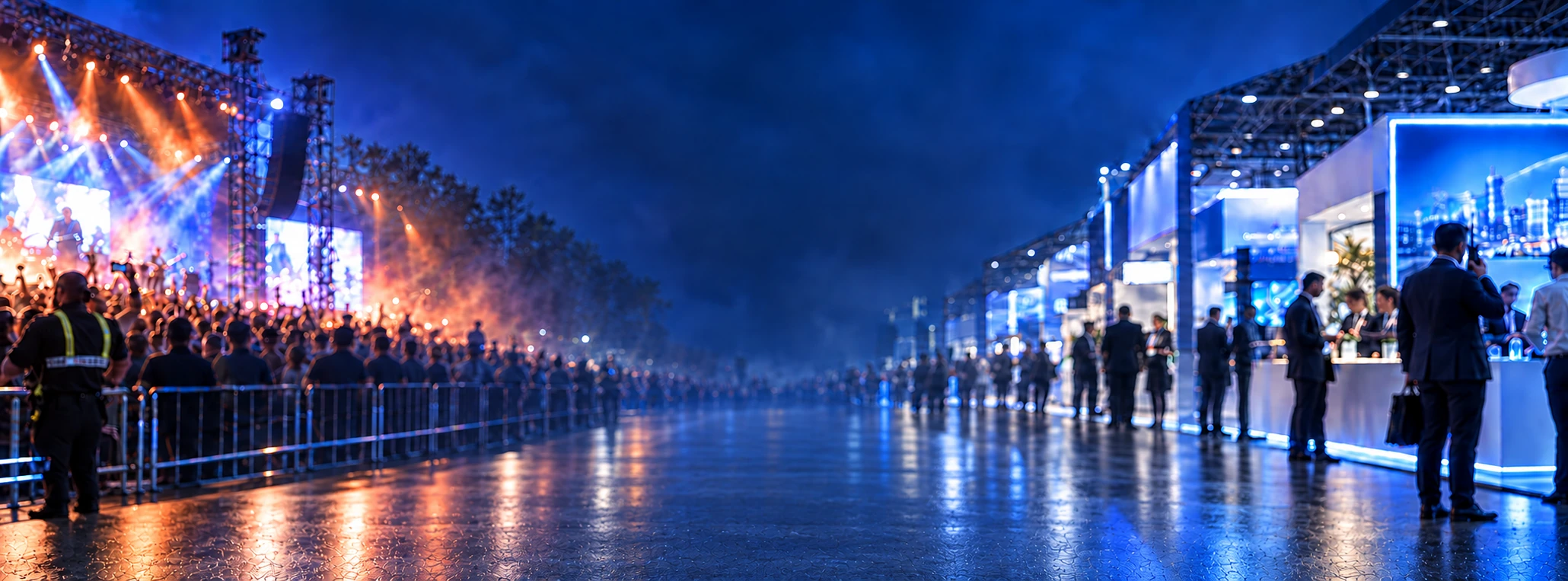
From registration to the last visitor
When thousands of people use mobile phones at the same time, the network becomes congested. Radios continue working between teams.
Why rent radios for events and trade shows
At public events, the cellular network often becomes congested at the busiest times: gate opening, intervals and departure. Two-way radios for events do not depend on a carrier: the call goes directly to every radio in the group, and the whole team hears the same notice simultaneously. During an incident, this saves seconds that make a difference.
Radios are also designed for an event’s pace: press a button and talk, without dialing or waiting for someone to answer, and with one hand free. With an earpiece, communication is discreet for those working near the public.
For producers, trade show organizers, agencies and security companies, event radio rental solves another problem: the number of radios changes greatly from one event to the next. A conference may need only a few devices; a festival, many dozens. With rental, the fleet follows each date, with no idle equipment between events.
How two-way radio rental for events works
1. Event briefing
Date, venue, setup and teardown times, estimated attendance and a map of the work areas: production, stage, registration, ticketing, bars, cleaning, security and emergency response team.
2. Group plan
Each work area gets its own talk group, with a general emergency and coordination channel. Those who need to follow more than one group, such as overall coordination and the head of security, receive a radio programmed accordingly.
3. Technical sizing
Battery life for long workdays, headsets for loud areas and coverage of the hall, outdoor areas and parking. If there are critical locations, we assess a coverage test or repeater.
4. Proposal and logistics
Radios, accessories, services, period and terms are described in the proposal. Delivery and return logistics and any extension are agreed before the event, and terms are negotiable according to the scope.
5. Radios ready by team
Event radios are prepared with the agreed programming. An operational tip: distribute radios by team using a list of who received each device. Checking returns becomes much simpler.
Communication groups by event type
Dividing into groups is what makes event radio rental work on the day: each team hears what concerns it, and coordination follows everything. Common configurations as a starting point:
| Event type | Typical groups | Special attention |
|---|---|---|
| Concert or festival | Production, stage, backstage, gates, bars, security and emergency response team | Loud sound, large audiences and extensive outdoor areas |
| Trade show or exhibition | Organization, registration, stand builders, loading docks, security and cleaning | Setup and teardown over several days and more than one hall |
| Conference or corporate event | Reception, rooms, audio and video technicians, support and security | Discreet communication near guests |
| Race or sporting event | Start, course, support points, finish and assistance | Large, dispersed area, with coverage assessed beforehand |
| Promotional activity or launch | Coordination, promoters and security | Small team, short period and radios ready to use |
In an event two-way radio rental proposal, final programming follows your event’s organization chart, rather than a ready-made template.
What event rental may include
Two-way radio rental for events is based on the event format. Depending on the scenario, it may include:
- Use of licensed frequenciesABC Mais Telecom already includes the use of Anatel-licensed frequencies in the rental.
- Programming by teamGroups for stage, production, registration, security and support, with a general emergency channel.
- Extra battery and chargersFor workdays that start with setup and end with teardown.
- Earpieces and lapel microphonesFor stage, loud areas and discreet public service, subject to compatibility.
- RepeaterFor large halls, extensive outdoor areas or multiple floors, when indicated by the study.
- Body cameraVideo recording for security and access control teams.
- Maintenance and replacementReplacement of a faulty radio during the event, as specified in the proposal.
- Integration with existing radiosProgramming alongside the producer’s or venue’s radios after checking compatibility.
Items, quantities and terms apply according to the approved proposal.
How many event radios to rent
There is no fixed rule based on audience size. Quantity is determined by how many people need to speak and listen during the operation. A practical approach:
- List the work areas and who leads each one.
- For each area, count who needs to transmit, not just listen. Large support teams sometimes work with a radio only for the leader.
- Add overall coordination, security and the emergency response team, who normally need individual radios.
- Add a reserve for replacements and last-minute contingencies.
- For events lasting more than one day, plan for extra batteries and an organized charging point.
Also remember teams that are present for only part of the event, such as stage setup or overnight cleaning: they can use the same radios on different shifts, provided charging is organized.
If in doubt, send the event map and organization chart: the technical team will help finalize the count. For event day, also see what to test before opening the gates.
Accessories for each role at the event
The right accessory prevents the radio from getting in the way of work. For event radio rental, it is worth considering each role:
- Stage, technical crew and bars: noise-isolating headset to hear calls even with loud sound.
- Reception, registration and rooms: discreet earpiece so the public cannot hear the conversation.
- Security and emergency response team: lapel microphone, leaving hands free during an intervention or assistance.
- Coordination: extra battery, because coordinators talk more and use the radio all day.
Earpieces and microphones depend on compatibility with the radio specified in the proposal. If the team prefers a type of earpiece for comfort or familiarity, mention it in the request: the final choice considers noise in each area and use time during the shift.
To see radio use in each work area and suggested equipment before requesting a quote, consult the guide to two-way radios for events.
Trade shows and halls: coverage considerations
For event radio rental in a hall, coverage deserves attention from the start. Trade shows in enclosed halls combine metal structures, stands, mezzanines, loading docks and parking, and each affects the signal. At exhibition centers in São Paulo and the state’s interior, operations also commonly occupy more than one hall at a time.
UHF usually performs better inside buildings; in large open areas, such as festivals and racetracks, the assessment may indicate another band or the use of repeater. Understand the differences in UHF or VHF: which band to choose. If the site is not yet known, plan a coverage test before the date.
Good practices on event day
- Test each group before opening: each leader confirms that they can hear and be heard in their group and on the general channel.
- Brief speaking protocol: identify yourself, state the location and message. Codes such as QAP and QSL help; see the complete Q code.
- General channel only for essentials: emergencies and notices everyone needs to hear.
- Organized charging point, with a person responsible and a record of who collected each battery.
- Checked returns at the end, using the same list as for distribution.
Security, emergency response and medical assistance in the same plan
At many events, security, emergency response and medical assistance are outsourced and arrive with their own teams. The communication plan must provide for how these teams talk to production, particularly in an emergency. The simplest approach is a general emergency channel programmed into all event radios, in addition to each team’s groups.
If a contractor brings its own radios, send the brand and model before the event: we check band, operating mode and programming so the rented equipment and the external team’s radios can communicate on the agreed channel where compatible.
Common mistakes when renting radios for events
- Requesting quantities based only on attendance: the number of radios is determined by the work areas and who needs to transmit.
- Forgetting setup and teardown: these are precisely the periods with more people moving around and more coordination.
- Putting everyone on the same channel: one team’s conversation disrupts the others, and important notices get lost.
- Not planning for charging: for long events, extra batteries and a charging point with someone responsible prevent silent radios at the end of the day.
- Discovering a dead spot during the event: basements, parking and mezzanines must be identified in advance to assess a coverage test or repeater.
Example: a multi-day trade show in a hall
At a business trade show with three days of setup, three event days and one day of teardown, radio requirements change throughout the week. During setup, coordination talks to stand builders, loading docks and hall security; on event days, registration, exhibitor service, cleaning and emergency response join in. This is why radio rental for this type of event is usually weekly, with groups already planned for both phases.
Loading docks and parking are usually the most difficult areas for coverage, and charging needs a fixed location because the same radios are used across several shifts. With the schedule available, the technical team prepares the event radio proposal with quantities for each phase, accessories by role and group programming.
After the event
Returning equipment is part of the operation. Collect radios using the same list as for distribution, together with batteries, chargers and earpieces, and report any faulty or damaged equipment. If the event is extended or gets a new date, notify us before the contracted period ends to adjust event radio rental under the terms of the proposal.
Event types served
Event radios are programmed according to each production’s format:
Concerts and festivals
Stage, backstage, dressing rooms, gates, bars and security in separate groups, with headsets for those working near speakers.
Trade shows and exhibitions
Organization, stand builders, registration, loading docks and hall security, usually with weekly rental to cover setup and teardown.
Conferences and corporate events
Reception, simultaneous sessions, audio and video technicians and speaker support, with discreet communication by earpiece.
Sporting events and road races
Start, course, support points and finish spread over a large area, where coverage must be assessed in advance.
Promotional activities and launches
Small teams, short periods and a need for ready-to-use radios, usually with daily rental.
Daily or weekly: which period to choose
In most cases, event radio rental is daily or weekly. One-day events use daily rental, including setup and teardown times. Trade shows and productions with several days of activity usually use weekly rental. Producers with recurring schedules can assess monthly or long-term rental. Compare the options on the page for two-way radio rental.
What to send to receive a proposal
To receive an event radio rental proposal, send whatever you have already defined. The technical team will help complete the rest:
- Event date and setup, operation and teardown times.
- Venue and address, with a map or floor plan if available.
- Organization chart or list of work areas and who leads each one.
- Estimated attendance and critical areas such as basement, parking, mezzanine or outdoor area.
- Radios already owned by the production team or venue, with brand and model.
- Need for earpieces, body cameras for security or a repeater.
With this information, the event radio proposal arrives with groups, accessories and period aligned with your schedule.
Where we offer event radio rental
ABC Mais Telecom serves events in the city of São Paulo, Greater São Paulo and the interior of the state from its headquarters in São Bernardo do Campo; events in other regions are assessed according to the project. For events in the Campinas region, also see the page on two-way radio rental in Campinas. If event security is outsourced, the company responsible can have its own programmed group. See the two-way radio rental for security.
The use of Anatel-licensed frequencies is already included in the rental. The general rules are in the Anatel regulations; with two-way radio rental for events, the team does not need to arrange a license for the rented radios.
Frequently asked questions
How many radios do I need to rent for my event?
It depends on how many teams need to communicate with one another and who needs to transmit in each one. Send us the event format, map and teams: ABC Mais Telecom helps determine the quantity and spare units.
Do the radios for events come preprogrammed?
Yes. Group programming is agreed in advance and the radios are prepared for the event teams, with a general emergency channel.
Do I need an Anatel license to use radios at the event?
There is no need to obtain a license for the rental radios: ABC Mais Telecom already includes the use of Anatel-licensed frequencies. If the operation will include your own radios or a repeater, mention this in the request so we can confirm the applicable arrangement.
Can I rent radios for a one-day event?
Yes, daily rental is available. Include setup and dismantling times in your request so that the rental period covers the entire operation.
Will the radio work inside the exhibition hall and in the parking lot?
It depends on the venue. When renting radios for events in exhibition halls, metal structures, mezzanines and basements affect the signal. Tell us about critical areas: we assess the appropriate band, a coverage test or the use of a repeater.
Do you serve events outside the city of São Paulo?
Yes. ABC Mais Telecom serves events in the city of São Paulo, Greater São Paulo and the interior of the state, primarily in São Paulo and the surrounding region; events in other regions are assessed according to the project. Provide the event city and address so that logistics can be agreed in the proposal.
How much does two-way radio rental for events cost?
The price depends on quantity, rental period, accessories, whether a repeater is needed and logistics. The terms are negotiable and are set out in the proposal.
Motorola Solutions and Hytera radios for rental
ABC Mais Telecom is an authorized Motorola Solutions and Hytera reseller. For two-way radio rental for events, equipment is selected according to operational needs (environment, shifts, noise and coverage) and confirmed in the proposal.


Official manufacturer ranges. Equipment, availability and composition are confirmed in each proposal.
Request a radio rental proposal for events
Provide the date, venue, setup and dismantling times and the teams that need radios. You do not need to know the model.
Tell us what your operation needs
Fill in the details to receive technical and commercial guidance.
Response by email and WhatsApp. No obligation · price on request.
