
Security guard codes: the 25 most-used radio codes (with PDF card)
Q Code for private security
The Q Code for security guards, also called security guard codes, combines Q codes, words and numbers that guards, gate staff and supervisors use over the radio to speak less and understand more. There is no single national table: international Q Code provides the basis, and each company defines its own standard. Here are the 25 most used, what is standard and what is customary, ready-to-use phrases and a pocket PDF card.
Updated on · ABC Mais Telecom technical team, Motorola Solutions and Hytera two-way radio sales and rental.
Q Code for security guards: the 25 most used on the radio
The table brings together Q codes for guards most often used at gatehouses, on patrol and in control centers. The “origin” column shows whether the meaning comes from the ITU international standard, is a Brazilian usage of an official code or is local practice. Local meanings vary between companies: check with your supervisor before use.
| Code | Meaning at the post | Origin |
|---|---|---|
| QAP | Listening, attentive to the radio. | Brazilian usage (in aeronautical code: a request to listen on a frequency). |
| QSL | Understood, message received. | ITU, same meaning. |
| QRU | Incident or news to report (“any QRU?”). | Brazilian usage (ITU: “do you have anything for me?”). |
| QTH | Location, address. | ITU (position). |
| QTI | Destination, where you are going. | Brazilian usage (ITU: heading). |
| QRA | Name, identification of the speaker. | Brazilian usage (ITU: station name). |
| QRV | Ready, available. | ITU, same meaning. |
| QRX | Wait. | ITU (I will call again at…). |
| QTA | Cancel the last message. | ITU, same meaning. |
| QTR | Correct time. | ITU, same meaning. |
| QSO | Contact, conversation. | ITU (communication between stations). |
| QTC | Message, note. | Brazilian usage (ITU: telegrams to transmit). |
| QRM | Interference on the channel. | ITU, same meaning. |
| QSY | Change channels. | ITU (change frequency). |
| QRL | Busy. | ITU, same meaning. |
| QRT | End transmission, go off air. | ITU (stop transmitting). |
| QSA | Signal strength, from 1 to 5. | ITU, same meaning. |
| QRK | Signal clarity, from 1 to 5. | ITU, same meaning. |
| QRR | Urgent request for support. | Local practice; confirm with your company. |
| QSD | Driver. | Local practice; confirm with your company. |
| QSV | Patrol vehicle. | Local practice; confirm with your company. |
| QTO | Restroom (quick break). | Local practice; confirm with your company. |
| QSJ | Money, amounts. | Local practice; confirm with your company. |
| TKS | Thank you. | Abbreviation of the English “thanks”; not a Q code. |
| Affirmative / Negative | Yes / no. | Radio language, without a code. |
Q Code for security guards: international standard or company practice?
Q Code was created for radiotelegraphy and is now included in ITU Recommendation ITU-R M.1172. It reached Brazilian private security through three paths, and understanding the differences avoids misunderstandings between teams from different companies.
- Official code with the same meaning. QSL, QTH, QRV, QTA, QTR, QRM, QSY, QRL, QSA and QRK mean the same at the post as in the ITU list.
- Official code with a Brazilian meaning. QAP, QRU, QRA, QTI and QTC gained different or broader meanings in Brazil than the originals (QAP comes from aeronautical code).
- Local practice. QTO (restroom), QSJ (money), QSD (driver), QSV (patrol vehicle) and QRR (urgent support) do not have those meanings in the international standard and vary between companies.
The practical rule for Q Code for guards is simple: write in the post procedure which codes the team uses and their adopted meanings. New arrivals from another company learn in a day, and nobody has to guess.
Guard numeric codes (codes 0 to 7, code 32): why there is no single table
Many people search for lists such as “patrol codes 0 to 7” or “code 32.” These numeric codes are defined by each company, organization or state and have no national standard for private security. The same number can mean different things at neighboring companies.
We therefore do not publish a numeric list as a standard. Instead, use the template below to record your company’s codes, meanings and when to use them.
| Code | Meaning in our company | When to use |
|---|---|---|
| Code ___ | (e.g., normal situation) | (e.g., patrol response) |
| Code ___ | (e.g., support needed) | (e.g., incident without immediate risk) |
| Code ___ | (e.g., emergency) | (e.g., risk to people; then plain language) |
| Code ___ |
Ready-to-use Q-code phrases for guards in each situation
The phrases below use Q codes for guards in their most common form. Replace call signs and locations with those of your team.
Start of shift
- Control center
“All posts, this is Control. Starting the shift. Report identification and status.”
Shift opening. - Gatehouse 1
“Control, Gatehouse 1, QRA Lima, taking over. All normal.”
Post introduction.
Patrol
- Control center
“Patrol 2, report your QTH.”
Location check. - Patrol 2
“Control, Patrol 2, parking lot B, sector 4. No QRU.”
Position and nothing to report. - Patrol 2
“Control, going down to the basement. QRX five minutes, I will call on exit.”
Area without signal.
Gatehouse and visitor
- Gatehouse
“Supervision, maintenance visitor at reception, awaiting access.”
Announcing a visitor. - Gatehouse
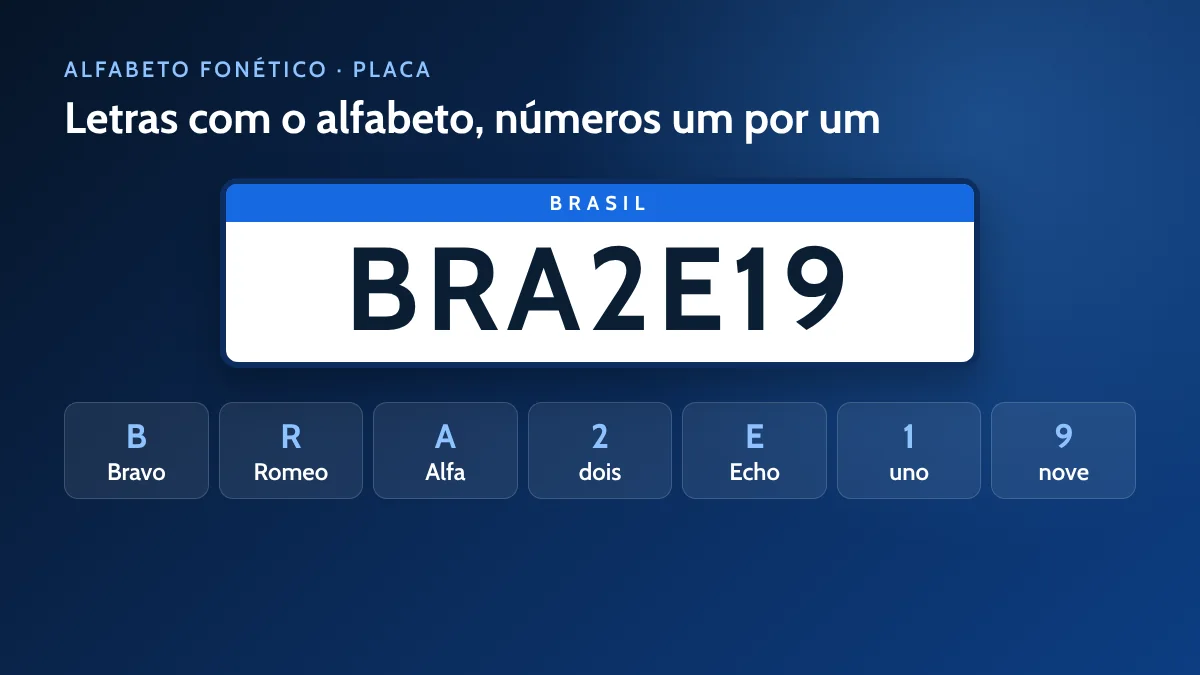
“Plate, I will spell it: Bravo, Romeo, Alfa, dois, Echo, uno, nove.”
Spelling a plate.
Incident
- Security guard
“Control, Post 4. QRU at dock 3: unauthorized person. Requesting support.”
Short report with location and request. - Control center
“QSL, support on the way. Keep your distance and report changes.”
Confirmation and guidance. - Security guard
“Control, QTA on support. Person identified, transport company employee.”
Cancellation after checking.
Shift change
- Supervision
“Post 2, handover at 18 hours. Confirm QSL.”
Handover time. - Post 2
“Supervision, Post 2 handed over, QRA Costa taking over. All normal.”
Service handover.
Event
- Coordination
“Access teams, report whether you are QRV to open.”
Readiness before opening. - North Access
“Coordination, North Access QRV. Queue at gate 2.”
Ready and useful information.
Numbers and alphabet in Q Code for security guards
Vehicle plates, names and numbers are the details most prone to errors. For letters, use the phonetic alphabet (Alfa, Bravo, Charlie…). For numbers, many security teams use Portuguese ordinal forms: primeiro (1), segundo (2), terceiro (3), quarto (4), quinto (5), sexto (6), sétimo (7), oitavo (8), nono (9) and negativo (0). In aviation, the Brazilian standard is digit by digit, with “uno” for 1 and “meia” for 6. Both forms work; what matters is that the whole team uses the same one.
| Data | Written | How to say it (ordinal form) |
|---|---|---|
| Vehicle plate | BRA2E19 | Bravo, Romeo, Alfa, segundo, Echo, primeiro, nono |
| Floor | 6th floor | Sexto andar |
| Badge | Badge 14 | Crachá primeiro, quarto |
7 radio rules at the post (beyond codes)
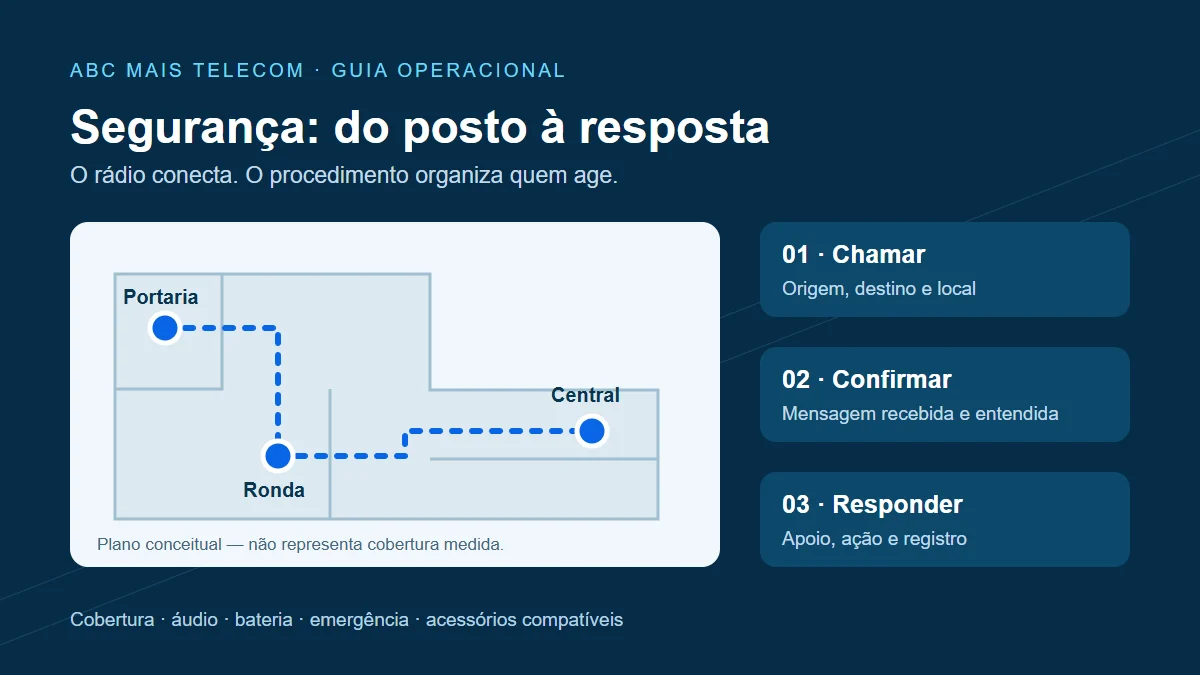
- Listen before speaking. Wait until the channel is clear to avoid cutting off another message.
- Press PTT and wait one second. This prevents the first word from being lost.
- Say who it is for and who is speaking. “Control, this is Patrol 2.”
- Keep it brief. One item at a time: location, situation, request.
- Confirm. Important messages always end with QSL from the receiver.
- No personal data. People’s identification documents, telephone numbers and addresses are not transmitted over the radio.
- Emergencies in plain language. When people are at risk, forget codes and speak directly.
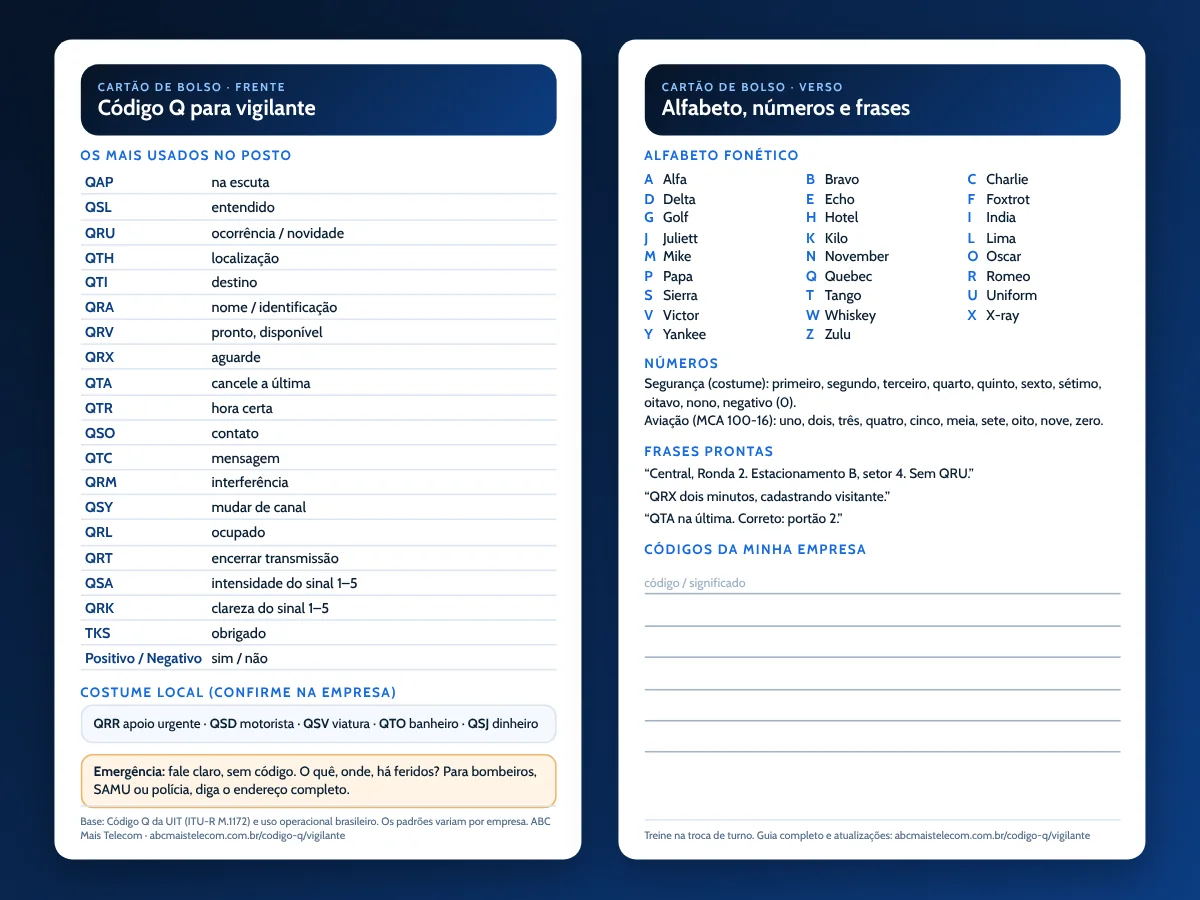
Q Code pocket card for guards: how to download and use it
The pocket card summarizes Q Code for guards on two sides. The front has the most-used codes and ready-to-use phrases. The back has the phonetic alphabet, numbers and space to note your company’s codes. It is designed to fit a shirt pocket or badge holder.
- Download the PDF. Save it on a mobile phone to consult without internet access.
- Print at actual size. In printer settings, choose “actual size” or “100%.”
- Fill in the back. Note your company’s own codes with your supervisor.
- Laminate it. The card lasts longer in rain and daily use.
Guides to each code
To explore Q Code for guards in detail, each guide includes the official and on-post meanings, complete conversations, ready-to-use phrases, common errors and a procedure template:
- QTH · location
- QRA · identification
- QRV · ready
- QRX · wait
- QTA · cancel
- QTR · exact time
- QSO · contact
- QAP · listening
- Phonetic alphabet · A to Z
- Complete Q code · 56 codes
Q Code for guards frequently asked questions
Is there an official Q Code for security guards?
There is no single national table for private security. The basis is international Q Code (ITU), and each company defines its own standard in the post procedure.
Does guard training teach radio codes?
Federal Police course plans require guards to know how to operate communication equipment. Everyday codes are defined by the company and should be practiced at the post.
Does QTO mean restroom?
In many teams, yes, but it is local practice. Its international-standard meaning is different. Confirm with your supervisor.
What does QRU mean for guards?
An incident or news to report. “No QRU” means there is nothing to report.
What is the difference between QAP and QRV?
QAP means listening. QRV means ready to act.
Can I use the PDF card in my company?
Yes. Print it, share it with the team and complete the back with company-specific codes.
Are numeric codes (code 1, code 2…) the same in every company?
No. Numeric codes vary between companies, organizations and states. Record your company’s codes in procedures.
Sources consulted
Does your security company need radios for its posts? ABC Mais Telecom rents two-way radios for property security, gatehouses and events in the state of São Paulo, with the use of Anatel-licensed frequencies already included in the rental.
See rental for securityRental WhatsAppPrefer to buy? Radios for security
