
QRA: radio meaning and how to identify yourself on a call
Q Code in practice · security
QRA means name or identification of the person speaking over the radio. “What is your QRA?” asks who you are. In security, the most useful answer is usually the post or role call sign, such as “Patrol 1” or “Gatehouse 2,” followed by the operational name.
Updated on · ABC Mais Telecom technical team, Motorola Solutions and Hytera two-way radio sales and rental.
What does QRA mean on the radio?
In the ITU international list (ITU-R M.1172), QRA asks “what is the name of your ship or station?” and answers “the name of my station is…”. The code originated to identify stations in maritime and telegraph communications when several vessels shared the same frequency.
In Brazil, QRA came to mean the operator’s name. In security companies, it is used at the start of a shift, during handover and whenever someone joins a channel without identifying themselves. Since identification is the basis of any call, it is one of the most commonly heard radio codes.
| Use | Question | Answer |
|---|---|---|
| Official (ITU) | What is your station’s name? | My station’s name is… |
| Security | What is your QRA? | Patrol 1, guard Lima. |
| Gatehouse | Visitor’s name? | Visitor Marcos, maintenance company. |
| Amateur radio operator | Your QRA, please. | Operator name and station call sign. |
QRA in practice: 3 complete conversations
Each conversation shows the coded message followed by the same message in plain language. Use it as a training script with your team.
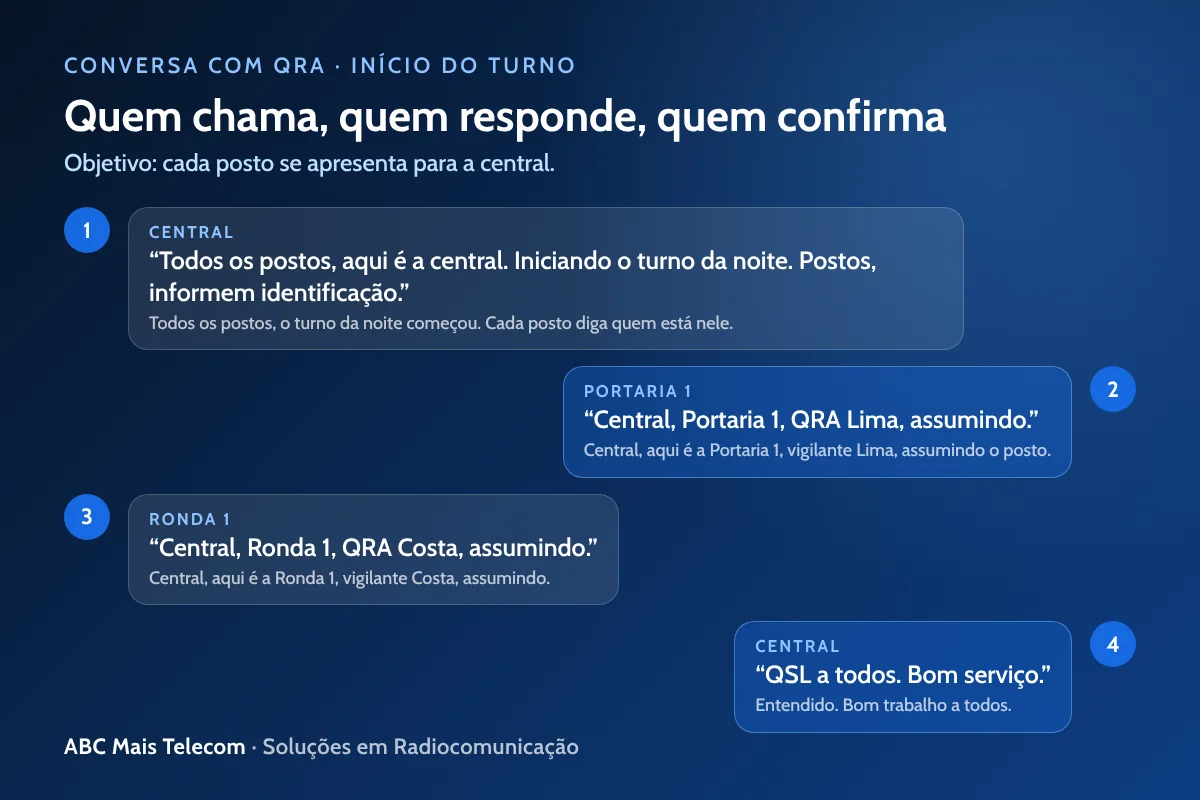
Start of shift
Goal: each post introduces itself to the control center.
- Control center
“All posts, this is Control. Starting the night shift. Posts, report identification.”
In plain language: All posts, the night shift has begun. Each post, say who is there. - Gatehouse 1
“Control, Gatehouse 1, QRA Lima, taking over.”
In plain language: Control, this is Gatehouse 1, guard Lima, taking over the post. - Patrol 1
“Control, Patrol 1, QRA Costa, taking over.”
In plain language: Control, this is Patrol 1, guard Costa, taking over. - Control center
“QSL to all. Have a good shift.”
In plain language: Understood. Have a good shift, everyone.
Unidentified call
Goal: find out who spoke on the channel.
- Unknown
“Anyone listening? I need to open the gate.”
In plain language: Is anyone listening? I need to open the gate. - Control center
“Calling station, report your QRA and QTH.”
In plain language: Who is calling? Give your name and location. - Patrol 2
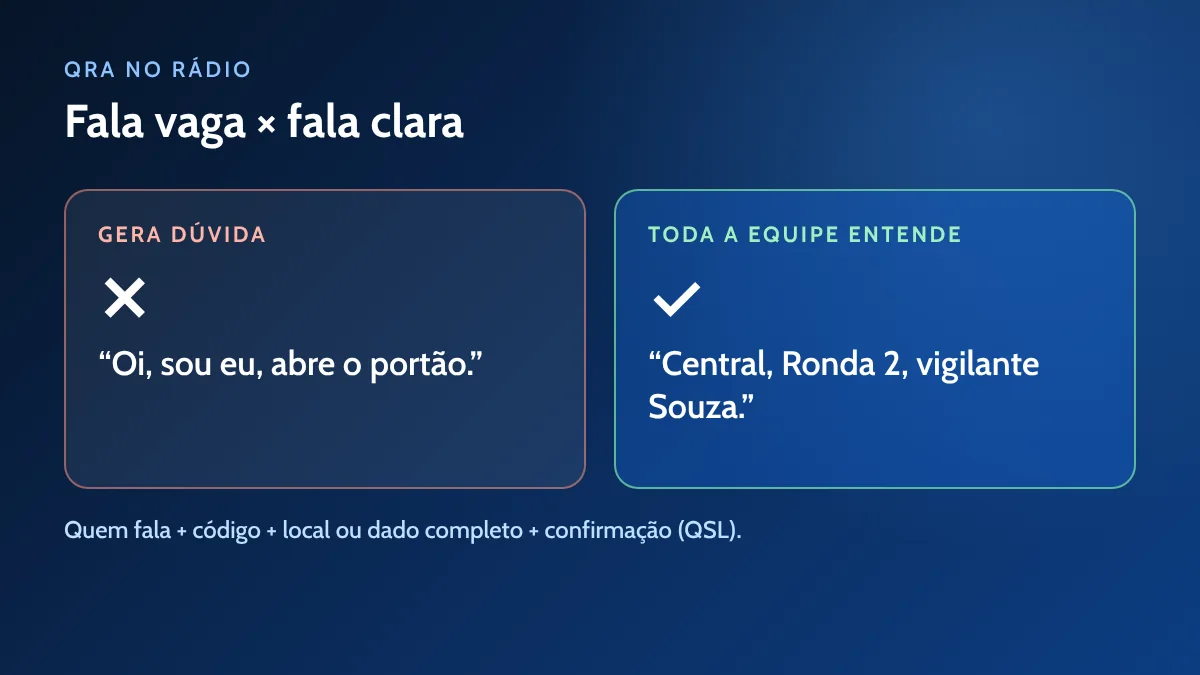
“Control, Patrol 2, QRA Souza, service gate.”
In plain language: This is Patrol 2, guard Souza, at the service gate. - Control center
“QSL, Patrol 2. Gate access in one minute.”
In plain language: Understood. The gate will be opened in one minute.
Visitor at the gatehouse
Goal: announce who arrived without disclosing personal data.
- Gatehouse 2
“Supervision, Gatehouse 2. Maintenance visitor, Marcos, awaiting access.”
In plain language: Supervision, this is Gatehouse 2. Maintenance technician Marcos is waiting for access. - Supervision
“QSL. Confirm the company name.”
In plain language: Understood. Give his company’s name. - Gatehouse 2
“Company Beta: Bravo, Echo, Tango, Alfa.”
In plain language: The company is Beta, spelled B-E-T-A. - Supervision
“QSL, cleared for block C.”
In plain language: Understood, access to block C is approved.
7 ready-to-use QRA phrases
Replace the names with your team’s locations and call signs. Before each message, say who it is for and who is speaking.
- Control center
“Station calling on channel 2, report your QRA.”
Someone spoke without identifying themselves. - Patrol 1
“Control, this is Patrol 1, QRA Lima, starting the shift.”
Start of shift. - Gatehouse
“Supervision, Gatehouse 2. Visitor at reception, Marcos, maintenance company, awaiting access.”
Announcing a visitor. - Supervision
“Post 3, what is the QRA of the incoming guard?”
Shift change. - Control center
“Name not copied, repeat slowly.”
The name was cut off. - Security guard
“QRA Souza: Sierra, Oscar, Uniform, Zulu, Alfa.”
Spelling a name with the phonetic alphabet. - Event
“Coordination, this is North Access, QRA Ana. Gate access cleared.”
Event teams with sector call signs.
How to use QRA without ambiguity
- Define call signs in the procedure. Gatehouse 1, Gatehouse 2, Patrol 1, Supervision, Control. No nicknames.
- First call the person who should hear. “Control, this is Patrol 1” avoids everyone answering at once.
- State the call sign and operational name. The call sign shows the role; the name shows who is at the post on that shift.
- Take care with personal data. On an unencrypted channel, others tuned to the same frequency may hear. Avoid full names, identification documents or telephone numbers over the radio.
- Spell difficult names. Use the phonetic alphabet for names, vehicle plates and acronyms.
Common QRA mistakes
- Using a nickname on the channel. Nicknames are not in the procedure and confuse new team members.
- Changing call signs every shift. The call sign belongs to the post; the name of the person at it changes.
- Speaking without identification. Every call starts with “who it is for” and “who is speaking.”
- Disclosing personal data. People’s identification documents, telephone numbers and addresses should not be transmitted over the radio.
QRA in each type of operation
- Property security: Each post and patrol has a fixed call sign; the operational name shows who is on shift.
- Gate staff and access control: Gate staff announce visitors by first name and company, without stating identification documents.
- Events: Temporary teams receive sector call signs (North Access, Bar 2, Stage) instead of relying on names nobody knows.
- Logistics and industry: Forklift, dispatch and maintenance operators identify themselves by role before asking for anything.
- Condominiums: Building supervisors, gate staff and maintenance have fixed call signs; residents are referred to by unit number.
10-minute training at shift change
Short, frequent training works better than one long annual class. This script fits into service handover.
- Review the call sign list. Print post call signs and display them on the base noticeboard.
- Do an identification round. At shift change, each post introduces itself with its call sign and operational name.
- Practice difficult names. Each guard spells their own name using the phonetic alphabet.
- Simulate an anonymous call. The supervisor calls without identification; the team should reply asking for QRA.
Template for the post procedure
Copy and adapt it for your company’s operating procedure. The text defines code usage for the whole team, including new arrivals.
| Item | Suggested text |
|---|---|
| Adopted meaning | QRA = identification of the speaker (post call sign + operational name). |
| When to use | Start and end of shifts, joining the channel, handover and whenever someone does not identify themselves. |
| Response format | “Gatehouse 2, guard Souza.” |
| When not to use | To request people’s identification documents, telephone numbers or addresses: this data is not transmitted over the radio. |
| Required confirmation | The control center replies with QSL and the caller’s call sign. |
5 questions for team refresher training
- Someone said “open the gate” without identification. How does Control respond?Answer: “Calling station, report your QRA and location.”
- What changes each shift: the call sign or the name?Answer: The name. The call sign belongs to the post.
- Can I give a visitor’s CPF over the radio?Answer: No. Use the first name and company; registration stays in the gatehouse system.
- How do you spell “Lima”?Answer: Lima, India, Mike, Alfa.
- Which code asks “who is calling me?”Answer: QRZ.
QRA and similar codes
| Code | Purpose | Example |
|---|---|---|
| QRA | Identifying the speaker. | “Patrol 1, guard Lima.” |
| QRZ | Asking who called. | “QRZ? Repeat identification.” |
| QTH | Stating the location. | “Gate 2.” |
Identification often comes with location: “Patrol 2, gate 2.” See the guide to QTH (location), the security guard codes with a pocket PDF card and the complete Q Code list.
QRA frequently asked questions
Is QRA the person’s name?
In Brazilian usage, yes: it is the operator’s name. In the ITU list, the original meaning is the station’s name.
What is the difference between QRA and a call sign?
A call sign identifies the role or station (Patrol 1, Gatehouse 2). QRA, in popular usage, is the name of the operator. Many teams state both.
Can I say my full name over the radio?
It is not recommended on unencrypted channels. Use the call sign and operational name defined by the company.
How should you answer “what is your QRA?”
State the call sign and name: “Gatehouse 2, guard Souza.” If the name is difficult, spell it.
What is QRZ?
It asks “who is calling me?” Use it when you hear a call but cannot identify the speaker.
Do amateur radio operators use QRA?
Yes. In amateur radio, QRA is the operator’s name, while the station has its own official call sign.
Can event call signs be assigned by sector?
Yes, and it is recommended: North Access, Bar 2, Stage. Temporary teams do not need to memorize names.
Should visitors be identified by name over the radio?
Use the first name and company when needed. Personal data stays in the gatehouse record.
Sources consulted
Need to organize communication across several posts? ABC Mais Telecom rents two-way radios for property security, gatehouses and events in the state of São Paulo, with the use of Anatel-licensed frequencies already included in the rental.
See rental for securityRental WhatsAppPrefer to buy? Radios for security
