
Motorola Talkabout: when a licence-exempt walkie-talkie meets business needs
Buying guide · walkie-talkies
The Motorola Talkabout is Motorola’s licence-free walkie-talkie range: lightweight radios, sold in pairs, that do not require a station licence. It works well for small teams in open areas and for occasional use. When a radio becomes an all-shift work tool, its limitations become apparent-and that is where professional radios come in.
Updated on · ABC Mais Telecom technical team, supplying, renting and servicing Motorola Solutions and Hytera two-way radios.
What is the Motorola Talkabout?
Talkabout is the name of Motorola’s consumer radio range. Versions sold in Brazil carry the BR suffix (T110BR, T210BR, T400BR, T470BR, T600BR H2O) and operate on the general-use channels provided for by Anatel, in the 462 and 467 MHz bands. They therefore do not require a station licence; the equipment remains subject to type approval, which applies to the exact variant shown on the label. The regulatory details are covered in the guide does a two-way radio require an Anatel licence?.
Many people search for this category using informal Brazilian names such as “rádio ok tok”, “oktok”, “tok tok” or “walk talk”. The technical term is walkie-talkie, and Talkabout is Motorola’s licence-free range. Motorola also sells professional radios through the same retail channels, but these have different operating, programming and accessory requirements.
Motorola Talkabout models sold in Brazil
The five models below appear in ABC’s catalogue with information from their Brazilian data sheets. They are generally sold in pairs; power options, protection and additional features vary, and channel availability follows the Brazilian data sheet for each version.
| Model | Power supply | Protection and features | Usage profile |
|---|---|---|---|
| T110BR | 3 AAA batteries per radio (not included) | LCD display, scanning and keypad lock | Occasional, light-duty use |
| T210BR | AA batteries or NiMH, USB charging | Backlit display, 121 privacy codes | Small teams, frequent use |
| T400BR | NiMH battery (PMNN4477) | Talkabout series audio kits | Users who need an earpiece and belt clip |
| T470BR | 800 mAh NiMH battery or AA batteries | IPX4, LED torch, iVOX/VOX | Outdoor areas with light rain |
| T600BR H2O | NiMH or AA batteries | IP67, floats with the NiMH battery, emergency alert | Wet and marine environments |
The battery life quoted in data sheets, such as “up to 12 h” for the T470BR, is measured using a standard transmit, receive and standby cycle. Frequent transmission, cold conditions and poor-quality batteries reduce that figure. For a business, the practical question is whether the radio lasts to the end of the shift without a battery change. Test this before buying in quantity.
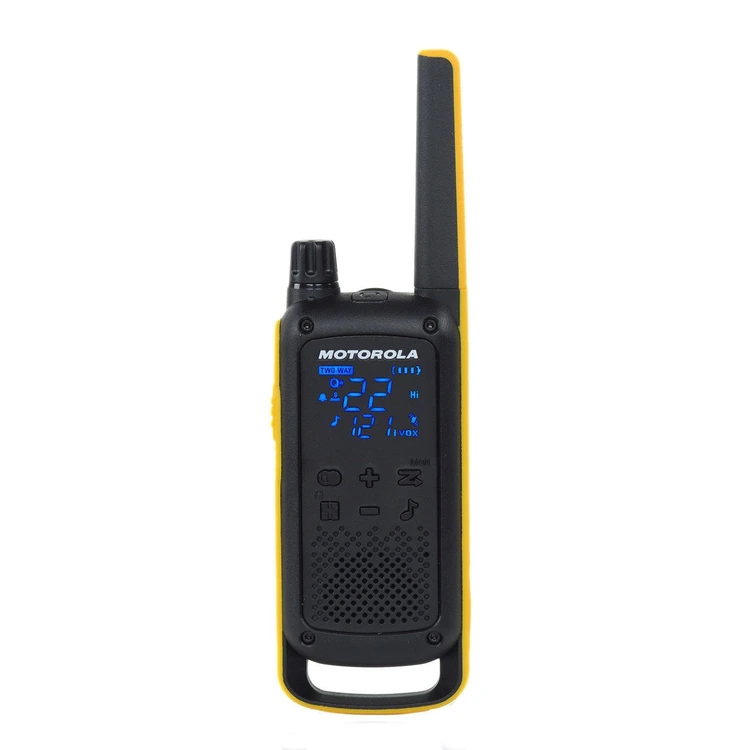
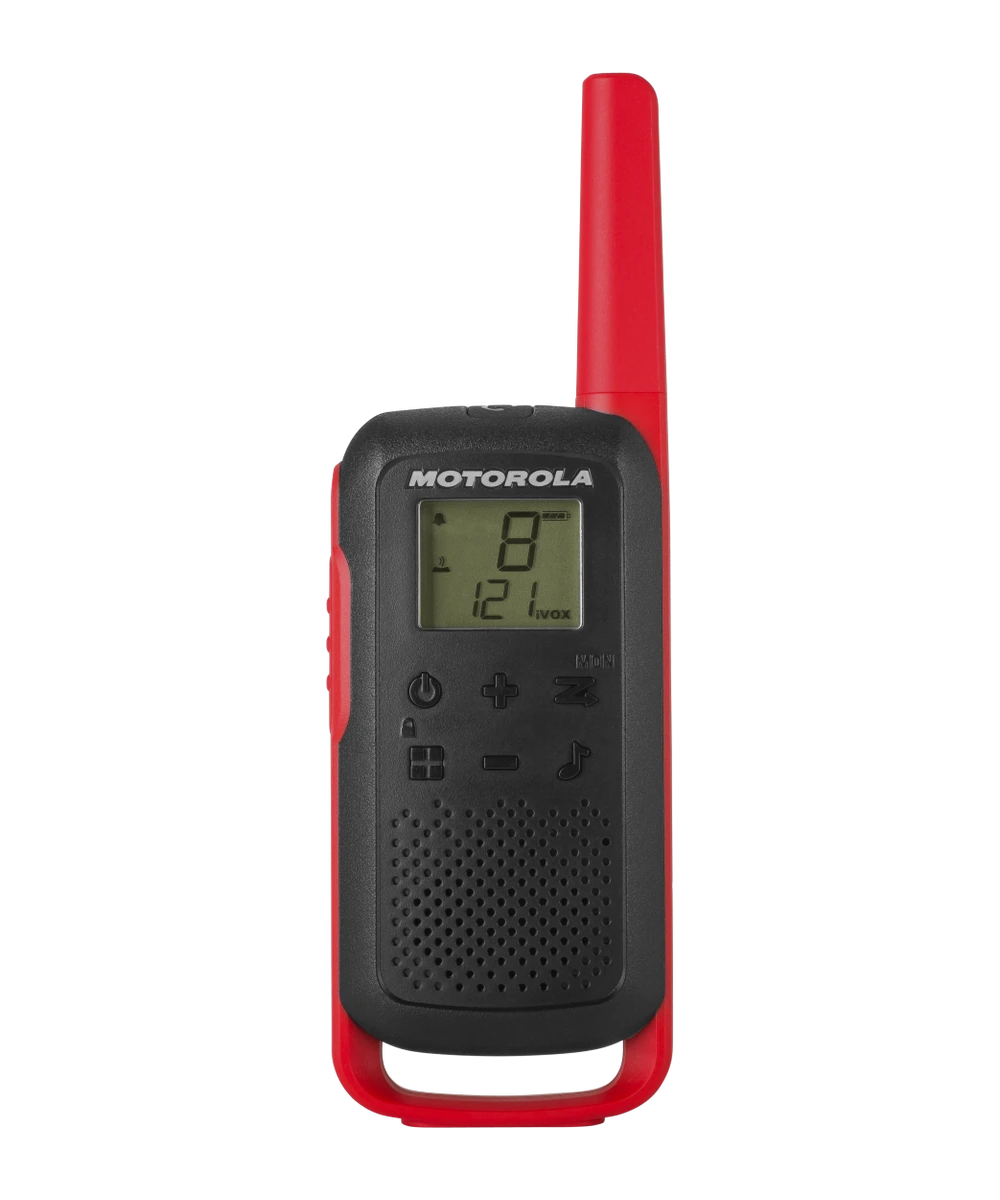
When Talkabout meets a business’s needs
- Small team and open area. Car parks, country properties, small single-storey construction sites and outdoor event support: a few radios, with few walls in the way.
- Occasional use. One-off team projects, weekend stocktakes, team trips and support for a specific activity.
- Simple communication. A single conversation group, without a control room, recording or integration with other systems.
- Entry-level budget. A pair of radios solves the problem without frequency planning or fleet programming.
In these situations, the Motorola Talkabout is often the simplest choice. Set the same channel and privacy code on every unit, make a test call at each point along the route, and decide who stores and charges the radios.
A useful reality check is to ask how many hours a day the radio is switched on and how many people speak at once. If the answers are “a few hours” and “two or three people”, Talkabout is likely to be adequate. If they are “the whole shift” and “several groups”, it becomes a bottleneck. If in doubt, buy a pair, use it for a week in the actual operation, and only then decide how many you need.
The operational limitations of licence-free walkie-talkies
Talkabout was designed for consumer use. In businesses, the most common limitations are:
| Limitation | What happens in practice |
|---|---|
| Shared channels | The general-use channels are available to everyone. A privacy code only filters what you hear; it does not prevent others from occupying the channel and is not encryption. |
| Advertised range | The “up to 32 km” printed on packaging is measured in open terrain without obstacles. In buildings, warehouses or basements, the actual range is much shorter. |
| Power | Disposable batteries or a low-capacity NiMH battery may need replacing or recharging during a shift under heavy use. |
| Ruggedness | Most models offer basic protection; the T600BR H2O, rated IP67, is the exception. A belt-worn radio that is dropped every day takes a beating. |
| Fleet management | No centralised programming, no area-specific groups and no features such as an emergency button integrated with a control room. |
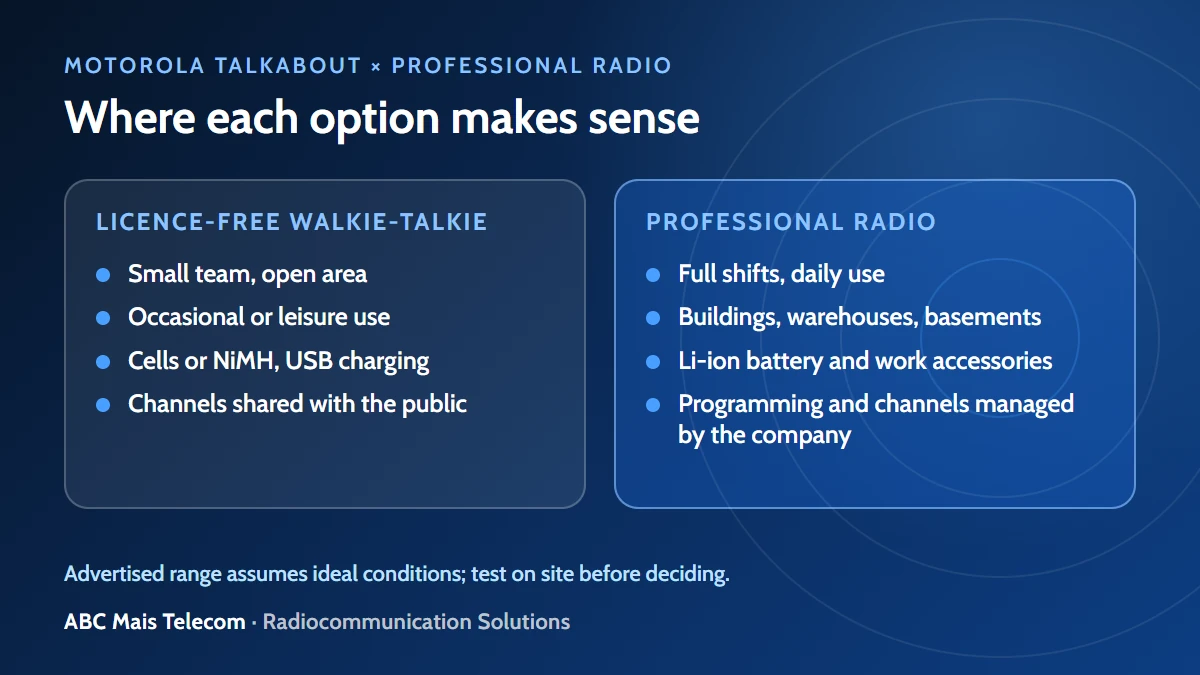
How to prepare Talkabout radios for team use
Talkabout radios can communicate straight out of the box, but ten minutes of preparation prevents most first-day complaints.
- Use the same channel and code on every unit. Choose a channel and privacy code and apply them to every radio in the team. A radio with a different code “cannot hear” the others, even on the same channel.
- Label each radio. The T110BR comes with personalisation labels; use the station name or radio number rather than the person’s name.
- Lock the keypad. This prevents the channel from changing accidentally in a pocket or on a belt.
- Test every point along the route. A short call from the most distant and most enclosed locations shows whether the range is sufficient.
- Plan the power supply. Keep spare batteries or rotate NiMH battery packs. Do not mix disposable and rechargeable batteries in the same radio.
- Agree on how VOX will be used. iVOX and VOX free up users’ hands, but noise can activate the channel. For teams, the default should be the push-to-talk button.
Once prepared, the Motorola Talkabout performs well at what it was designed for: simple communication between a few people. When the list of adjustments keeps growing, the operation probably needs a different category of radio.
Motorola Talkabout or professional radio: signs that it is time to upgrade
- The radio is used for the entire shift, every day. A lithium-ion battery, desktop charger and work accessories become essential.
- Communication fails inside buildings. Floors, cold rooms and warehouses require a radio with more power, a suitable frequency band and sometimes a repeater.
- Strangers appear on the channel. This indicates that a shared channel no longer suits the operation.
- The team needs groups. Reception, maintenance and cleaning on separate channels, with the control room monitoring them all.
- The radio is dropped, gets wet and becomes hot. Professional radios undergo drop tests and offer IP54, IP67 or higher protection.
For users who want to continue without a station licence, the Motorola DTR720 is the next step: digital, using restricted-radiation operation at 900 MHz, with IP54 and up to 16,5 h of battery life according to its data sheet. See the comparison in the guide to DTR720 and DEP450. For larger operations, the DEP450 and MOTOTRBO models offer fleet programming. If the need is temporary, professional walkie-talkie rental avoids purchasing equipment.
Frequently asked questions about Talkabout
Does the Motorola Talkabout require an Anatel licence?
The BR versions operate on the general-use channels provided for by Anatel and do not require a station licence. The equipment needs type approval; check the variant on the label.
What is Talkabout’s actual range?
It depends on the environment. Maximum figures on the packaging refer to open terrain. In urban areas, warehouses or buildings, test at the actual site before buying in quantity.
Can Talkabout communicate with a professional radio?
Only if both are on the same general-use channel, which is not the usual configuration for professional radios programmed for a business. In practice, treat them as separate systems.
Which Talkabout should I choose for work?
For frequent use, prefer models with rechargeable batteries and audio kits, such as the T400BR and T470BR. For wet environments, the T600BR H2O offers IP67. For daily, intensive use, consider the DTR720 or a professional radio.
What do “rádio ok tok” and “oktok” mean?
They are informal Brazilian names for a walkie-talkie. Talkabout is Motorola’s range of licence-free walkie-talkies.
Can I use an earpiece with Talkabout?
Yes, using kits designed for the range, such as those listed for the T210BR and T400BR. Professional radio earpieces are not suitable.
Is Talkabout suitable for site security?
Security patrols and posts usually involve daily use and sensitive information on a channel shared with the public. In these cases, a professional radio programmed for the business or security radio rental is more suitable.
Can I mix Talkabout models within the same team?
Generally, yes, provided all units use the same channel and privacy code. Check the available channel configuration in each BR version’s data sheet and test before use.
Sources consulted
Unsure whether to choose Talkabout or professional radios? ABC Mais Telecom supplies Motorola Solutions and Hytera two-way radios and original accessories, checks compatibility using each part’s code, and provides specialist technical support for your fleet.