

Does a two-way radio need an Anatel licence? Understand the cases
Does every two-way radio need a licence? There is no single answer by brand or appearance. The first step is to separate three things that are often incorrectly called “radio licence”: equipment type approval, authorisation to use radio frequency and station licensing. The rule depends on the type of emission and how the network will be operated.
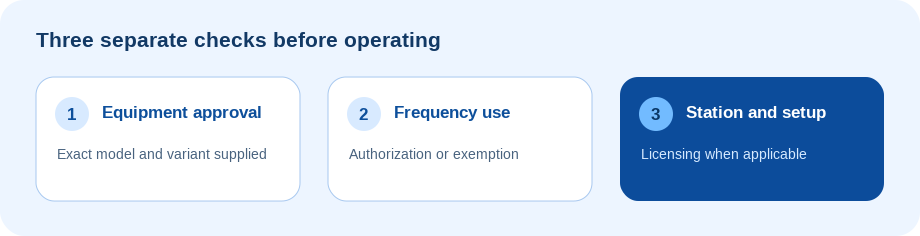
Type approval, frequency and station: three different checks
Check whether the equipment variant is type-approved for sale and use in Brazil. The number and manufacturer can be checked in Anatel’s public database.
A professional network outside restricted-radiation conditions may require authorisation to use specific frequencies. A free channel cannot simply be chosen by guesswork.
Depending on the service and station classification, registration and an operating licence may be required. A licence exemption does not automatically remove other obligations.
The Anatel guide explains how to check type approval by the number on the seal or by manufacturer. Check the exact model and variant, including when the equipment is rented. A similar trade name does not prove that all versions have the same regulatory status.
Which general-use radio frequencies may be exempt from individual authorisation?
Anatel does not “approve a frequency” for any radio. It type-approves equipment and establishes technical conditions for bands and applications. For the General Use Radiocommunication Equipment, item 15 of Anatel Act No. 14.448/2017 presents 26 reference channels within 462,53-462,74 MHz and 467,53-467,74 MHz. The table below reproduces the centres of these channels, in MHz, for technical reference; the act also allows interstitial channels under specific conditions.
| Channel 01-13 | Frequency (MHz) | Channel 14-26 | Frequency (MHz) |
|---|---|---|---|
| 01 | 462,5625 | 14 | 467,5625 |
| 02 | 462,5750 | 15 | 467,5750 |
| 03 | 462,5875 | 16 | 467,5875 |
| 04 | 462,6000 | 17 | 467,6000 |
| 05 | 462,6125 | 18 | 467,6125 |
| 06 | 462,6250 | 19 | 467,6250 |
| 07 | 462,6375 | 20 | 467,6375 |
| 08 | 462,6500 | 21 | 467,6500 |
| 09 | 462,6625 | 22 | 467,6625 |
| 10 | 462,6750 | 23 | 467,6750 |
| 11 | 462,6875 | 24 | 467,6875 |
| 12 | 462,7000 | 25 | 467,7000 |
| 13 | 462,7125 | 26 | 467,7125 |
“Exempt” has conditions: the portable equipment must be certified/type-approved for this classification and operate within its approved characteristics. The same act limits effective radiated power to 500 mW and the occupied channel bandwidth to 12,5 kHz. It is not enough to program one of these frequencies into a higher-power professional HT to make it exempt. Changing power, antenna, configuration or purpose may change the classification.
When the network uses exclusively compliant restricted-radiation equipment, Anatel states that individual authorisation for radio-frequency use and operating licences for the corresponding transmitting stations are not required. This does not remove product type-approval requirements or other applicable duties. There is also no protection against interference from other stations: for a critical event, suitability must be tested rather than assumed because the channel appears in the table.
Which situation requires authorisation and which can be exempt?
| Situation | What to check | Common mistake |
|---|---|---|
| Professional radio on a company RF network | Type approval, service classification, frequency-use authorisation and station licensing or registration, as applicable. | Assuming that buying a type-approved radio authorises transmission on any channel. |
| Equipment classified as restricted radiation | Type approval and full compliance with the classification’s limits and conditions. Anatel describes frequency-authorisation and licensing exemptions for qualifying equipment. | Calling any small handheld “licence-exempt” without checking its certificate and the applicable rule. |
| PoC terminal via cellular/Wi-Fi network | Terminal type approval, coverage, contracted service/platform and the conditions of the third-party network. | Confusing the use of the carrier’s network with a private RF network created by the customer. |
| Rental of professional radios | Who is responsible for frequency use, which operation and area the proposal covers, and whether the equipment/stations meet the applicable regulatory requirements. | Assuming that any supplier licence covers every frequency, region and configuration. |
For a professional Serviço Limitado Privado (SLP) network, the Anatel Act No. 915/2024 sets out channel arrangements, among others, in parts of 148-174 MHz (VHF) and 450-470 MHz (UHF). These bands are examples of technical planning, not a list of channels freely available to any company: there are different sub-bands, channel widths, arrangements and allocations, in addition to authorisation and licensing according to the project. Even two radios that display ‘UHF’ may be in incompatible bands or modes.
It is the technical and regulatory classification, not the logo, that determines the exemption. Anatel itself emphasizes that exemption from authorisation does not eliminate other applicable duties. For a concrete project, confirm the documentation of the network and equipment before operation.
What changes when the company rents the radios?
With ABC Mais Telecom two-way radio rental, use of Anatel-licensed frequencies is already included in the contracted solution, according to the package and conditions defined for that operation. The customer does not need to choose a frequency or programme the devices independently. Even so, a responsible proposal identifies the location, period, models, infrastructure and responsibilities; it does not promise that one authorisation covers every imaginable scenario.
If the requirement involves an event, a temporary repeater, multiple addresses or integration with an existing network, regulatory compliance must be checked for that project. The Anatel guidance for event organisers also covers checking any temporary use of the spectrum.
What the radio brand alone does not tell you
Motorola Solutions and Hytera offer families for professional networks as well as technologies supported by data networks. Therefore, “Motorola does not need one” or “Hytera needs one” are incorrect statements. In ABC’s catalogue, see the Motorola R2, Hytera HP506 and the Motorola TLK110 PoC as examples of different architectures, not as an automatic list of exemptions.
If your question started with distance, also read how to choose the technology and how rental works.
Frequently asked questions
Can a type-approved radio use any frequency?
No. Product type approval and the right to use a radio frequency are separate matters. For a professional network, check the applicable authorisation and programming.
Does “licence-exempt” mean no rules?
No. Restricted radiation equipment must comply with the technical requirements of its classification and the type-approval rules. There may be registration obligations depending on the service or installation.
Can I use 462,5625 MHz in any radio?
No. The channel appears in the table of Act No. 14.448 for general-use radiocommunication equipment, but the exemption depends on the equipment and operation being classified as restricted radiation, on type approval, and on technical limits. Programming the frequency into another HT does not grant exemption.
Does PoC/LTE require a customer-owned frequency?
The PoC terminal uses the data network provided by the carrier or Wi‑Fi, with a contracted platform; this is not a private RF authorisation for the customer. The terminal remains subject to applicable type-approval rules.
In rental, who handles the frequency?
ABC’s rental solution includes the use of licensed frequencies for the contracted scope. Provide where, when, and how the radios will be used so the team can prepare the proposal correctly.
How do I verify a model?
Ask for the equipment’s type-approval number and check Anatel’s public database. Confirm the delivered variant; do not use only the family name as proof.
Official sources and review date
Regulations reviewed in October 2026; application to a specific case must be rechecked when contracting.
- Anatel: search for type-approved products.
- Anatel: cases and limits of authorisation exemption.
- Anatel: radio frequency authorisation and station licensing.
- Anatel: Act No. 14.448/2017, item 15 and Table XII (26 general-use channels, power and channel width).
- Anatel: Resolution No. 680/2017, restricted radiation, interference and certification.
- Anatel: Act No. 915/2024, SLP requirements and channel arrangements.
Want a technically compliant proposal?
Describe the operation, not the frequency. The team evaluates equipment, coverage, and responsibilities for purchase or rental.
Talk to ABC Mais Telecom
Tell us briefly about your operation. Our team can help you assess equipment, rental or support in Brazil.