
Two-way radio rental for hospitals and clinics
Two-way radio rental for hospitals connects the support teams that keep the hospital running: maintenance and engineering, security, hospitality services and cleaning, patient transport and gate staff. ABC Mais Telecom prepares tailored proposals with professional Motorola Solutions and Hytera radios programmed by team, accessories for discreet use and the use of Anatel-licensed frequencies already included.
Support teams
maintenance, security, hospitality services and transport
Anatel included
use of licensed frequencies already included in the rental
Discreet use
earpieces and suitable volume near patients
Construction and expansions
radios for renovations while the hospital remains open
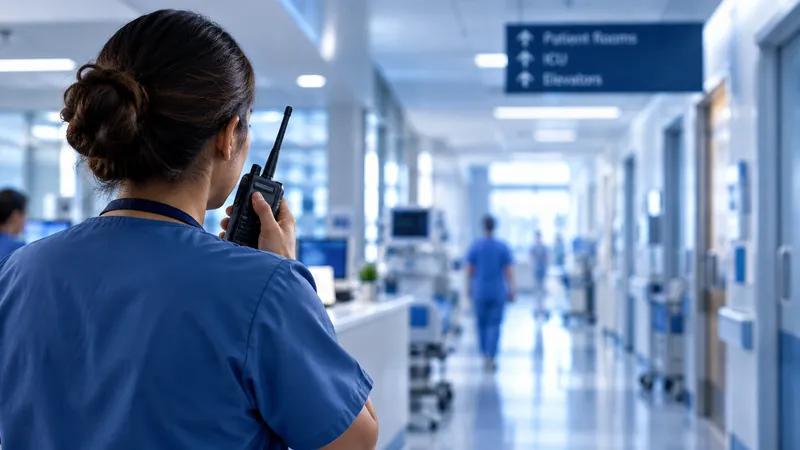
The hospital never stops, and neither does its support team
A stretcher that needs to go upstairs, a leak in the operating suite, an agitated visitor at reception: each requires the right person, right away.
Where radios help in a hospital
A two-way radio for hospitals does not replace care systems or clinical communication. It serves support teams moving throughout the building who need to be contacted quickly:
- Maintenance and clinical engineering: equipment calls, medical gases, electrical systems, air conditioning and elevators.
- Security and gate staff: access control, patrols, incidents and emergency department support.
- Hospitality services and cleaning: bed availability, terminal cleaning and linen services.
- Patient transport: stretcher-bearers contacted by the transport control center.
- Internal logistics: pharmacy, stores and nutrition.
Many hospitals buy radios for permanent routine work. Two-way radio rental for hospitals comes in when needs are temporary, change frequently or when the hospital prefers a monthly expense, with maintenance that can be negotiated in the contract.
When hospitals rent radios
- Expansion or retrofit work while the hospital remains open, when the builder, engineering and security teams need to coordinate.
- Relocation of a unit or moving patients between buildings, involving many people for one or two days.
- Field hospitals, healthcare outreach campaigns, vaccination campaigns and health events.
- Emergency drills and contingency plans, with emergency response and support teams.
- Additional security during busier periods.
Radios near medical equipment
The coexistence of radios and sensitive medical equipment is a legitimate concern. Professional radios transmit at low power, but any transmitter must follow the institution’s electromagnetic compatibility rules. The hospital therefore defines the areas where radios may transmit and the minimum distances from critical equipment, such as in intensive care units and operating suites. Include these rules in your request: programming, accessories and usage guidance follow the clinical engineering team’s requirements.
Discreet use near patients
In corridors, rooms and waiting areas, patients and visitors should not hear the radio. Discreet earpieces, low volume and well-separated groups address this: security does not hear cleaning calls, and maintenance does not hear gate incidents. In critical areas, silent mode with vibration can be combined with earpiece use.
Blocks, basements and technical areas: coverage
Hospitals often have connected blocks built at different times, basements with utility plants, shielded imaging areas and long corridors. These create coverage gaps. A test with the maintenance team walking through critical points shows whether direct radio-to-radio communication is enough or a repeater is needed.
Before finalizing the agreement, it is useful to know: UHF radios handle concrete and urban obstacles better, while VHF performs better in open areas (understand the difference). If the terrain requires it, a repeater extends the range, and the coverage test confirms the result.
What is in the proposal
Two-way radio rental for hospitals is assembled item by item. The most common items:
- Anatel handledRadios already operate with licensed frequency use included.
- Ready configurationRadios delivered with the agreed groups for each work area.
- Organized chargingSingle-unit or multi-unit chargers and extra batteries when shifts are long.
- Support during the periodMaintenance and replacement under the contract.
- Voice accessoriesLapel microphone, discreet earpiece or noise-isolating headset, depending on the role.
- Extended coverageRepeater for large areas, basements or difficult terrain.
Items, quantities and terms apply according to the approved proposal.
Three questions that define the proposal
Before discussing quantities, the technical team answers three questions about two-way radio rental for hospitals: who needs to talk to whom (this defines the groups), where the team will be (this defines coverage, band and repeater) and for how long and on which shifts (this determines batteries, charging and rental period). With the answers, the proposal describes radios, accessories and terms; the hospital or clinic address (city and number of blocks) and photos of the site speed up the assessment.
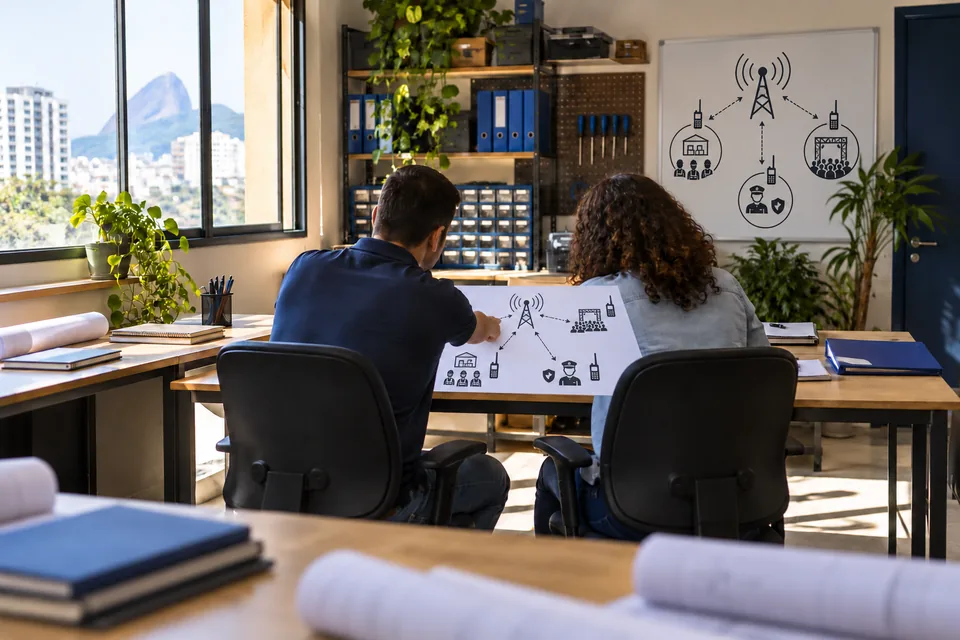
Who talks to whom in a hospital
Group arrangement used as a starting point when preparing a two-way radio rental proposal for a hospital:
| Group | Users | Purpose |
|---|---|---|
| Maintenance and engineering | Building maintenance, clinical engineering, utilities | Technical calls and infrastructure failures |
| Security and gate staff | Guards, gate staff, access control | Incidents, access and emergency department support |
| Hospitality services and cleaning | Housekeeping, cleaning, linen services | Bed availability and terminal cleaning |
| Patient transport | Transport control center and stretcher-bearers | Internal patient transport calls |
| Emergency response and management | Emergency response team, supervision, facilities management | Serious incidents and contingency plans |
The table is a starting point: each hospital adapts the groups to its workflow, number of blocks and internal rules.
Example: transferring patients to a new block
When moving to a new block, a hospital transfers patients, equipment and materials within a few hours, with nursing teams, stretcher-bearers, maintenance, security and hospitality services working together. A common arrangement creates a move coordination group, a patient transport group, one for maintenance and installation, one for security and route control, and the emergency channel.
Reserved elevators, blocked routes and the timing of each stage are coordinated by radio in real time. After the move, radios are returned and the hospital does not keep an idle fleet. This is the kind of project where two-way radio rental for hospitals offers the best value for money.
Example: construction while the hospital remains open
During expansion works, the builder operates alongside patient care areas. Communication between hospital engineering, security and the site supervisor prevents unexpected interruptions to power, water or medical gases and controls material traffic. In this case, hospital radios use groups separate from routine operations, with a shared coordination channel. Also see two-way radio rental for construction.
Emergency drills and contingency plans
Fire, evacuation and power failure drills test a hospital’s ability to coordinate dozens of people in a few minutes. During these exercises, two-way radios for hospitals allow emergency response teams, security, maintenance and management to hear the same information at the same time, while care teams follow their own protocols. Radios rented for the drill can be programmed with the same groups as the contingency plan, helping validate the plan in practice.
After the exercise, the occupational safety team can assess where communication failed: a basement without coverage, a congested group, a post without a radio. These points inform the hospital’s final communication planning.
Field hospitals, outreach campaigns and health events
Temporary facilities such as field hospitals, vaccination centers and testing campaigns operate for weeks or months in places not designed for them: gyms, parking lots and tents. Two-way radio rental for hospitals serves these projects with groups for reception, triage, support, logistics and security, and quantities reviewed according to demand under the terms provided in the contract.
Cleaning radios
In hospital environments, radios pass through several hands and must follow infection control service rules. Cleaning must use the products and methods recommended by the equipment manufacturer and approved by the institution. Individual covers and accessories, such as personal earpieces, help reduce sharing. Include hospital rules in your request so the proposal considers suitable accessories and quantities.
Clinics, laboratories and healthcare units
Multi-floor clinics, laboratories with separate sample collection and processing areas, and healthcare units at events and outreach campaigns also use radios to coordinate reception, support and security. Quantities are smaller, but the approach is the same: groups by role, discreet use and a clear emergency channel.
Example: the night shift
At night, the hospital operates with smaller support teams, and each person covers a larger area. The on-duty maintenance technician serves all blocks, the guard patrols outside and inside, and hospitality services prepare beds for overnight admissions. At this time, one support group heard by everyone often works better than several empty groups. At shift change, programming returns to daytime groups without needing to change radios.
Spare batteries in the duty room and a charging base at the gatehouse ensure hospital radios are ready at each shift change. The roster for who carries each radio can follow the same list used for other on-duty equipment.
Radios, mobile phones and call systems
The hospital already has telephones, extensions and nurse call systems. Two-way radios for hospitals complement these systems for people on the move: the stretcher-bearer in the elevator, the technician in the machinery room, the guard in the parking lot. At the touch of a button, the message reaches the whole group without relying on mobile phone coverage in basements and technical areas.
Parking, access and valet staff
At hospitals with their own parking, valet staff, access controllers and security handle ambulances, patients arriving by car and visitors at the same time. A radio group for access and parking, separate from internal security, keeps the emergency department entrance clear and organizes vehicle queues at peak times.
During renovations that block access, this group becomes even more important because routes change from day to day. Hospital radios can be supplemented just during construction and returned when access returns to normal.
Quick training for support teams
Stretcher-bearers, cleaning assistants and access controllers are not always used to radios. Brief guidance on hospital rules (where to transmit, how to speak without disclosing patient information, which channel is for emergencies) prevents most problems. To standardize terminology, the team can consult the guide to Q code. It is also useful to define who may use the general channel and in which situations, so it is not occupied with routine calls just when an incident involving several teams arises, such as a power failure or partial floor evacuation.
How long to rent for
The two-way radio rental period for hospitals follows the project: one day for an event, one or two weeks for installation or a shutdown, months for routine operations and long contracts when communication is permanent. Renewal and quantity changes follow the proposal; see the options on the page about two-way radio rental.
Service area
ABC Mais Telecom is based in São Bernardo do Campo, primarily serving the state of São Paulo, with other regions served according to the project. For purchasing radios for permanent use, the page two-way radios for hospitals and clinics sets out the selection criteria. For security teams, see rental for security.
Information that speeds up the proposal
The more specific the request for two-way radio rental for hospitals, the fewer back-and-forth exchanges. Useful details include the hospital or clinic address, dates, number of users by team, type of environment, shift length, and brand and model of any radios already in use.
Who is behind the rental
ABC Mais Telecom is an authorized Motorola Solutions and Hytera reseller, based in São Bernardo do Campo with more than 10 years in professional radiocommunications. Besides two-way radio rental for hospitals, the same team provides technical service team, repeaters and systems; details on the page for company facts.
Frequently asked questions
Do two-way radios interfere with medical equipment?
Professional radios transmit at low power, but any transmitter must follow the hospital’s electromagnetic compatibility rules. Provide the areas and distances defined by clinical engineering: usage guidance follows these rules.
How can we talk over the radio without disclosing patient information?
Agree with the team not to say names or diagnoses over the radio: use bed, room or incident numbers. Discreet earpieces and separate groups by team also reduce who hears each conversation.
Can the hospital parking area have a separate radio group?
Yes. Valet staff and access controllers can have their own group, separate from internal security, to keep the emergency department entrance clear and organize vehicle queues.
Do I need an Anatel license to use rented radios at the hospital?
No. For rented radios, ABC Mais Telecom already includes the use of Anatel-licensed frequencies. Simply mention in the request if the operation will also use your own radios or a repeater so we can check the applicable arrangement.
Which hospital teams usually use radios?
Support teams: maintenance and engineering, security and gate staff, hospitality services and cleaning, patient transport and internal logistics.
Can rented radios communicate with the hospital's existing radios?
They can communicate, provided the frequency band, operating mode (analog or digital) and programming are compatible. Send the brand and model of the existing radios: we check in advance and, if compatible, program the rented radios into the team’s same groups.
Do you rent radios for field hospitals and outreach campaigns?
Yes. Temporary healthcare facilities can use weekly or monthly rental, with groups for reception, triage, support, logistics and security. Provide the location, dates and number of people.
Will patients hear the conversations?
With discreet earpieces, low volume and separate groups, communication stays within the team. Accessories are defined in the proposal.
How much does two-way radio rental for a hospital cost?
The price depends on quantity, rental period, accessories, whether a repeater is needed and logistics. The terms are negotiable and are set out in the proposal.
Can we rent radios just for a block relocation or drill?
Yes. Rental can be daily or weekly for short projects such as moves, drills and campaigns, or monthly for construction and ongoing operations.
What happens if a radio develops a fault?
Maintenance and replacement of faulty radios may be included, and the support request procedure is written in the proposal.
Motorola Solutions and Hytera radios for rental
Motorola Solutions and Hytera equipment, brands for which ABC Mais Telecom is an authorized reseller, make up the two-way radio rental offering for hospitals according to the situation.


Official manufacturer ranges. Equipment, availability and composition are confirmed in each proposal.
Request your two-way radio rental proposal for hospitals
Provide the hospital or clinic, teams involved, dates and internal usage rules. You do not need to know the radio model.
Tell us what your operation needs
Fill in the details to receive technical and commercial guidance.
Response by email and WhatsApp. No obligation · price on request.
