
HT radios: meaning, types and how to choose for your business
Guide · HT handheld radio
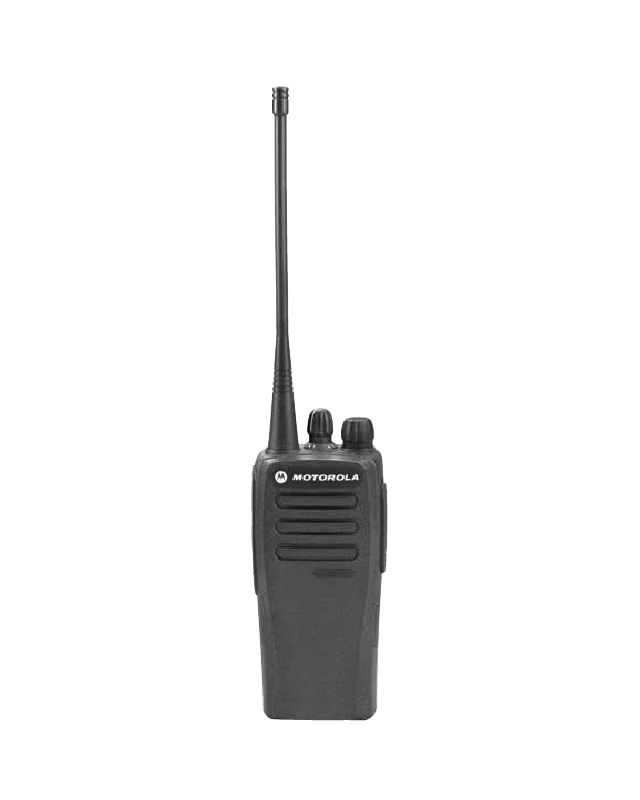
An HT radio is a handheld two-way radio: you carry it on your belt, press the PTT button to talk and release it to listen. It works directly between radios or through a repeater, without relying on mobile coverage, and is the most widely used format for security, events, industry, logistics and hospitality teams.
What is HT? HT comes from Handie-Talkie, the name Motorola gave its first handheld two-way radio in the 1940s. The abbreviation became synonymous with a portable radio. When buying or renting, however, the name matters little: what determines the result is the technology (analogue or digital DMR), band (UHF or VHF), battery and accessories.
Updated on · ABC Mais Telecom technical team: Motorola Solutions and Hytera two-way radio sales, rental and technical support.
What an HT radio is and what the abbreviation means
In the early 1940s, Galvin Manufacturing Corporation, the company later renamed Motorola, developed the SCR-536 for the United States Army: a two-way radio that fitted in one hand. Its trade name was Handie-Talkie. According to Motorola Solutions itself, it weighed around 2,2 kg and had a range of approximately 1,6 km on land.
The brand name caught on and became a generic term: “HT” came to mean any portable radio that transmits and receives, with an antenna, speaker, microphone and PTT button built into the body. Many people interpret the abbreviation as hand-held transceiver , a term common in amateur radio and English-language specifications. The meaning is the same; its origin is the Handie-Talkie brand.
A useful fact: the original “walkie-talkie” was a different radio from the same period, the backpack-mounted SCR-300. Today, in Brazil, “rádio HT”, “HT rádio”, “rádio comunicador HT” and “walkie-talkie” are used almost interchangeably. Some people reserve “walkie-talkie” for licence-exempt models sold in pairs and “HT” for professional models, but there is no technical rule for this.
HT, walkie-talkie, mobile and base radio: what is the difference?
The difference is in the format, power supply and antenna. All four can communicate when they belong to the same system, use the same band and have matching programming.
| Format | Where it goes | Power supply and antenna | Typical use |
|---|---|---|---|
| Professional HT radio | On a belt, vest or in the hand | Removable battery; short antenna on the radio | People on the move: patrols, maintenance, events, construction, warehouses |
| Licence-exempt walkie-talkie | Handheld, sold in pairs | Disposable cells or NiMH battery; fixed antenna | Occasional use, few people, open areas |
| Mobile radio (vehicle-mounted) | Installed in a vehicle or machine | Vehicle battery; external antenna | Fleets, trucks, forklifts, service vehicles |
| Base radio (fixed) | On a desk in the control room or gatehouse | Mains power supply; elevated antenna | Operations centre, CCO, main gatehouse |
The HT gains mobility but has limitations in antenna size and battery capacity. For large areas, companies therefore often combine HTs with a base radio in the control room and, if necessary, an elevated repeater that receives and retransmits the signal. The guide to walkie-talkies for professional use explains when a licence-exempt model is still sufficient.
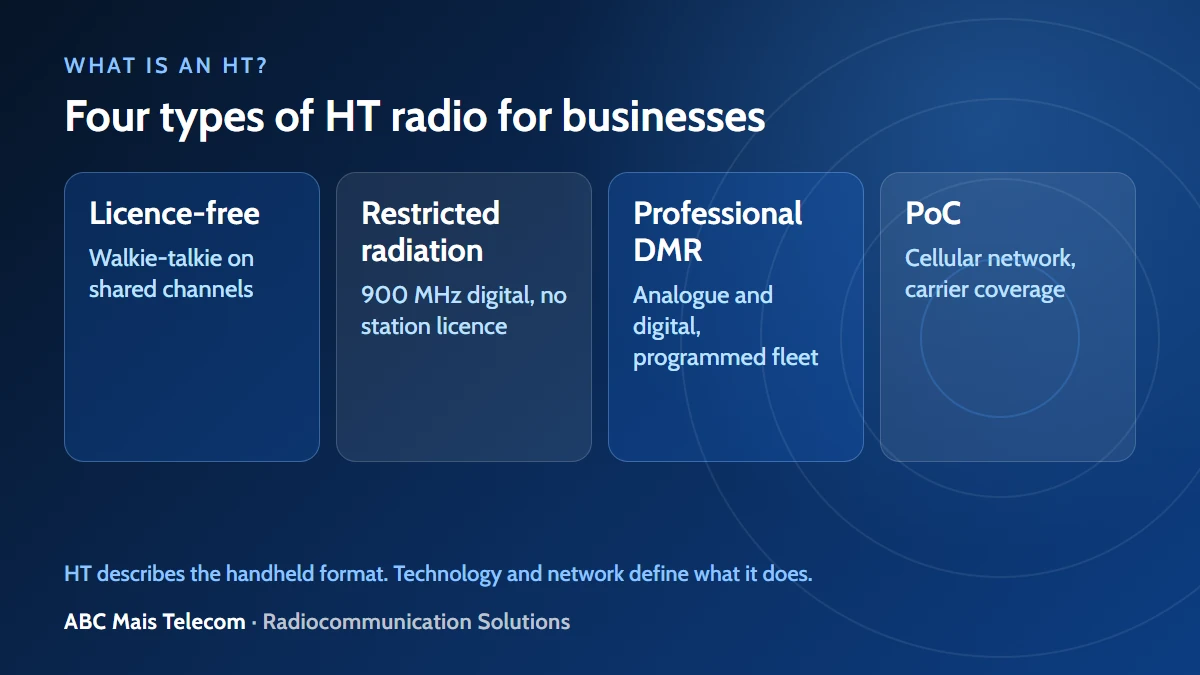
The four types of HT for businesses
Very different technologies share the same handheld format. For businesses, four groups cover almost every situation:
| HT type | Examples | How it communicates | When it makes sense |
|---|---|---|---|
| Licence-exempt (walkie-talkie) | Motorola Talkabout | Radio to radio, on general-use channels shared with the public | Small teams, occasional use, open areas |
| 900 MHz digital | Motorola DTR720 | Digital radio-to-radio communication in a restricted-radiation band | Retail, hospitality, offices, medium-sized buildings |
| Professional analogue and DMR | MOTOTRBO (DEP, DGP, R), Hytera BD, PD and HP | Radio to radio or through a repeater, on UHF or VHF, with programmed channels and groups | Security, industry, logistics, large events |
| PoC (mobile network) | Motorola TLK 25 | Through the operator’s data network (4G/LTE) | Teams spread across cities and regions |
Professional HTs are the most common business radios because they allow channel and group programming, work accessories and, with digital DMR, two time slots per channel. PoC replaces radio-to-radio communication with mobile internet: it reaches anywhere with data coverage, but stops where mobile coverage stops. The guide to PoC two-way radios explains when this is worthwhile.
Analogue or digital (DMR) HT radio
The most common professional digital HT radio uses the DMR (Digital Mobile Radio) standard, defined by ETSI, the European Telecommunications Standards Institute. In conventional DMR, each 12,5 kHz channel is divided into two time slots (TDMA): in practice, two simultaneous conversations in the space of one. Motorola Solutions’ MOTOTRBO family and Hytera’s BD, PD and HP ranges use DMR.
| Criterion | Analogue HT | Digital DMR HT |
|---|---|---|
| Audio | Becomes noisier as the signal weakens | Stays clear until near the coverage limit, then cuts out |
| Channel capacity | One conversation per channel | Two conversations per 12,5 kHz channel |
| Call types | Everyone on the channel listens | Group, individual and emergency calls |
| Data | Limited | Text messages, caller identification and, on some models, location |
| Existing fleet | Communicates with existing analogue radios | Many models operate in both modes, allowing gradual migration |
Two points need care. First, digital does not create range where no signal reaches: it improves quality within coverage. Second, although DMR is a standard, manufacturers’ extra features and encryption may not work across different brands. If the company will mix Motorola and Hytera, test interoperability first; the Motorola or Hytera comparison helps with that decision.
UHF or VHF: the right band for the environment
The frequency band determines how the signal behaves in the environment. Professional HT specifications generally list VHF around 136 to 174 MHz and UHF around 403 to 470 MHz (some UHF versions extend to 527 MHz).
- UHF usually performs better in environments with many walls: buildings, shopping centres, hospitals, warehouses and basements.
- VHF tends to perform better in open and vegetated areas: farms, highways, parks and rural areas.
- 900 MHz is the band used by restricted-radiation digital HTs such as the DTR720, designed for buildings and shops.
Radios on different bands cannot communicate with each other. Before buying more units, check the band of the existing fleet. The full selection guide is UHF or VHF: which band to choose.
Motorola and Hytera HT radios: families and examples
Motorola Solutions and Hytera are the two brands sold by ABC Mais Telecom. Rather than listing dozens of codes, it helps to understand the families. Model and band availability changes over time, so confirm it when requesting a quote.
| Family | Profile | Typical applications |
|---|---|---|
| Motorola DTR720 | 900 MHz digital, without a repeater | Shops, hotels, offices, restaurants |
| MOTOTRBO DEP 450 and R2 | Entry-level professional, analogue with a path to digital | Gatehouses, condominiums, security, maintenance |
| MOTOTRBO R7 and DEP 500e | Mid-range DMR, with more audio and data features | Industry, logistics, large-scale events |
| MOTOTRBO DGP 8000e/5000e | High-end, IP68, Wi-Fi, Bluetooth and a lone-worker option | Critical operations, noisy environments, security |
| Hytera BD series | Entry-level DMR, value for money | Retail, hospitality, support teams |
| Hytera PD and HP series | Professional DMR; HP is the new generation of the H series | Industry, energy, transport, security |
Both brands offer intrinsically safe versions with specific certification for areas with explosion risks, such as oil and gas facilities. In this case, selection starts with the area classification rather than the model.
Motorola DEP 450 HT radio: what the specifications say
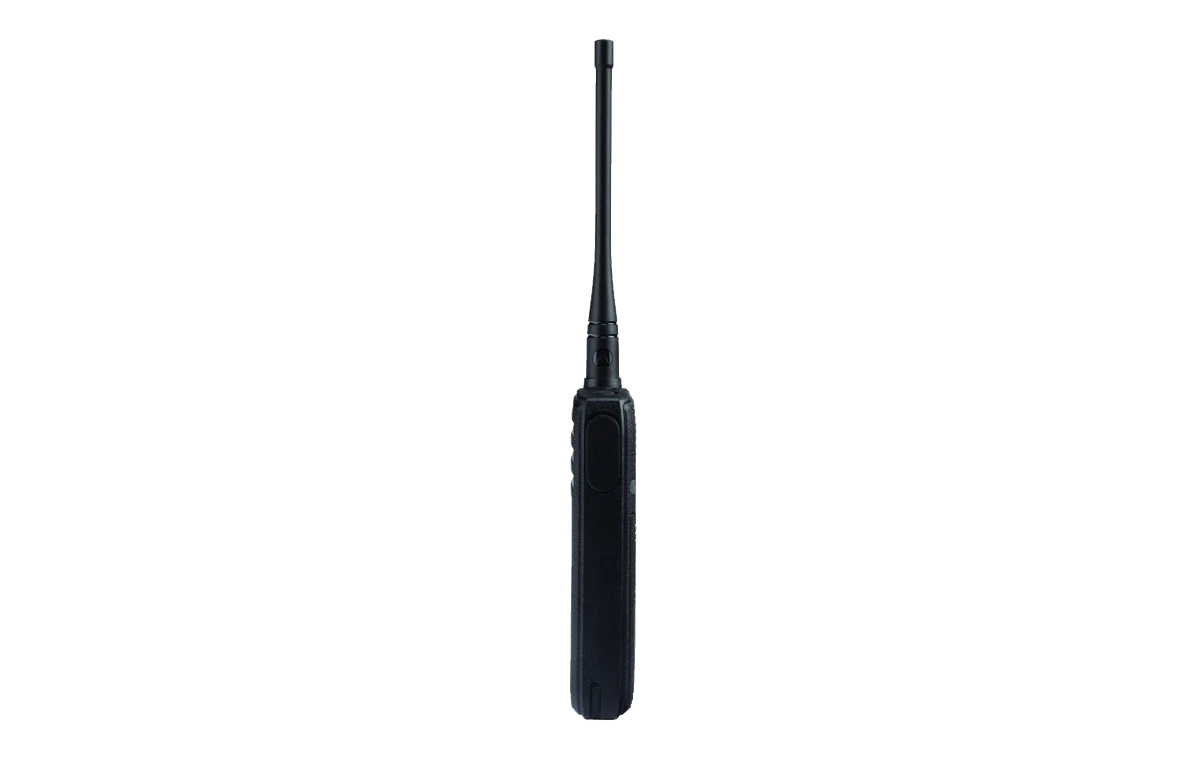
The DEP 450 is one of the professional HTs most frequently requested by businesses. According to Motorola Solutions’ specifications, it has 32 channels, IP54 protection, MIL-STD 810 testing, output power from 1 W to 5 W on VHF (up to 4 W on UHF) and analogue and digital operation. In digital mode, stated battery life is around 13,5 hours with the 1.600 mAh lithium-ion battery and 19 hours with the 2.250 mAh high-capacity battery. It is a good starting point for an analogue fleet moving to DMR without replacing everything at once. To compare the brand’s portable models side by side, see the Motorola HT radio comparison.
To see the available models, browse ABC’s two-way radio catalogue .
Battery and operating time: how long an HT lasts
The battery life shown in specifications is measured using a standard cycle, generally 5/5/90: 5% of the time transmitting, 5% receiving and 90% on standby. A security team talking throughout a shift departs considerably from this pattern. The specification therefore helps compare models rather than promise a number of operating hours.
- What reduces battery life: high power used continuously, frequent transmission, cold, an old battery, and active Bluetooth and location features.
- 12-hour shift: choose a high-capacity battery or plan one charged spare battery per radio.
- Large fleet: a multi-unit charger in the control room and battery rotation between shifts prevent a radio from going dead during a patrol.
- Original battery: a battery and charger from the same manufacturer help preserve radio service life and safety.
As a reference, Motorola states up to 27 hours for the DGP 8000e/5000e series in digital mode. Test a real shift before finalising the number of batteries.
Accessories that make a difference during a shift
The radio is only part of the equipment. When comparing HT radio quotes, check whether these items are included or charged separately:
- Battery: its capacity and whether spares are included for rotation.
- Charger: single-unit or multi-unit, with a power supply and Brazilian-standard plug.
- Antenna: matched to the radio’s band; the wrong antenna reduces range.
- Belt clip, holster or case: to keep the radio from falling every time the wearer crouches.
- Remote speaker microphone (shoulder PTT): for people who wear the radio on a vest, such as security guards.
- Acoustic-tube earpiece: for discreet communication in hotels, events and reception areas.
- Hearing-protection headset: for noisy environments such as factories and construction sites.
- Programming: channels, groups and radio names configured for your operation.
Accessories from one brand rarely fit another, and sometimes do not even fit another range from the same brand. Request compatibility confirmation using the part number.
How to choose the right HT for your business
- Environment. Open areas, buildings, warehouses, basements, cold rooms. This determines the band and whether a repeater will be needed.
- Tested coverage. Test the radio at the operation’s most distant and most enclosed points. The guide to coverage testing for 1 km or 5 km shows how.
- Shift. Daily operating hours and transmission frequency determine the battery and charger.
- Groups. Gatehouse, maintenance and cleaning teams on separate channels need programmable radios; DMR’s two time slots help.
- Durability. Rain, dust and drops call for an appropriate IP rating (IP54, IP67 or IP68) and military-standard testing.
- Existing fleet. The same band, the same mode (analogue or digital) and matching programming, otherwise the radios cannot communicate.
- Accessories. Decide in advance who needs an earpiece, shoulder microphone or headset.
- Purchase or rental. Continuous use favours buying; events, construction and seasonal peaks favour two-way radio rental.
Licensing, certification and rental
Every radio sold in Brazil must be certified by Anatel; check the seal and code on its label. Operating rules vary by radio type and band and are explained in the guide does a two-way radio need an Anatel licence?. With ABC Mais Telecom rental, the radios arrive programmed, with use of Anatel-licensed frequencies already included.
Use cases by sector
Common business scenarios, what usually solves them and what to measure after deployment:
| Sector | Problem | HT solution | What to measure |
|---|---|---|---|
| Property security and condominiums | Patrols losing contact with the control room in garages and common areas | UHF HT with shoulder microphone, emergency button and a base radio at the gatehouse | Patrol dead spots and call response time |
| Events | Congested mobile networks in large crowds; teams talking over each other | Rented HTs with groups for each team (access, stage, cleaning, medical) and acoustic-tube earpieces | Missed calls, busy channels and radios running out of battery at the end of the day |
| Industry and maintenance | High noise levels and teams in distant parts of the plant | Rugged DMR HT, hearing-protection headset and group calls by area | Time between a call and the technician’s arrival |
| Logistics and distribution centres | Docks, stock and dispatch lacking coordination during shifts | HTs with batteries for the full shift, a multi-unit charger and one channel per area | Dock time and rework caused by communication errors |
| Hospitality and retail | Reception, housekeeping and maintenance talking in front of guests | Compact HT or DTR with a discreet earpiece | Room turnaround time and response time to requests |
Common purchasing mistakes
- Choosing by the range printed on the box. The number is measured under ideal conditions. Buildings, warehouses and basements substantially reduce actual range.
- Assuming digital increases range. DMR improves audio and channel capacity, but does not bring a signal to places it cannot reach.
- Buying a different band from the fleet. A VHF HT cannot communicate with a UHF HT, even from the same brand.
- Forgetting the spare battery. On a long shift, the radio stops before the team does.
- Confusing privacy codes with confidentiality. On licence-exempt radios, the code only filters what you hear; other people can occupy and listen to the channel.
- Buying an imported HT without certification. Low-cost generic radios, including some Baofeng models, may operate outside permitted bands and cause interference. Check certification first.
- Ignoring programming. A radio without defined groups becomes a single congested channel.
Checklist before requesting a quote
- Number of radios per shift, plus spares.
- Main environment: building, warehouse, open area, basement or mixed.
- Longest distance between two operating points.
- Shift length and spare battery use.
- Required talkgroups (e.g. gatehouse, maintenance, cleaning).
- If there is an existing fleet: brand, band, analogue or digital mode.
- Whether a repeater or base radio already exists.
- Accessories by role: earpiece, shoulder microphone, headset, case.
- Term: purchase, event rental or long-term rental.
Quick HT radio glossary
| Term | What it means |
|---|---|
| PTT | Press-to-talk button (push-to-talk) |
| Channel | Frequency or configuration used by the group to communicate |
| Group | A set of radios that can hear each other, such as the gatehouse or maintenance team |
| Repeater | Fixed equipment that receives and retransmits the signal to extend coverage |
| DMR | ETSI digital standard used by Motorola Solutions (MOTOTRBO), Hytera and others |
| TDMA | Dividing a channel into time slots; in DMR, two per channel |
| IP54, IP67, IP68 | Protection ratings against dust and water |
| 5/5/90 cycle | Battery measurement standard: 5% transmitting, 5% receiving, 90% standby |
| Restricted radiation | Bands usable without a station licence, subject to Anatel technical conditions |
Frequently asked questions about HT radios
What does HT mean in radio?
HT comes from Handie-Talkie, the name Motorola gave its first handheld two-way radio in the 1940s. Today it means any portable two-way radio. Many also interpret it as hand-held transceiver.
Are an HT radio and a walkie-talkie the same thing?
In everyday usage, yes: both names refer to a portable radio. In practice, “walkie-talkie” usually means licence-exempt models sold in pairs, and “HT radio” means programmable professional models.
What is the range of an HT radio?
There is no single figure. Range depends on band, power, antenna, terrain and buildings. In buildings and warehouses it falls considerably compared with open areas. Testing on site is the reliable way to find out; a repeater is used to extend it.
How long does an HT radio battery last?
It depends on the model, battery and usage. Professional HT specifications state around 13 to 27 hours on the standard 5/5/90 cycle. Actual battery life is shorter on shifts with frequent conversations; plan a spare battery.
Can a digital HT radio communicate with an analogue radio?
Yes, if the digital radio has analogue mode and is programmed to the same channel and band. Many DMR HTs support both modes, allowing a gradual fleet migration.
Does an HT radio work without internet?
Yes. Conventional HTs communicate directly with each other or through a repeater, without internet or mobile coverage. Only PoC radios depend on the operator’s data network.
Does Intelbras make HT radios?
Yes. Intelbras has a range of professional portable radios as well as licence-exempt models. Comparisons with Motorola and Hytera should use the same criteria: band, mode, battery, durability, accessories and technical support.
Can HT radios be rented?
Yes. For events, construction and demand peaks, rental avoids buying and includes programmed radios and accessories. ABC Mais Telecom rental includes use of Anatel-licensed frequencies.
Sources consulted
- Motorola Solutions: history of the SCR-536 Handie-Talkie radio.
- IEEE Spectrum: the SCR-536 Handie-Talkie and SCR-300 walkie-talkie.
- Wikipedia (English): Walkie-talkie, origin of the HT abbreviation.
- DMR Association: ETSI DMR standards and two-slot TDMA in 12,5 kHz.
- Motorola Solutions: MOTOTRBO DEP 450 specification sheet (PDF).
- Motorola Solutions: MOTOTRBO DGP 8000e/5000e series.
- Motorola Solutions: MOTOTRBO digital radio system.
- Hytera Europe: DMR portable radio range.
- Land Mobile: launch of the entry-level DMR Hytera BD series.
- Business Wire: Hytera announces the H series of DMR radios (HP6 and HP7).
- Intelbras: professional two-way radios.
- Anatel: product certification and approval, frequently asked questions.
- Anatel, Resolution no. 680/2017: restricted-radiation equipment.
Need help choosing the right HT radio? ABC Mais Telecom, an authorised Motorola Solutions reseller and a Hytera channel for over 10 years, sells and rents HT radios for businesses, checks accessory compatibility by each part number and has its own technical support facility in São Bernardo do Campo (SP).