

DEP450 or Motorola R2: comparison for businesses
MOTOTRBO comparison
DEP450 or Motorola R2: both are handhelds without displays, supporting analog and digital DMR. The R2 is a newer generation with 64 channels, more powerful audio and IP55 protection; the DEP450 remains familiar in many fleets.
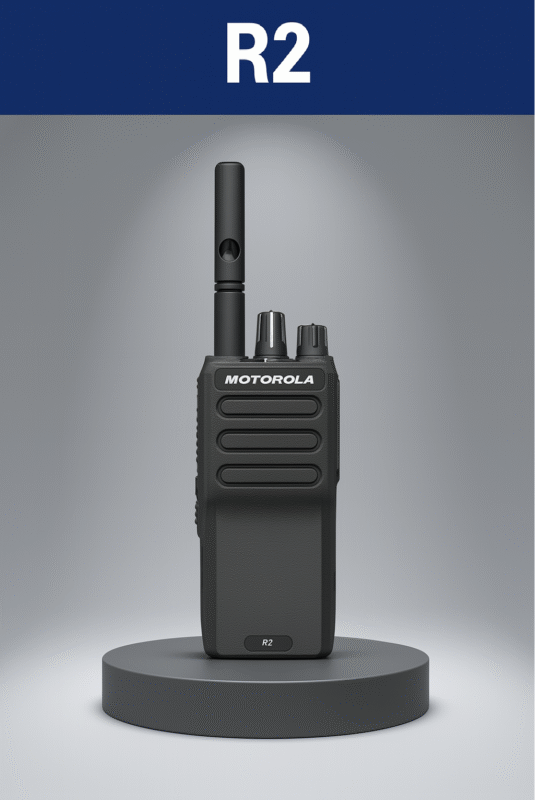
DEP450 or Motorola R2: where to start?
The DEP450 built a substantial installed base by offering simple operation and analog/digital modes. The R2 retains the screenless frontline radio approach, expanding audio, channel, protection and software security features.
Migration should not be decided by specifications alone. Frequency, repeaters, accessories, programming, batteries and procedures influence costs. In a large fleet, coexistence and gradual replacement may make more sense than an immediate change.
Technical comparison beyond a single number
| Item | DEP450 | Motorola R2 |
|---|---|---|
| Technology | Analog and digital DMR. | Analog and digital DMR. |
| Channels | 16. | 64. |
| Protection | IP54. | IP55. |
| Rated audio | 0.5 W. | 1 W, stated maximum of 3 W. |
| Battery life with the largest cited battery | Up to 18.5 h in digital with 2,200 mAh. | Up to 26.5 h in digital with 2,300 mAh. |
| Current features | Essential MOTOTRBO functions. | SINC+, audio leveling and additional security features. |
Battery life follows test cycles and specific batteries. Operational gains need comparison with the transmission profile, noise and accessory availability for the selected kit.
When to keep, migrate or combine a transition
The fleet meets requirements, accessories are available and no new requirement justifies replacement.
More channels, audio, battery life or protection address a documented need.
Test interoperability on the network and replace in stages, preserving operations.
If coverage is the problem, a repeater or architecture may matter more than the handheld.
The R2 includes a rental timer among its documented features, useful for temporary fleets. The DEP450 installed base may favor continuity when a company has established chargers, batteries and procedures.
How to validate the choice in the environment
- Confirm the current fleet's band and programming.
- Compare audio in actual noise, not just in an office.
- Test critical coverage points and movement.
- Use the accessories that will be part of daily work.
- Simulate a shift to observe battery life and ergonomics.
- Calculate parts, programming, support and the kit's working life.
Technical comparisons gain value when they end in testing with defined criteria. The consultant and client team then observe the same result.
Also record feedback from different users. Someone working with gloves may experience PTT differently; staff near machinery assess audio; leaders observe groups and priority. A decision based on several roles reduces the risk of selecting a radio that feels comfortable in a demonstration but is unsuitable for a full shift.
Frequently asked questions
Does the R2 automatically replace the DEP450?
No. It is a newer option, but migration depends on compatibility, need and total cost.
Are the accessories the same?
Some items may be compatible and others not. Always confirm the approved part numbers for each model.
Which has more channels?
The R2 has 64 channels; the DEP450, 16.
Which is better in noisy environments?
The R2 has higher audio processing and power specifications. Still, test it with actual accessories and noise.
DEP450 or R2: a decision guide
To choose between DEP450 or R2, start with fleet compatibility and the problems that need resolving.
- ✓ Compare DEP450 or R2 with the existing programming.
- ✓ Test DEP450 or R2 in actual noise and obstacles.
- ✓ Check accessories and batteries before deciding between DEP450 or R2.
A proposal for DEP450 or R2 is more precise when quantity, channels, shifts and integration are specified.
Sources and references
Want to compare your DEP450 fleet with the Motorola R2?
Send the band, quantity, accessories and critical points. The team helps plan testing, continuity or gradual migration.
