
Maintenance shutdown: how to plan radio communication for a scheduled outage
Two-way radio rental · industry
A maintenance shutdown compresses months of work into a few days: dozens of contractors, 12-hour shifts, equipment releases and high-risk tasks happening at the same time. Radio communication needs to scale accordingly, keeping work-front discussions separate from operations and preventing emergencies from competing for channel access.
Updated on · ABC Mais Telecom technical team, Motorola Solutions and Hytera two-way radio sales and rental specialists.
What is a maintenance shutdown?
It is a planned stoppage of a plant, unit or line to carry out maintenance, mandatory inspections, equipment replacements and improvements that cannot be performed while the process is running. It is also known as a planned shutdown, general shutdown or turnaround.
Scale distinguishes a shutdown from routine maintenance. The team that normally looks after the plant must coordinate hundreds of people from several companies, on an hourly schedule with a high cost for each extra day of downtime. Any delay in exchanging information becomes a delay on the critical path.
Why communication is critical during a planned shutdown
- Many new people: contractors who do not know the plant or its area names.
- Sequential clearances: work only starts after operations clearance, isolation and the permit to work.
- Simultaneous high-risk tasks: confined spaces, work at height, lifting and hot work in the same area.
- Round-the-clock shifts: shift handovers need to communicate outstanding work.
- A difficult environment: noise, metal structures, basements and equipment interiors affect the signal.
- Not enough plant radios: the existing fleet is sized for normal operations, not the shutdown peak.
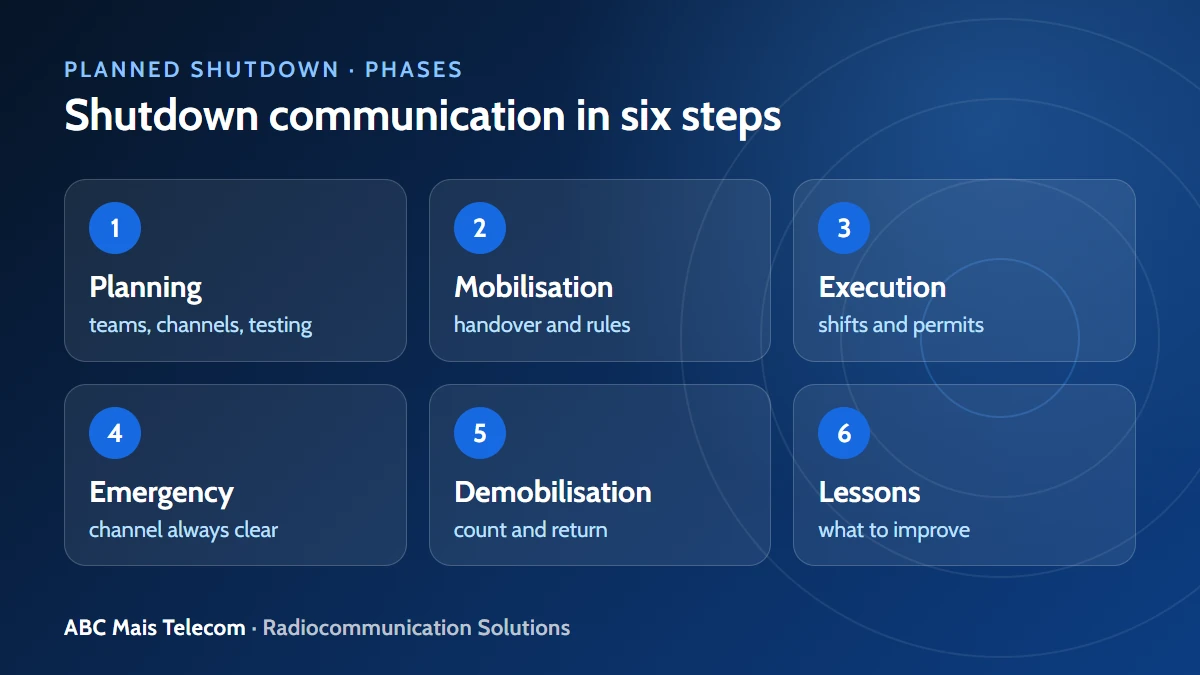
Maintenance shutdown planning: 8 steps for communication
- List the work fronts and teams. Every work front has a leader, and every leader needs a radio. Include planning, stores and internal transport.
- Define the hierarchy. Who coordinates the shutdown, who issues operations clearances, who is responsible for safety and who represents each contractor.
- Create the channel map. Dedicated channels for coordination, operations, safety and emergencies; work fronts grouped by area; a dedicated lifting channel.
- Standardize call signs. Use role and area names: “Coordination”, “Operations U-200”, “Boiler Crew”, “Lifting 1”. No nicknames.
- Test coverage beforehand. Make calls from inside vessels, galleries, pipe racks, substations and tower tops. Plan a repeater where communication fails.
- Prepare the radio station. Multi-unit chargers, numbered batteries, spare radios and someone responsible for issue and sign-out records.
- Give a radio briefing. During contractor induction, spend five minutes on the rules: each person’s channel, how to call and what counts as an emergency.
- Plan demobilization. Count numbered units, record outstanding items and report failures to improve the next shutdown.
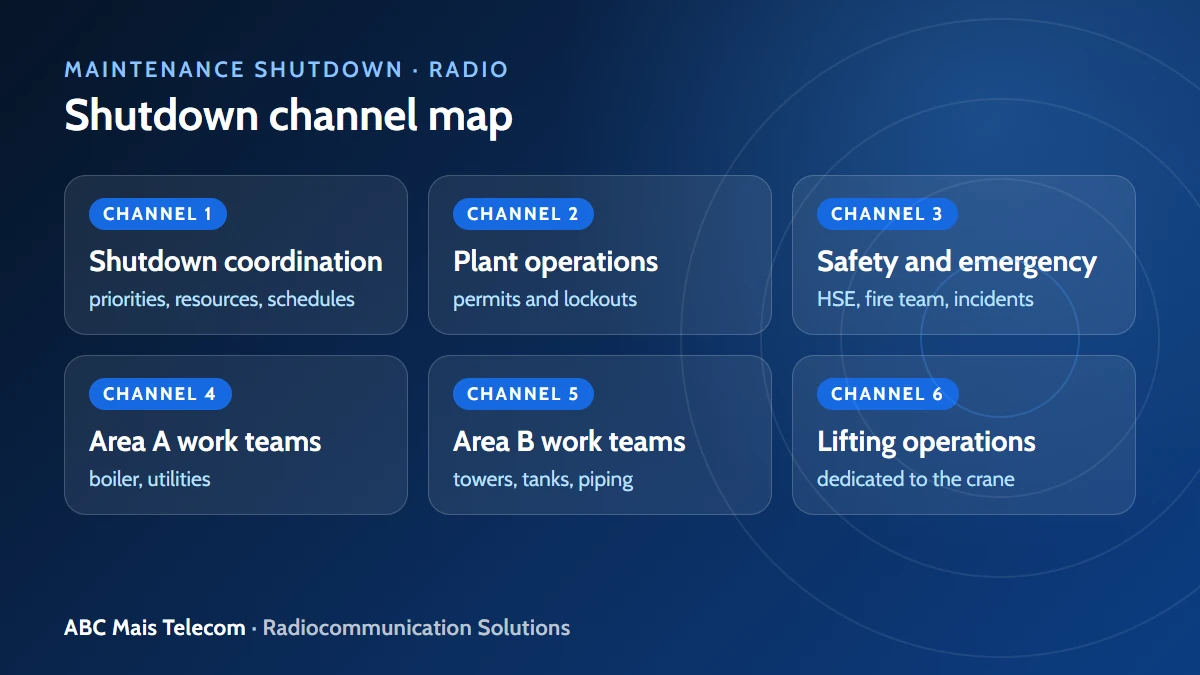
Channels by work front: who speaks on each channel
| Channel | Users | Main rule |
|---|---|---|
| Coordination | Shutdown coordinator, planning team, area leaders | Priorities and resources; no detailed execution discussions |
| Plant operations | Operators and people requesting clearances | Always confirm clearances and isolations by reading them back |
| Safety and emergency | Safety technicians, emergency response team, coordination | Keep the channel clear; incidents have absolute priority |
| Work fronts by area | Contractor leaders and supervisors | One channel for each area with multiple work fronts |
| Lifting | Crane operator, signaler, rigger | Dedicated during the maneuver; nobody else transmits |
| Support | Stores, internal transport, meals | Clear requests without occupying execution channels |
If the plant already uses radios in its operations, assess beforehand whether the temporary radios will communicate with its own fleet. This depends on technology, programming and authorization to use the plant’s frequencies. During many shutdowns, the clearest arrangement is to keep operations on the plant fleet and give coordination a radio with both channels.
Confined spaces, work at height, lifting and hazardous areas
High-risk tasks have their own rules, defined by Brazilian regulatory standards and company procedures. Radio supports those rules and never replaces them.
- Confined spaces: NR-33 assigns the attendant responsibility for communicating with people inside. Test the radio from inside the equipment before each entry and define what to do if communication fails.
- Work at height: under NR-35, the rescue plan depends on a quick response; people working at height need hands-free operation, with an earpiece and lapel microphone.
- Lifting: a dedicated channel, continuous communication during the maneuver and an immediate stop if the signal fails.
- Electrical work: confirm NR-10 clearances and isolations by reading them back, using the equipment’s full name.
- Hazardous areas: only radios certified for explosive atmospheres and compatible with the area’s classification may enter. Keep ordinary radios outside.
Work clearance with confirmation
Operations channel: the work front requests clearance and operations grants it.
- Boiler Crew
Operations U-200, Boiler Crew. Requesting clearance for pump B-12 to replace the seal.
Why it works: it identifies the requester, the recipient and the equipment in full. - Operations U-200
Boiler Crew, Operations. Pump B-12 locked out and tagged. Cleared for permit PT 3471.
Why it works: it states the isolation and links it to the permit to work. - Boiler Crew
Understood: B-12 cleared, permit PT 3471. Starting work.
Why it works: it repeats the critical information to avoid errors.
Contractor induction: a 5-minute radio briefing
Reserve five minutes for radio use during the safety induction. People arriving for the shutdown receive a radio already set to their area’s channel and need to leave knowing how to call, what to say and what never to do. The phrases below can be printed on the back of an ID badge or displayed at the radio station.
- Make a call
“Coordination, Tank Crew.” (wait for the reply)
First name whom you are calling, then identify yourself. - Request clearance
“Operations, Tank Crew. Requesting clearance for tank T-04 under permit PT 3502.”
State the equipment and permit in full. - Report completion
“Coordination, Tank Crew. Work on T-04 complete, area clear.”
This closes the task and releases the resource. - Request materials
“Support, Tank Crew. I need two hoists in area B, gate 3.”
Make the request on the support channel, not the operations channel. - Emergency
“Emergency, emergency, emergency. Tank Crew, area B, injured person.”
Everyone stops transmitting.
Also reinforce three simple prohibitions: do not change channels without authorization, do not lend the radio to another contractor and do not leave it charging away from the radio station.
Temporary radios for the shutdown
Because a shutdown creates a peak in demand, two-way radio rental often makes more sense than buying radios that will sit unused until the next shutdown. A request is more precise when it includes the number of work fronts, shifts, areas with difficult coverage, the need for radios certified for hazardous areas, and mobilization and demobilization dates.
ABC Mais Telecom rentals include use of Anatel-licensed frequencies, with radios programmed by channel and team. For plants in the Campinas and Paulínia region, see radio rental in Campinas. For large areas, also assess radio repeater rental. Distribution by contractor is easier with an agreement and radio sign-out records for each shift.
Mistakes that cost hours during a shutdown
- A single channel for everyone: operations clearances get lost among requests for materials.
- Radios with no assigned user: units passed from person to person without records disappear by the second week.
- No battery plan: a 12-hour shift requires scheduled swaps and charged batteries at the radio station.
- Assumed coverage: a radio that works in the yard may not work inside a vessel or gallery.
Frequently asked questions about maintenance shutdown communication
When should radio planning for a maintenance shutdown begin?
Alongside shutdown planning, when work fronts and contractors are defined. This allows time to test coverage, plan a repeater and organize the charging station.
Can I use an ordinary radio in a hazardous area?
No. Only equipment with Ex certification compatible with the area’s classification may enter an explosive atmosphere. Include this requirement in the rental request so availability can be assessed.
Can the rented radios communicate with the plant’s radios?
That depends on technology, programming and authorization to use the plant’s frequencies. Assess this beforehand; coordination often receives a radio with access to both channels.
How many channels should a planned shutdown use?
Enough to separate coordination, operations, safety, work fronts by area and lifting. Too many channels also create problems: every leader must know exactly where to listen.
Is an Anatel license needed for the temporary radios?
ABC Mais Telecom rentals include use of Anatel-licensed frequencies. The hiring company does not need to obtain its own license to use the rented radios.
How can I prevent the night shift from being left without radios?
Keep the charging station running 24 hours, with numbered batteries, spare radios and sign-out records for each shift. Shift handover includes a radio count.
Sources consulted
Is your shutdown approaching? Based in São Paulo, ABC Mais Telecom rents two-way radios for events, construction sites, industry and security. Rentals include use of Anatel-licensed frequencies, radios programmed by team and the accessories agreed in the proposal.