
Corporate event: how to organize team communication on the day
Two-way radio rental · events
At a corporate event, attendees only notice the team’s communication when it fails: a speaker walks on without a microphone, the bus arrives before reception is ready, or the coffee break runs late because nobody notified the kitchen. This guide explains how to organize who talks to whom, on which channel and with which cues, from setup to teardown.
Updated on · ABC Mais Telecom technical team, Motorola Solutions and Hytera two-way radio sales and rental specialists.
Why corporate event communication needs a plan
Sales conventions, launches, training sessions, awards ceremonies and year-end parties share a challenge: many suppliers working at the same time to a timed schedule. Event management, sound and video technicians, reception, catering, security, the emergency response team, transport and the client’s own staff need to react within seconds.
Mobile messaging groups work well before the event to agree on details. On the day, however, they can cause delays: messages reach people who do not need them, replies get lost among photos, and coverage fluctuates in basements, kitchens and crowded convention centers. Radio handles communication that needs an immediate response, at the press of a button and without dialing.
Planning does not mean giving everyone a radio. It means deciding who needs to speak, who only needs to listen and who can be contacted through their team leader.
Who needs a radio at a corporate event
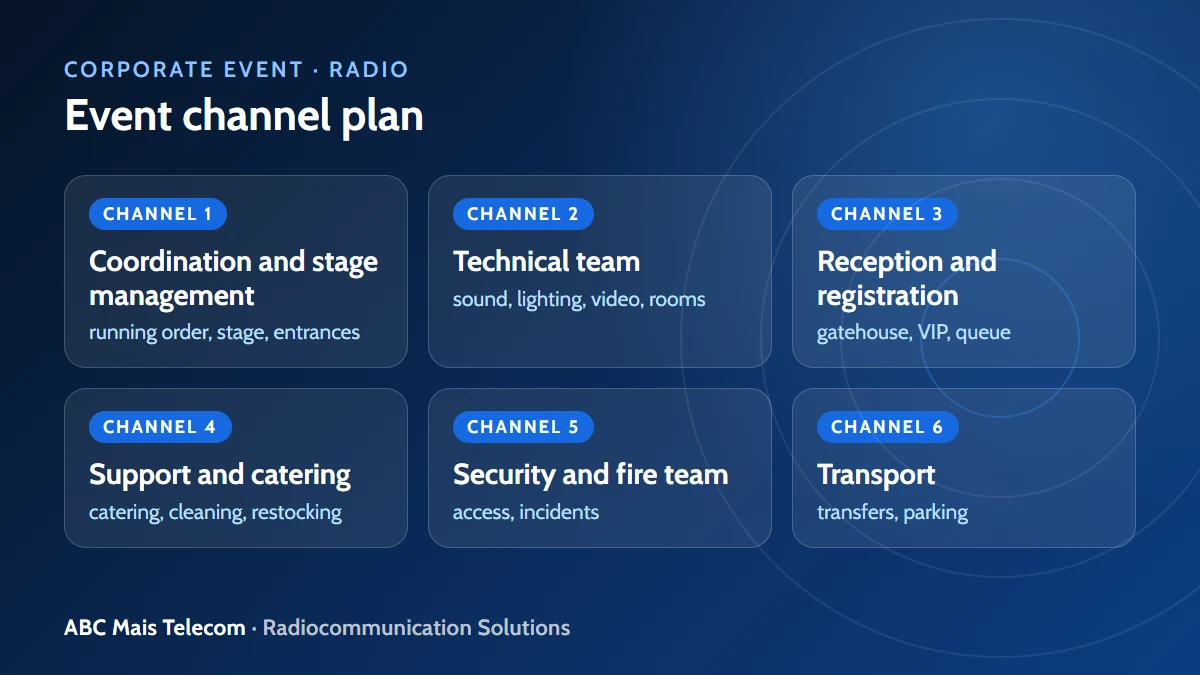
| Team | Role on the day | Suggested channel | Discreet earpiece? |
|---|---|---|---|
| Coordination and event management | Run of show, entrances, dignitaries, timing | Channel 1 | Yes, in the main room |
| Technical crew (sound, lighting, video) | Microphones, videos, streaming, rooms | Channel 2 | Yes |
| Reception and registration | Arrivals, VIPs, speakers, queues | Channel 3 | Yes |
| Catering and support | Coffee breaks, replenishment, cleaning | Channel 4 | Optional |
| Security and emergency response | Access control, incidents, first aid | Channel 5 | Yes |
| Transport | Transfers, parking, valet service | Channel 6 | Optional |
The overall coordinator usually monitors both their own channel and the security channel. At smaller events, the technical crew and event management may share a channel; at events with several rooms, each room has a person in charge identified by the room name rather than their personal name.
How to organize a corporate event: 10 steps for team communication
- Map the roles. List the teams, leaders and fixed posts. The number of radios follows the roles, not the number of guests.
- Decide who speaks and who listens. A person at the entrance may only need to listen; the reception leader needs to speak.
- Create the channel plan. One channel for each team working together; keep a separate security channel clear at all times.
- Use role-based call signs. “Event Management”, “Stage”, “Reception 2”, “Blue Room”. Personal names cause confusion at shift changes.
- Choose the accessories. A discreet earpiece for people in the main room during presentations; a lapel microphone for people carrying equipment.
- Write a run of show with cues. For each critical moment, define who gives the warning, who confirms it and which word triggers the action.
- Test on site. With the venue set up, make calls from every location: basement, kitchen, loading dock, rooms and parking areas.
- Organize batteries and the radio station. A charging station with someone in charge, numbered radios and scheduled swaps during breaks.
- Track radio issue and return. Keep a list of who collected each radio, its number and accessory, and require its return at the end of each shift.
- Finish with a short report. What failed, where coverage was missing and how many radios were left over: this improves the next event.
Run of show and cues: event management on the radio
On stage, advance notice makes the difference between a calm event and a tense one. The technical crew needs to know about the next entrance before it happens. That is why event management uses two words: standby, which prepares the team, and go, which triggers the action. The recipient confirms using their own role-based call sign.
Director’s entrance on stage
Channel 1, event management with stage and technical crew. Two minutes before the entrance.
- Event Management
Stage, Technical, Event Management. Standby for the director’s entrance in two minutes.
Why it works: who is calling, whom they are calling and when, in one sentence. - Stage
Event Management, Stage. Standby, understood. Director in the wings.
Why it works: it confirms the message and states where the person is. - Technical
Event Management, Technical. Microphone 1 and opening video ready.
Why it works: it confirms the specific resource rather than just saying “OK”. - Event Management
Go video. (pause) Go entrance.
Why it works: the action happens only on the agreed cue word.
Also agree on how to communicate numbers, names and license plates. The phonetic alphabet helps spell a guest’s name or a vehicle’s license plate at the entrance without errors.
Types of corporate event and how communication changes
| Event type | Critical point | Radio communication focus |
|---|---|---|
| Sales convention | Many rooms operating simultaneously and attendees moving between them | One person in charge per room, called by the room name |
| Product launch | Stage schedule, press and VIP guests | Event management cues and a clearly separate reception channel |
| Training session or workshop | Breaks, coffee service and support rooms | Advance notice to catering and the technical crew before each break |
| Year-end party | Loud music, transfers and guest departures | Earpieces and speakers at the right volume; transport channel active until the end |
| Awards ceremony | Calling order and trophy presentation | List checked with the stage team and each name confirmed |
For events with accommodation, communication starts at check-in and ends with the last airport transfer. Include the transport channel in the plan from day one and decide who monitors it outside the scheduled program.
Common mistakes that undermine event communication
- Everyone on the same channel: catering hears the stage schedule and the stage crew hears requests for ice; nobody pays attention when it matters.
- An untested radio: a radio handed out without a test call becomes the silent unit discovered when the doors open.
- Personal names as call signs: at shift change, nobody knows who “Carla” is now.
- Long transmissions: lengthy explanations occupy the channel; radio is for action, and the meeting can happen later.
- No spares: a faulty radio at opening time leaves an entire team without communication.
On-site testing: where coverage often fails
Hotels and convention centers contain concrete, industrial kitchens, basements and mezzanines. A radio that works perfectly in the main room may lose communication at the loading dock or parking area. Test with the venue set up because metal structures, screens and temporary walls change radio propagation.
- Test route: leave the main room and call from each critical location: kitchen, loading dock, basement, rooms, dressing room and parking area.
- Test in both directions: the person in the basement needs to hear coordination and be heard by them.
- Audio in noisy conditions: repeat the test with the sound system on; adjust the volume and accessory.
- Plan B: if communication fails at a location, arrange for someone to relay messages or assess a repeater.
For a large area or a venue with many floors, a repeater may help. See when it makes sense in the guide to radio repeater rental and how to test distances in radio rental for 1 km or 5 km.
After the event: collect, count and record
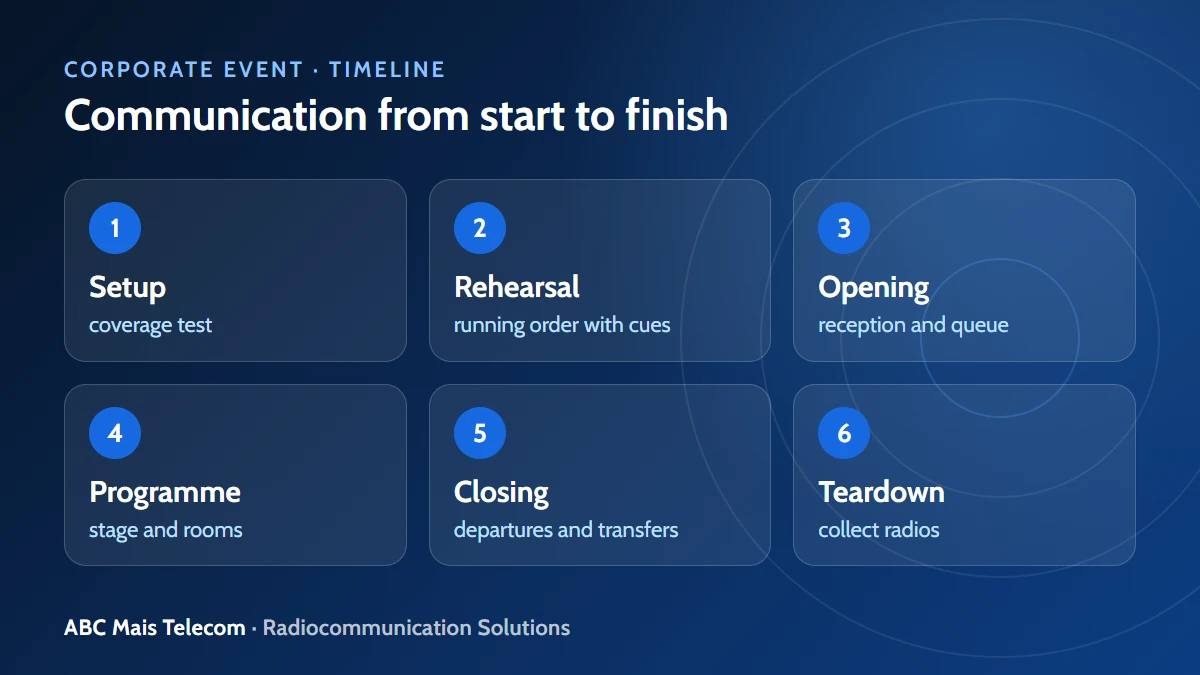
The end of the event is when radios are most often lost: the team leaves tired, suppliers dismantle their equipment and a charger stays plugged into a room outlet. Set a single return point, check each numbered unit and record outstanding items before releasing the teams. A short report of locations with poor coverage and congested channels helps the next corporate event.
ABC Mais Telecom offers two-way radio rental for events with radios programmed by team, accessories specified in the proposal and use of Anatel-licensed frequencies included. For hotel receptions and room-based events, professional walkie-talkie rental can also serve smaller teams.
Frequently asked questions about corporate event communication
How many radios does a corporate event need?
It depends on the roles, not the number of guests. Add up each team’s leaders, fixed posts that need to speak and spare units for failures. A medium-sized event typically has between five and eight teams using radios.
Is radio or a messaging group better?
Both. The group is useful for advance arrangements and sharing documents. On the day, radio handles anything requiring an immediate response, without dialing or relying on mobile coverage.
Will the radios interrupt the presentation?
No, provided the team in the main room uses discreet earpieces at low volume. Speaker audio is for the loading dock, kitchen and parking areas.
Do radios work in a hotel with a basement?
Often yes, but testing with the venue set up is essential. If communication fails at a location, assess a repeater or a relay point.
Is an Anatel license needed to use radios at the event?
ABC Mais Telecom rentals include use of Anatel-licensed frequencies. The hiring company does not need to obtain a license to use the rented radios.
Who should be responsible for the radios on the day?
One member of the production team manages the charging station, issue list and returns. They do not need to be a technician; they need to be organized and have the authority to require returns.
Sources consulted
Planning a corporate event? Based in São Paulo, ABC Mais Telecom rents two-way radios for events, construction sites, industry and security. Rentals include use of Anatel-licensed frequencies, radios programmed by team and the accessories agreed in the proposal.
See event radio rentalRental team on WhatsAppWalkie-talkie rental