
QAP Code: meaning and examples of radio use
Quick operating guide
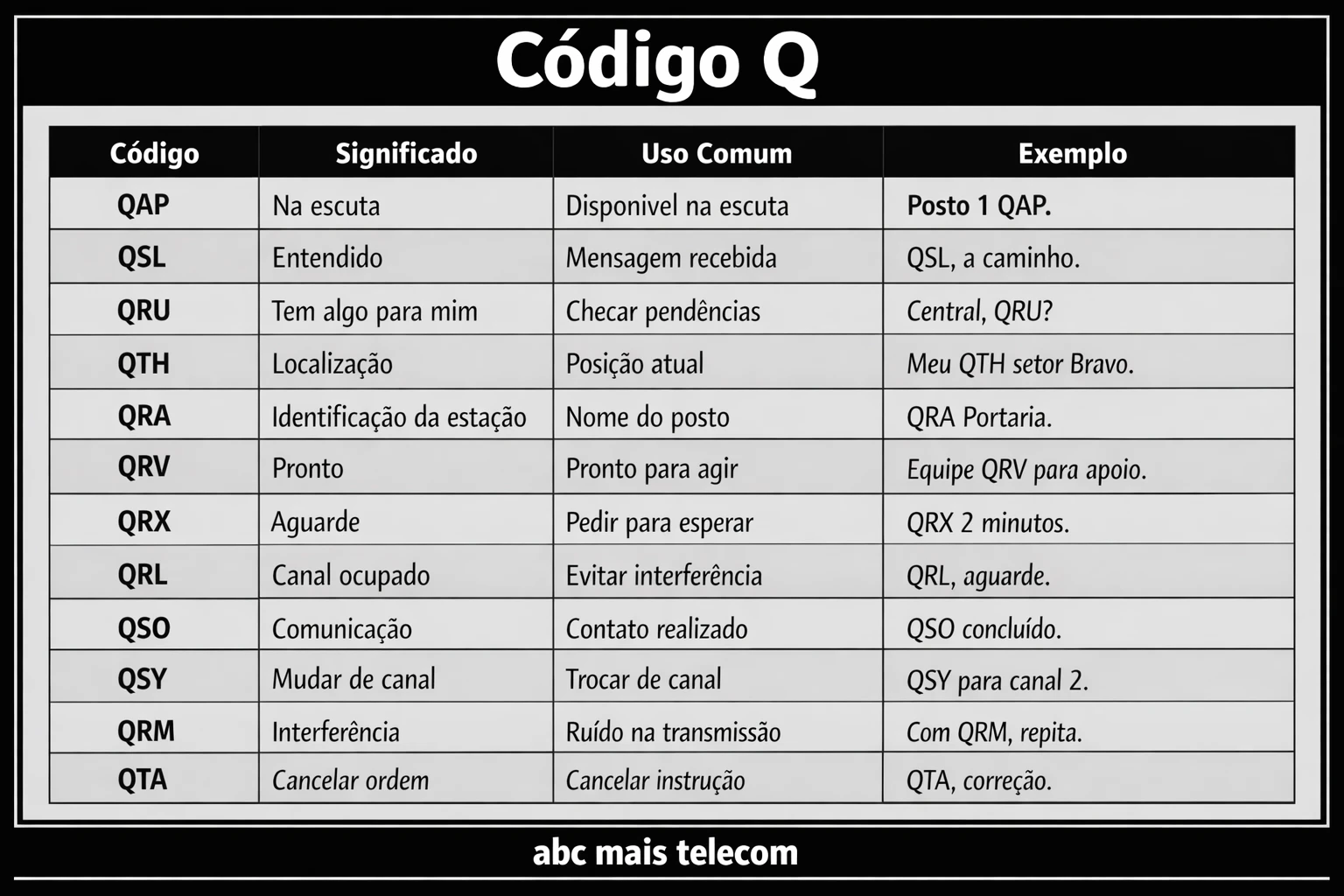
QAP Code is an expression widely used in Brazil to indicate that someone is "listening" or attentive to the radio. The operational meaning must be known by the entire team to avoid ambiguous responses.
What does QAP mean on the radio?
In many Brazilian operations, "I'm QAP" means "I'm listening," "I'm available on the channel" or "I'm remaining attentive." The expression appears in property security, events, logistics, maintenance and other voice communication routines.
The Q Code originated to abbreviate radiotelegraphy messages and has formal definitions tied to the service in which it is used. Popular QAP usage should not automatically be treated as a universal translation. If the team interacts with agencies, regulated services or external protocols, follow the applicable procedure.
Short examples with QAP
"Maintenance team, remain QAP on channel 2." Reply: "QSL, maintenance QAP."
"Patrol, are you QAP?" Reply: "Affirmative, QAP. Go ahead."
"South entrance, remain QAP until the gates open."
"Team released from the channel. QRT until further instructions."
There is no need to fill every sentence with codes. The aim is to save time without making the message unintelligible to someone who recently joined the team.
QAP, QRV and QSL are not the same response
| Code | Common operational use | Example |
|---|---|---|
| QAP | Listening, attentive to the radio. | "Remain QAP." |
| QRV | Ready or available for action. | "Team QRV to start." |
| QSL | Received or understood. | "QSL, movement authorized." |
Someone may be QAP but not yet QRV. Likewise, hearing a call does not prove an instruction was understood; QSL should therefore include confirmation when the message is critical.
For details of each response, with ready-to-use phrases, consult the guides to QRV: radio meaning (ready and available) and QRX: how to ask someone to wait over the radio.
How to incorporate QAP into company procedures
- Define the meaning of internally used codes in writing.
- Limit the list to what is actually used in daily work.
- Train identification, calling, messaging and confirmation.
- Avoid personal data or sensitive information on open channels.
- Use plain language when there is a risk of misinterpretation.
- Review channels, coverage and equipment alongside the procedure.
To see a complete conversation, visit the interactive Q Code simulator from ABC Mais Telecom. It shows gatehouse, logistics and event scenarios, with accessible transcripts.
Private security teams can start with the Q-code guide for security guards, with a pocket PDF card, to build the post's procedure.
Training should also explain when to abandon abbreviations. Visitor names, vehicle plates, quantities, times and safety instructions deserve repetition in ordinary language. Practice with noise, shift changes and new users; observe where questions arise and adjust the procedure. Efficient communication uses the fewest words needed to arrive correctly and be confirmed, rather than the most codes.
Frequently asked questions
Does QAP mean "listening"?
That is the popular operational meaning in Brazil. Teams should document the meaning they adopt and follow applicable formal protocols.
Can I answer with QAP alone?
It can work in a trained routine, but important instructions deserve more explicit confirmation.
Are QAP and QSL the same?
No. QAP indicates availability or listening; QSL confirms receipt or understanding.
Does Q Code improve range?
No. It organizes messages. Coverage depends on the radio system and environment.
Sources and references
Does your team need more organized communication?
ABC Mais Telecom helps assess equipment, accessories, coverage and support for a B2B operation that is easier to use.
