
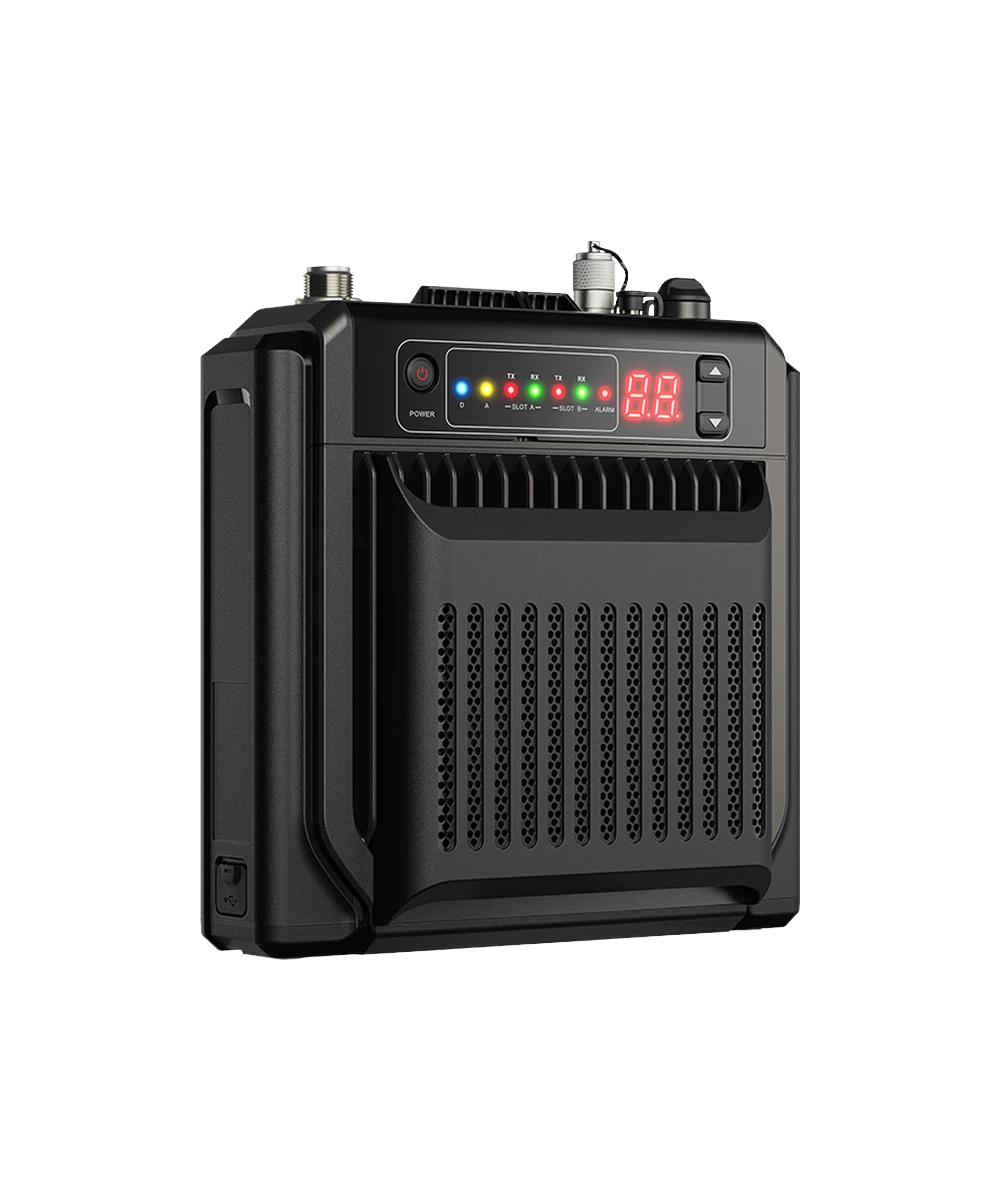
Intelbras REP25 Repeater
The Intelbras REP 25 is a DMR repeater for digital and analog communication projects. The VHF or UHF version and the necessary infrastructure are defined according to the scenario.
The manufacturer reports output power from 1 to 25 W, 1,024 channels, DMR and analog modes, 15 V power supply, and compact dimensions for infrastructure.
Digital activation: units manufactured from 08/06/2024 require key activation to operate in DMR, according to Intelbras. The proposal must confirm whether this activation is included. This is a license for the digital feature, not radiofrequency regularization.
1 to 25 W
Published RF output.
1,024 channels
Published capacity.
DMR and analog
Published modes.
2.0 kg
Published weight.

OVERVIEW
Meet the Intelbras REP 25 DMR repeater
The REP 25 can be evaluated when the operation needs to extend a digital or analog communication infrastructure according to the technical project.
- DMR and analog with 1,024 published channels
- VHF or UHF versions and RF output from 1 to 25 W
- Antenna, duplexer, and cables defined by the project
Operating modes
DMR and analog
Operation can be configured according to the infrastructure.
• 1.024 channels
• 1 to 25 W
• VHF or UHF
Infrastructure
Components defined in the scenario
RF and supplemental power supply must be sized.
• 15 V power
• MIL-STD-810G
• -30 °C to +60 °C
Intelbras REP 25: compact DMR repeater
The Intelbras REP 25 is a DMR repeater up to 25 W for projects that require evaluation of band, coverage, and infrastructure.
What the Intelbras REP 25 offers
The Intelbras REP 25 is a DMR digital repeater that also supports analog operation. The manufacturer publishes 1,024 channels and adjustable power from 1 to 25 W. There are VHF and UHF versions, so the band should not be chosen based solely on the model name. The version, the authorized frequency, and the radios that will participate in the system need to be compatible.
A repeater receives and retransmits the signal according to the system configuration. The presence of the equipment does not by itself define the range. Antenna, height, cables, duplexer, losses, obstacles, interference, and site topology directly affect the result. ABC Mais Telecom does not set coverage distance without a technical study.
Capacity, power, and operating modes
The 1,024 channels help organize different configurations, but the channel plan must respect the applicable authorization and the real operational need. The power from 1 to 25 W allows adaptation to the project, without meaning that the highest value is always the most suitable. Excessive power does not correct a poorly positioned antenna, inadequate cable, or interference.
Support for DMR and analog can be useful in gradual migrations. Digital operation allows structuring groups and features specific to the DMR system. Analog configuration can serve existing terminals during a planned transition. All radios must receive programming consistent with the repeater.
Dimensions and installation
The datasheet publishes dimensions of 201 x 211 x 80.6 mm and weight of 2.0 kg. The indicated power supply is 15 VDC. Installation must provide for ventilation, mounting, grounding, electrical protection, and access for maintenance. The antenna position and cable routing need to be defined before assembly.
Intelbras mentions resistance according to MIL-STD-810G tests. This data does not make the repeater portable equipment nor eliminate installation care. The protection of the set depends on the environment, the cabinet, the connectors, and all components used.
Programming cable and system components
The official page states that the programming cable, code 4160039, is sold separately. The PC 47 programming cable (code 4160039) is specified by the manufacturer for REP 25. Wall bracket, antenna, duplexer, cables and supplementary power supply are treated as project components, not generic included items.
Not every cable or duplexer is suitable for the REP 25. Each component must have a compatible band, connectors, power handling and losses. The proposal must state what is included and what depends on the customer’s infrastructure.
Data needed for sizing
Before the quote, inform city, band used, approximate area, building characteristics, number of users, and existing radio models. If there is a previous repeater, it is also useful to send photos of the installation, antenna height and type, cable lengths, and available programming.
With these data, ABC Mais Telecom can assess coverage studies, programming, installation and technical assistance. The objective is to size the solution according to the network into which REP 25 will be integrated.
Technical checklist for specifying the REP25
The specification of the REP25 begins with identifying the exact version. The page does not combine features from different versions. The published capacity is 1,024 channels and the RF output is 1 to 25 W. The project needs to relate these data to the authorized band, the number of groups, and the radios already in operation.
1. Confirm band and version before programming
For the REP25, the VHF or UHF version compatible with the radios and authorized frequencies must be confirmed. The frequency is not chosen solely by user preference. It must respect regulations, licensing when applicable, and compatibility with portables, mobiles, antenna, and duplexer. The complete unit code helps avoid configuration based on a different variant.
2. Measure the installation point
The REP25 site must be inspected before assembly. Available height, cable route, grounding, ventilation, maintenance access, and distance to the antenna influence the result. The equipment measures 201 x 211 x 80.6 mm and 2.0 kg. These measurements help check rack, wall, cabinet, and service space without improvisation.
3. Size antenna and duplexer
Antenna and duplexer are not universal accessories for the REP25. The band, transmit-receive separation, power, and losses must be compatible. The duplexer adjustment must be measured with appropriate instruments. A visually similar part may operate in another band and harm coverage, reception, or transmitter protection.
4. Calculate transmission line losses
Cable length and type, connectors, splices, and surge protection alter the power reaching the antenna. The published output of 1 to 25 W does not automatically equal radiated power. For the REP25, the project records these losses and checks the standing wave ratio before concluding that a coverage difficulty comes from the repeater.
5. Prepare power and contingency
The official power supply for the REP25 is 15 VDC. Power supply, circuit breakers, cables, and possible contingency battery must be sized for actual consumption and desired autonomy time. The existence of an electrical input does not prove that any power supply works. Polarity, voltage, current, and protection must be verified.
6. Plan programming and groups
The REP25 programming must be consistent with all radios in the system. Frequencies, channel width, color code, groups, lists, and analog or digital parameters are documented before changes. A validated backup reduces the risk of configuration loss. Changes are tested in a controlled manner because a repeater affects many users at once.
7. Validate network resources
For the REP25, DMR and analog operation configured according to system terminals should be considered. An Ethernet connector or a mention of IP does not guarantee ready interconnection. Version, licenses, topology, addressing, security, and network availability need to be confirmed. Conventional communication should also remain documented for diagnostics.
8. Commission with measurements
After installation, the REP25 undergoes verification of power, frequency, modulation, reception, alarms, and operation with real terminals. The radiating system is also measured. Voice tests are performed at representative points in the environment. The report should separate measured facts from estimates, avoiding turning a test condition into a general range promise.
9. Document preventive maintenance
The REP25 routine may include inspection of power supply, ventilation, connectors, grounding, cables, alarms, and programming parameters. Failure history and infrastructure changes help find root cause. When coverage changes, the investigation considers antenna and transmission line before concluding that the RF module needs replacement.
10. Respect the model’s life cycle
Version and availability remain subject to inquiry.
11. Separate proven components from generic items
Infrastructure components remain within the technical scope, but are specified by band, power and installation, not by appearance or image reuse.
12. Information for a responsible quote
To evaluate the REP25, send city, band, frequencies, number of users, existing radios, area, obstacles, installation point, and network needs. Photos of the infrastructure and programming backups also help. ABC Mais Telecom uses this data to guide study, implementation, programming, and specialized technical service without forcing a solution before diagnosis.
REP25 identification check
REP25 is the compact spelling of the Intelbras REP 25 model. When requesting support for the REP25, also photograph the unit’s complete label. Identification avoids confusing the REP25 with another repeater that has different power, band or firmware.
The VHF or UHF version of the REP25 must be confirmed before programming. The 1,024 channels of the REP25 organize configurations but do not change the physical band of the unit. The power of the REP25 is adjustable from 1 to 25 W according to the project.
When installing the REP25, record power supply, antenna, duplexer, cables, and grounding. If the REP25 experiences coverage loss, these components are measured along with the repeater. The programming cable 4160039 is documented by Intelbras for the REP25 and sold separately.
A backup of the REP25 should accompany the inventory of frequencies and groups. During maintenance, the REP25 is tested with compatible terminals. A responsible quote for the REP25 considers band, infrastructure, number of users, and area before indicating components.
Technical specifications
Technical data of the Intelbras REP 25 DMR repeater according to official manufacturer documentation.
DMR capacity depends on digital activation in units manufactured from 08/06/2024. See the official DMR license activation guide.
1 to 25 W
Published RF output.
1,024 channels
Published capacity.
15 V
Published power supply.
DMR and analog
Published modes.
Detailed data sheet
| Category | Fixed infrastructure DMR repeater |
| Modes | Digital DMR and analog |
| Output power | 1 to 25 W |
| Channels | 1,024 |
| VHF version | 136 to 174 MHz |
| UHF version | 400 to 470 MHz |
| Power supply | 15 V on the plug; the installation guide specifies 12 to 16.8 VDC. Confirm the revision and power supply of the unit. |
| Operating temperature | -30 °C to +60 °C |
| Environmental standard | MIL-STD-810G |
| Dimensions | 201 × 211 × 80.6 mm |
| Weight | 2.0 kg |
Explained features
The points below reproduce features published by Intelbras. Suitability for the environment and infrastructure must be verified in the technical design.
Frequency versions
The REP 25 is offered in VHF versions from 136 to 174 MHz or UHF from 400 to 470 MHz. The compatible version is defined in the design and does not represent simultaneous use of both bands.
Power and capacity
The manufacturer reports output power from 1 to 25 W and capacity of 1,024 channels. The coverage scenario must be dimensioned, without presumed results.
Power supply and connectors
Operation and environment
The published operating temperature is -30 °C to +60 °C and the indicated environmental standard is MIL-STD-810G. The manufacturer does not declare duty cycle percentage.
Dimensions and weight
The published dimensions are 201 × 211 × 80.6 mm, with a weight of 2.0 kg.
Infrastructure design
Technical consultation
If there is any doubt about networks, accessories or intended use, send the context so that the commercial team can evaluate the appropriate configuration.
Manufacturer source
Applications to evaluate
The REP 25 can be evaluated for projects that require repetition in DMR or analog systems. ABC Mais Telecom sizes the solution according to the operation.
Manufacturer source
Applications and design of Intelbras REP 25


The REP 25 can serve low-power repeat projects when the band and infrastructure are compatible.
Where the REP 25 can be evaluated
Condominiums, logistics operations, industries, buildings, and areas with obstacles may require repetition. The decision depends on the coverage survey and the radiating system.
VHF or UHF project
The VHF or UHF version must match the authorized frequencies and existing terminals. The two bands are not combined in the same equipment just by programming.
Implementation and support
ABC Mais Telecom can evaluate programming, installation position, power supply, cables, and maintenance. Cable 4160039 is a programming item sold separately by the manufacturer; other components are defined according to the project.
Technical quote
Send the usage scenario and available infrastructure. The proposal can then indicate the appropriate equipment and components, without assuming range or inclusion of undocumented items.
Components defined by the project
Antenna, duplexer, cables, and supplementary power depend on the installation. ABC Mais Telecom evaluates these items in the quote, without assuming compatibility or inclusion.
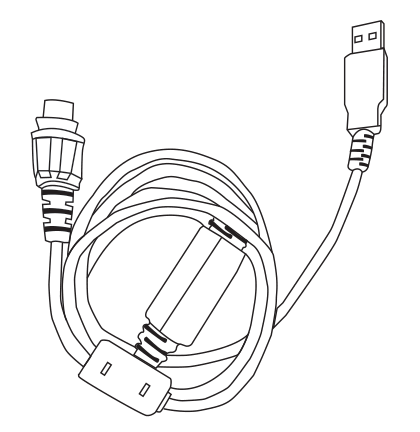
USB programming cable
Connects the REP 25 to the computer for programming. Sold separately and requires the appropriate driver and programmer, provided by the manufacturer. Code PC 47.
Request a quote
Fill in the fields to receive a technical quote, with price on request and guidance on the usage scenario.
Loading accessories…
Response by email and WhatsApp. No obligation · price on request. We also rent: in rentals, Anatel frequency licensing is already included by ABC Mais Telecom.
