
DTR720 and DEP450: which suits your operation best?
Motorola technology comparison
DTR720 and DEP450 are professional radios with different purposes. The DTR720 uses FHSS at 900 MHz for local communication; the DEP450 integrates analog and digital DMR networks in professional bands.
DTR720 and DEP450 are not direct replacements
They are similar in handheld form and PTT use. Internally, they take different approaches. The DTR720 uses frequency hopping in the 900 MHz ISM band and organizes contacts and groups in a local network. The DEP450 comes in VHF, 350 MHz or UHF variants and supports analog and digital DMR channels.
They therefore cannot communicate directly. A company already using repeaters, licensing and a DMR fleet is likely to assess the DEP450 for continuity. A team without conventional infrastructure, concentrated at one location, can assess the DTR720 after a coverage test.
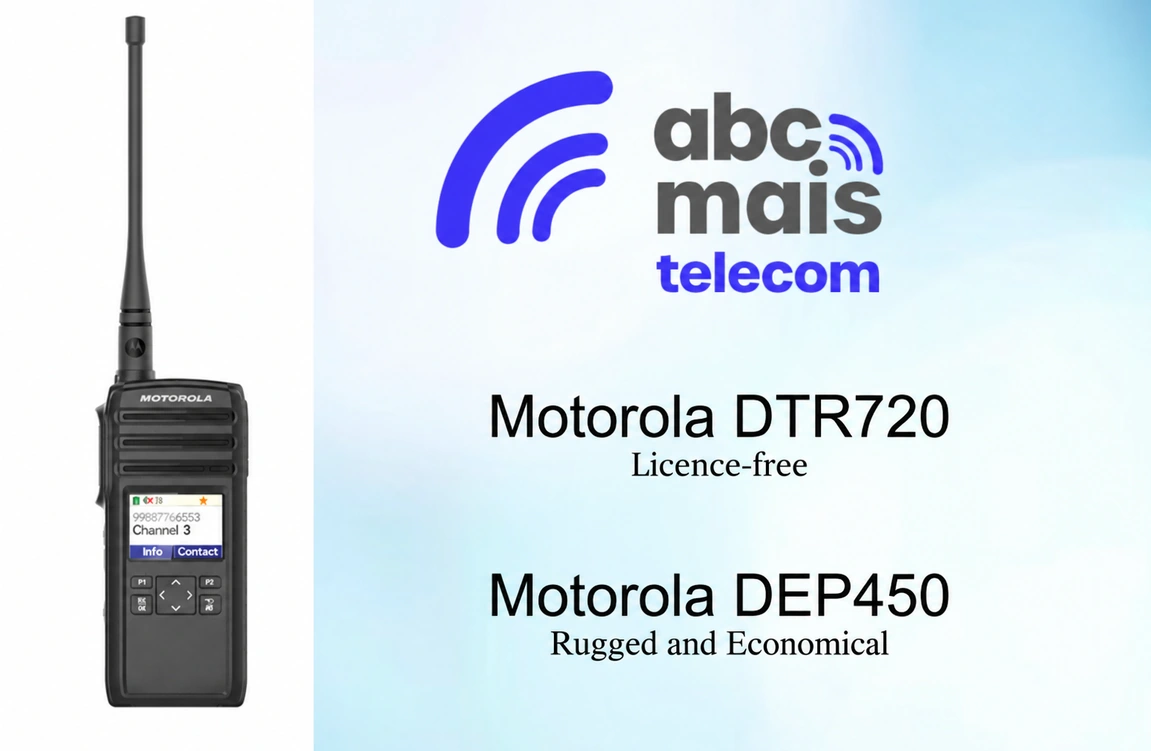
DTR720 and DEP450 comparison
| Criterion | DTR720 | DEP450 |
|---|---|---|
| Technology | Digital FHSS on 900 MHz. | Analog and digital DMR. |
| Channels | 50. | 16. |
| Screen | Color display. | No display. |
| Infrastructure | Focus on direct local communication. | Can integrate with MOTOTRBO systems and compatible repeaters. |
| Protection | IP54. | IP54. |
| Better question | Is coverage at the location sufficient at 900 MHz? | Do the DMR network and band suit the operation? |
The table does not pick a winner. It identifies which project deserves testing. Even ergonomics differ: screens and contacts can help a leader; a screenless radio can simplify use for operational teams.
Which scenario helps guide the decision?
The DTR720 can be considered when a team works in one area and wants digital groups without an existing DMR network.
The DEP450 can preserve compatibility, provided the variant and programming match.
A color screen and contacts support selected calls.
The DEP450 can participate in compatible systems planned for the area.
If the operation occupies metal warehouses, basements or separate buildings, carry out coverage testing. Renting for a test or event can also reduce risk before a larger purchase.
Six answers for a better quote
- Are radios already in use? Provide the brand, model and band.
- Is there a repeater or active frequency license?
- How many users and groups will communicate at the same time?
- What is the area, how many floors and what obstacles are present?
- Does the team need a display and private calls?
- Does buying, renting or field testing best fit the timeframe?
With this briefing, the sales conversation moves beyond "what is the radio's price?" to compare solutions that can actually work.
Ask the proposal to identify the variant, included accessories, programming and coverage assumptions. If testing is carried out, record the approved locations and points needing reassessment. This record prevents future expansion from being treated as a fresh start and helps compare proposals with the same scope.
Frequently asked questions
Can DTR720 and DEP450 communicate with each other?
Not directly. They use different bands and technologies.
Which has more channels?
The DTR720 specifies 50 channels; the DEP450, 16. That number alone does not determine coverage or suitability.
Which supports a repeater?
The DEP450 can integrate with compatible MOTOTRBO systems. The DTR720 focuses on local communication within its own architecture.
Can I test before buying?
Coverage testing is recommended in complex environments. Ask about demonstration or rental availability.
DTR720 and DEP450: validate the choice in the environment
DTR720 and DEP450 serve different architectures, so comparisons should start with the area and existing network.
When requesting a quote for DTR720 and DEP450, provide quantity, groups, obstacles and integration needs. These details prevent choosing by channels or battery life alone.
Sources and references
DTR720 or DEP450 for your operation?
Describe what is already installed, the location and who needs to communicate. ABC Mais Telecom compares both approaches without pushing a generic model.