
Digital radio systems
DMR systems: from local communication to a trunked network
DMR is more than a radio model. It is a voice and data architecture that can operate directly, with a repeater, between sites connected over IP or in higher-capacity systems. ABC Mais Telecom designs the solution around the required area, traffic, contingency and features.
- Voice and dataFeatures depend on the architecture, licenses and terminals.
- Planned capacityGroups, peak times and priority are part of the calculation.
- Validated coverageNo distance promises without a technical study.
Understand before choosing
What changes when radio becomes a system
DMR (Digital Mobile Radio) is an open standard for professional digital radio communication. In a simple deployment, two terminals can communicate directly. When an operation needs to pass through structures, organize many groups or connect units, repeaters, IP links, controllers, applications and contingency policies come into play.
The project does not start with the number of devices. It starts with the routine: who talks to whom, in which areas, at which times and what must keep working if a link or coverage point fails.
Radios and consoles
Portable radios, mobile radios and dispatch stations provide access to the voice, groups, alerts and data specified in the configuration.
Repeating and interconnection
Repeaters, antennas, cables, the IP network and power supply determine coverage, continuity and availability.
Groups, priority and management
A communication plan, call rules, supervision, records and support turn technology into a process.
Motorola Solutions and Hytera
Two DMR families, designed for the same operation
The choice should not come down to brand or appearance. Compatibility, topology, capacity, applications, security and support must be settled as a single project.
Motorola SolutionsMOTOTRBO
The family ranges from conventional systems to trunking and multi-site connection options. The aim is to combine digital communication, capacity and operational features in a design suited to the company.
- Capacity PlusScalable digital trunking for a single site.
- Capacity MaxScalable trunked architecture focused on security.
- IP Site ConnectSystem extension between sites using IP connectivity.
- Connect PlusWide-area, high-volume communication across multiple sites.
HyteraHytera DMR
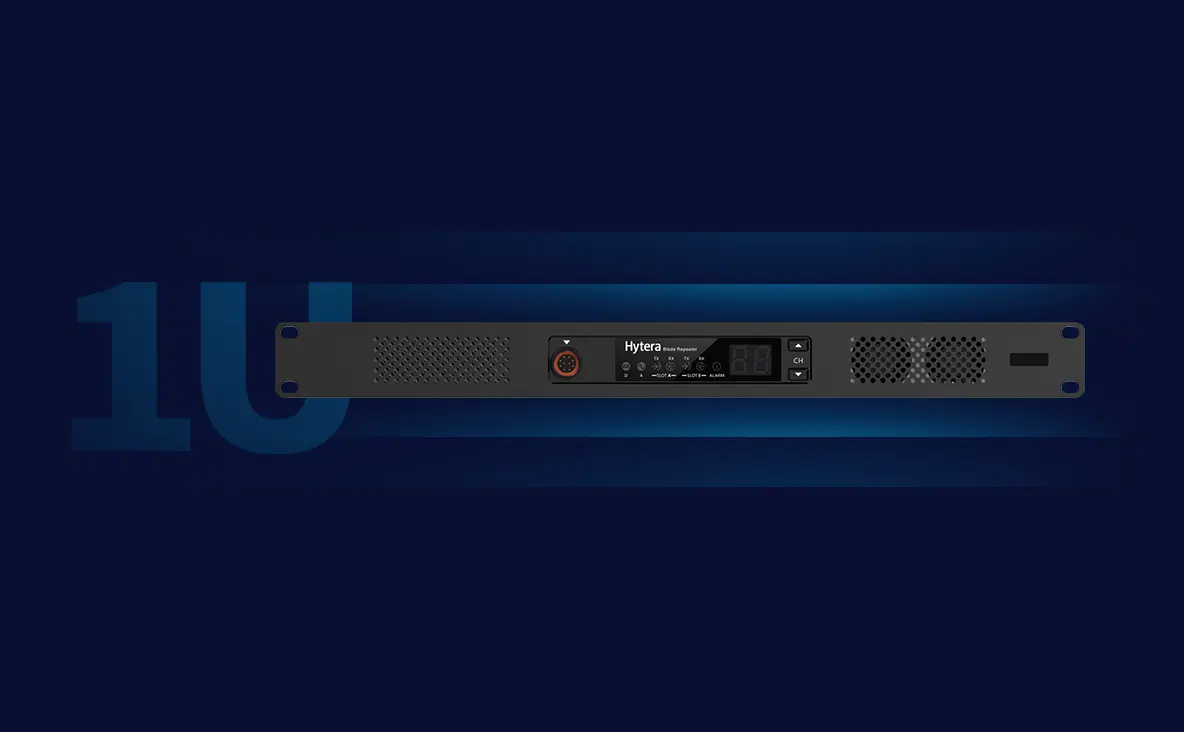
Hytera combines radios, repeaters, hardware and applications in DMR solutions focused on coverage, capacity and administration. The family includes conventional repeating and trunked alternatives.
- DMR repeatingPlanned expansion of the communication path.
- XPTDigital trunking alternative described in the Hytera portfolio.
- Trunking LiteTrunked architecture tailored to scale and traffic.
- DMR TrunkingManagement of voice and data calls on shared frequencies.
Topology to suit the requirements
Four common levels of evolution
These are not automatic packages. They are references for discussing growth, limitations and dependencies before a quote.
Radio to radio
For nearby teams, with few groups and no intermediate infrastructure. Physical barriers and user positions remain determining factors.
With a repeater
Creates an intermediate reception and transmission point. The antenna, cable, power, shelter and installation site are part of the system.
Sites connected over IP
Connects distant units over a data network. Link quality and contingency must be included in the project.
Trunking
Dynamically distributes channels among groups to make better use of frequencies and support more simultaneous calls.
Hytera base stations
Hytera infrastructure for DMR trunking and simulcast
When an operation requires trunking or wide-area coverage, Hytera's DS range offers different base station formats. The choice depends on traffic, site count, physical space and required continuity: sizing is part of the project, not the catalogue.
DS-6210 · Trunking Pro
Trunking base station for large networks: up to 16 carriers per station, expandable to 48, and interconnection of up to 512 MSOs. 29U and 42U cabinets for operation centers.
DS-6211 · Trunking Lite
Compact ETSI DMR Tier III trunking: 1 to 8 carriers, up to 10 thousand subscribers per MSO, GPS or PTP synchronization and adjustable power from 5 to 100 W.
DS-6250S · Trunking Cube
Compact multi-carrier SDR station: 16,7 kg, IP68 protection and operation from −40 °C to +55 °C. Designed for remote sites and limited spaces, with GNSS and PTP synchronization.
DS-6310 · Simulcast
Multiple sites transmit on the same frequency pair to cover a wide area without changing channels, with a migration path from existing analogue systems.
| Model | Standard | Carriers | Frequency band | Power |
|---|---|---|---|---|
| DS-6210 | Trunking Pro (PDT/DMR) | 1-16, expandable to 48 | VHF 136-174 MHz · UHF 330-520 and 806-941 MHz | 1-50 W |
| DS-6211 | Trunking Lite · ETSI DMR Tier III | 1-8, up to 24 | VHF 136-174 MHz · UHF 330-520 MHz | 5-100 W |
| DS-6250S | Trunking Cube · DMR Tier III | 1-8 UHF · 1-4 VHF | VHF 136-174 MHz · UHF 350-470 MHz | up to 50 W (2 UHF carriers) |
| DS-6310 | Simulcast · DMR | 2 | VHF 136-174 MHz · UHF 330-470 MHz | 5-50 W |
Before deciding: the available band, licenses, site synchronization and regional configuration must be confirmed in the project. The data above comes from the manufacturer's official pages and does not replace system sizing.
From need to operation
A DMR system is only complete when all layers work together
Coverage, capacity and applications are not independent. An infrastructure decision can change licenses, terminals, links and the support routine.
Actual use
Areas, shifts, groups, priority, privacy and emergency situations.
Radio frequency
Frequencies, coverage study, antennas, cables, power and interference.
Network and power
IP, quality of service, redundancy, power supply and infrastructure monitoring.
Management
Programming, licenses, dispatch, recording, maintenance and an expansion plan.
Important technical limitation: the “DMR” designation does not guarantee that two devices from different brands share encryption, applications or proprietary features. Compatibility must be validated in the intended configuration.
Design criteria
What ABC Mais assesses before recommending an architecture
This assessment avoids buying insufficient infrastructure or complexity the operation does not need.
| Criterion | Project question | Impact on the solution |
|---|---|---|
| Coverage | Which areas need to communicate and what obstacles are present? | Repeater position, antenna system, number of points and field validation. |
| Capacity | How many groups use the system and how many calls overlap at peak time? | Channel count, need for trunking and group organization. |
| Availability | What can stop, and for how long? | Power, link and server redundancy, and a contingency procedure. |
| Data and dispatch | Are location, messages, alarms or recording part of the routine? | Applications, licenses, interfaces, storage and operator stations. |
| Expansion | Are new areas, units or users already planned? | Topology, reserved capacity, addressing and platform selection. |
Architecture questions
Questions about DMR systems
Does DMR always need a repeater?
No. An operation can start in direct mode. A repeater or trunked system is introduced when the study identifies a need for coverage, capacity, management or integration.
Are Capacity Plus, Capacity Max and IP Site Connect equivalent?
No. They are MOTOTRBO architectures with different purposes: capacity at one site, scalable trunking and extension between sites over an IP network. Selection depends on the operation and infrastructure.
Do radios from different brands work together because they are DMR?
The DMR standard helps with basic interoperability, but advanced features, licenses, encryption, applications and implementation must be checked case by case.
A responsible DMR project
Design coverage and capacity before defining equipment.
ABC Mais Telecom evaluates the operation, site, network and growth to propose an architecture consistent with actual use.
