
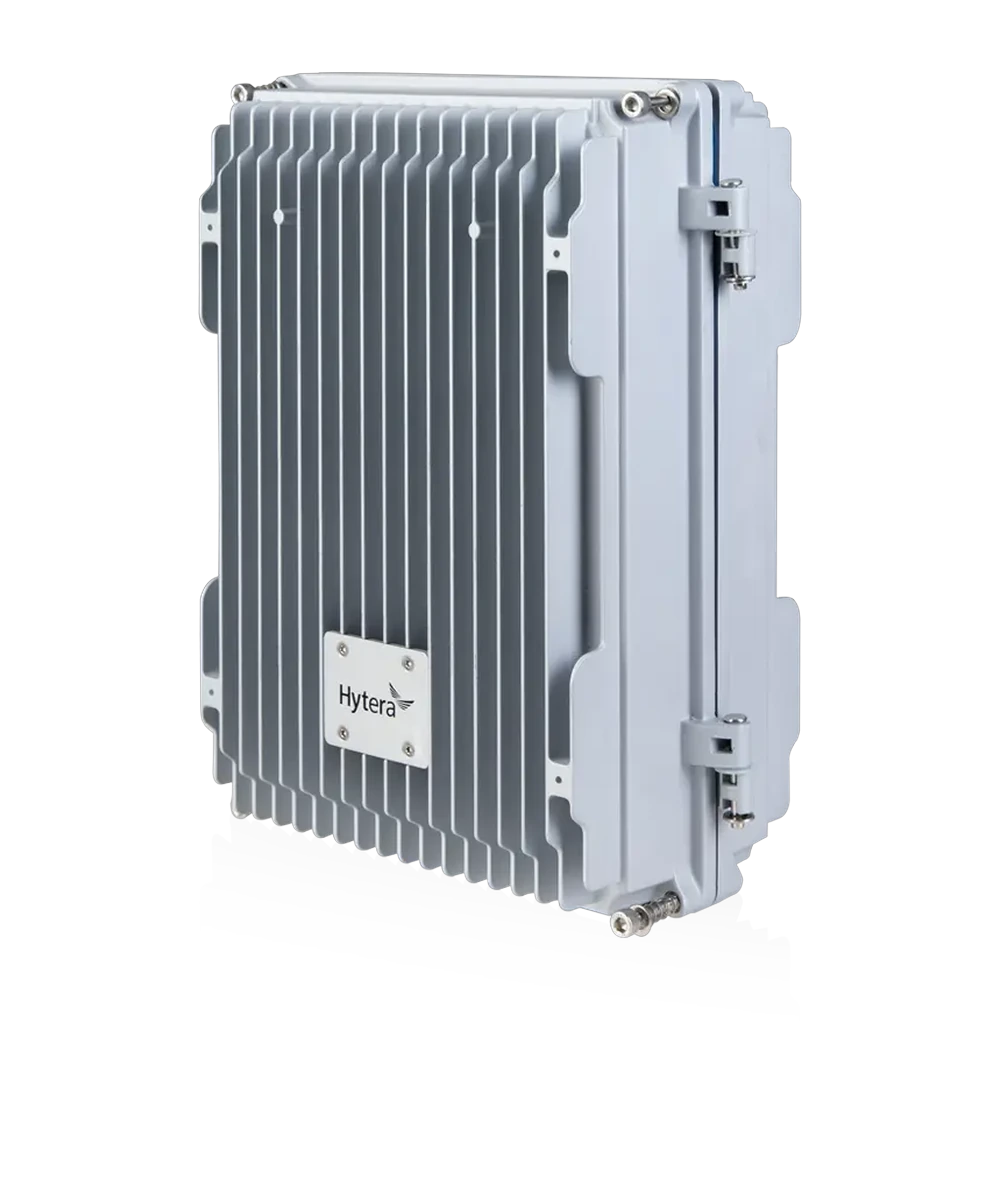
Hytera E-Pole100-S Repeater
The Hytera E-Pole100-S, also searched as E-Pole100S, is an ad-hoc DMR repeater that transmits and receives on the same frequency. It is designed for pole or wall mounting in temporary and operational response scenarios.
The manufacturer states DMR Tier II, adjustable power of 5, 10 or 20 W, VHF or UHF versions, IP56 protection and AC/DC power supply.
Up to 20 W
5, 10 or 20 W.
IP56
Published protection.
DMR Tier II
Published mode.
7.3 kg
Published weight.

OVERVIEW
Meet the Hytera E-Pole100-S repeater
The E-Pole100-S creates an ad-hoc DMR layer on the same frequency, with pole or wall mounting. The architecture and frequency band must be defined according to the project.
- DMR Tier II with transmission and reception on the same frequency
- Adjustable power of 5, 10 or 20 W and IP56 protection
- Pole or wall mounting with AC/DC power supply
Single frequency
DMR Tier II ad-hoc
Transmits and receives on the same frequency.
• 5, 10 or 20 W
• VHF or UHF by version
• Temporary deployment
Outdoor environment
Published data
Enclosure with IP56 and flexible power.
• AC 90 to 264 V
• DC 11,4 to 16,8 V
• -30 °C to +60 °C
Confirmed features of the E-Pole100-S
The model combines DMR Tier II, adjustable power, IP56, AC/DC power supply and structure for outdoor installation according to official documentation.
DMR project with technical evaluation
- DMR Tier II with transmission and reception on the same frequency
- Adjustable power of 5, 10 or 20 W and IP56 protection
- Pole or wall mounting with AC/DC power supply
Support to size the solution
Before requesting a quote, inform the intended frequency band, deployment area, mounting position, available power supply and DMR architecture.
Architecture and frequency
The E-Pole100-S transmits and receives on the same frequency. Programming must follow the radio architecture defined for the operation.
Groups and operation
Groups and channels must be planned within the DMR Tier II network and the frequency assigned to the selected variant.
Specialized technical service
ABC Mais Telecom provides specialized technical service in radiocommunication and guides the evaluation of the equipment according to the technical diagnosis.
Data for the quote
Provide city, locations, band, number of users, installation position and power supply to guide the technical analysis.
Components defined in the project
Antenna, cables, supplementary power and other components depend on the project. No accessory is presumed on this page.
Technical quote
Request a quote so that the commercial team can evaluate the scenario and the appropriate conditions for your use.
Technical specifications
Technical data of the Hytera E-Pole100-S according to the official table specific to the model with suffix S.
DMR Tier II
Published mode.
5, 10 or 20 W
Adjustable power.
IP56
Published protection.
AC/DC
Published power supply.
Detailed data sheet
| Category | Single-frequency ad-hoc DMR repeater |
| Mode | DMR Tier II |
| Power | 5, 10 or 20 W adjustable |
| VHF version | 136 to 174 MHz |
| UHF 1 version | 350 to 400 MHz |
| UHF 2 version | 410 to 470 MHz |
| AC power | 90 to 264 V |
| DC power | 11.4 to 16.8 V |
| Internal battery | 2 Ah, 10.8 V |
| Protection | IP56 |
| Temperature | -30 °C to +60 °C |
| Dimensions | 316 × 223 × 133 mm |
| Weight | 7.3 kg |
Features explained
The points below reproduce features published by Hytera. Suitability for the environment and infrastructure must be verified in the technical design.
Single frequency
The E-Pole100-S transmits and receives on the same frequency in DMR Tier II. This feature must be configured within the architecture defined for the operation.
Power and versions
Power is adjustable to 5, 10 or 20 W. There are VHF versions from 136 to 174 MHz, UHF from 350 to 400 MHz or UHF from 410 to 470 MHz, without simultaneous use of the bands.
Power supply
The published power supply is AC from 90 to 264 V or DC from 11.4 to 16.8 V. The published internal battery has 2 Ah and 10.8 V, with no autonomy in hours declared.
Protection and environment
The manufacturer reports IP56, operating temperature from -30 °C to +60 °C and MIL-STD-810 C/D/E/F/G environmental compliance.
Dimensions and weight
The published dimensions are 316 × 223 × 133 mm, with a weight of 7.3 kg.
Ad-hoc deployment
See the E-Pole100-S data sheet to define the project.
Technical consultation
If there is any doubt about networks, accessories or intended use, send the context so that the commercial team can evaluate the appropriate configuration.
Manufacturer source
See the E-Pole100-S data sheet to define the project.
Applications to evaluate
The E-Pole100-S can be evaluated for temporary deployment, operational response and ad-hoc expansion of DMR communication on the same frequency.
Manufacturer source
See the E-Pole100-S data sheet to define the project.
Communication oriented to the usage scenario

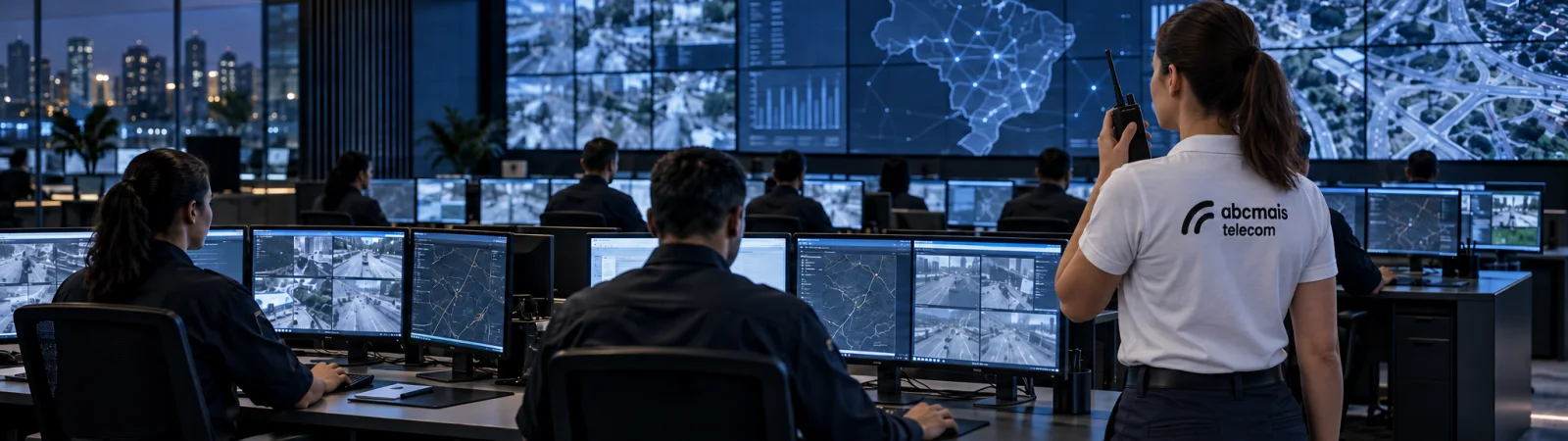
ABC Mais Telecom gathers context, connectivity and number of users before suggesting a configuration.
Points for the commercial conversation
Logistics, private security, field services and events may have different needs. ABC Mais Telecom gathers the context before suggesting a configuration.
Points for the commercial conversation
Number of users
The approximate number helps organize groups, additional batteries and the routing of the quote.
Work environment
Band, position, power supply and integration with the operation need to be defined before the quote.
Installation and power supply
The selection of antenna, cables and supplementary power supply depends on the band, installation and technical design.
Validation before the proposal
A conversation about band, position, power supply, and DMR architecture avoids a proposal based only on nominal power.
Selection criteria
Band, power, power supply, mounting position, and network integration must be evaluated for each operation.
Technical quote for E-Pole100-S
Define band, frequency, power, power supply, position, and DMR network integration before the proposal.
Data required for analysis
Published resources
Power, band, power supply, protection, dimensions, and mounting method must match the project.
Components under design
Each installation component must match the exact reference defined in the project.
Components defined in the project
There are no accessory cards because the specific source of the model does not provide individual code, compatibility, and official image for each component.
How to specify the Hytera E-Pole100-S
E-Pole100S is a search form used for the model officially written as E-Pole100-S. The E-Pole100S was created to form an ad-hoc DMR layer on a single frequency. This means that transmission and reception are organized on the same frequency, within an architecture that needs to be defined before deployment. The E-Pole100S should not be treated as a conventional two-frequency repeater nor as a PoC terminal. Hytera’s current official source identifies DMR Tier II, pole or wall mounting, and use in temporary and operational response scenarios.
E-Pole100S frequency bands and power
The specific documentation for the model with suffix S publishes three band variants: VHF from 136 to 174 MHz, UHF from 350 to 400 MHz, and UHF from 410 to 470 MHz. One unit corresponds to the selected variant. The E-Pole100S data sheet does not suggest simultaneous operation on all bands. Power can be adjusted to 5, 10, or 20 W. The definition should not consider only the highest value. Frequency, network architecture, position, antenna, obstacles, interference, and applicable rules influence the design.
Power supply and internal battery
The published AC input accepts from 90 to 264 V. The DC input works from 11.4 to 16.8 V. The specified internal battery has 2 Ah and 10.8 V. The E-Pole100S source does not provide battery life in hours for the E-Pole100-S. Therefore, this page does not convert electrical capacity into a promise of duration. Power source, electrical protection, grounding, cabling, and continuity strategy need to be defined according to the location and the criticality of the operation.
Protection and environment
The published rating is IP56. It describes protection against limited dust ingress and against water jets under test conditions. It does not equate to submersion. The operating temperature ranges from minus 30 to plus 60 degrees Celsius. Hytera also publishes environmental compliance MIL-STD-810 C, D, E, F, and G. This E-Pole100S data helps evaluate the scenario, but does not replace correct installation, connector sealing, mechanical support, and periodic inspection.
Dimensions, weight, and mounting
The E-Pole100S enclosure measures 316 by 223 by 133 mm and weighs 7.3 kg. These numbers matter for support calculation, transportation, and choice of mounting point. Installation of the E-Pole100S on a pole or wall must consider maintenance access, cable strain, ventilation, connector protection, and site safety. The E-Pole100S should not be positioned solely for physical convenience. Position also contributes to radio performance and must be part of the survey.
Single frequency does not mean guaranteed range
The E-Pole100S documentation describes the operating mode, not a fixed distance. The result depends on the variant, selected power, antenna system, height, terrain, materials present, and radio frequency noise. A temporary deployment of the E-Pole100S may require field testing at critical points. The proposal must record where the unit will be installed, which areas need communication, and which limitations were observed.
Project components
E-Pole100-S installation components are selected according to the variant and project. The antenna, duplexer where applicable to the architecture, cables, connectors, electrical protection and supplemental power supply must be specified by exact reference. A generic category does not prove electrical, mechanical or band compatibility.
Checklist for technical analysis
- Confirm the exact spelling and variant of the E-Pole100S.
- Define VHF or one of the two published UHF bands.
- Record frequency, power, and DMR Tier II architecture.
- Map pole or wall, height, access, and cable route.
- Verify AC or DC power, protection, and continuity.
- Define antenna system by band and installation.
- Perform testing at critical points when the scenario requires.
- Document configuration, location, date, and responsible parties.
Deployment and acceptance
Acceptance of the E-Pole100S must separate equipment specification, installation condition, and observed field result. Record variant, frequency, power, position, source, and components used. Then, perform representative calls between the defined points. If there is a difference between expected and observed, analyze antenna, cables, height, obstacles, interference, and programming before attributing the problem to the enclosure. This method preserves traceability and avoids generalizations.
Evidence-based maintenance
A technical review of the E-Pole100S should begin with unit identification and reading the known configuration. Inspect connectors, sealing, support, cables, power, and signs of exposure. Compare current behavior with the acceptance record. Changes in location, antennas, cables, or frequency can change the result even without internal failure. The E-Pole100-S is best analyzed as part of an installed system, not as an isolated box.
Variant registration
The technical form must record E-Pole100S along with the official spelling E-Pole100-S, the band, and the unit’s serial number. This dual identification avoids confusing the equipment with E-Pole100 without suffix S or with other response solutions from the brand. The record must also store configured power, frequency, power supply used, and mounting position.
Inspection before energization
Before energizing the E-Pole100S, check enclosure integrity, connectors, support, cables, and power source. Verify that the variant corresponds to the planned band. Confirm that the antenna system was chosen for that band and that the mounting point does not strain the connectors. The inspection must be repeated after transportation or change of location.
Documented functional test
The E-Pole100S test must use radios programmed for the defined architecture. Record locations, power, position, environmental conditions, and call results. Repeat at the most critical points. If communication varies, note obstacles, height, noise, and any installation changes. A single result should not be converted into a distance promise.
Temporary operation
In a temporary deployment, the E-Pole100S needs a responsible person, installation date, period of use, and removal procedure. Cables and power must remain protected throughout the period. The team must know how to report a failure and who can change the configuration. Power or frequency changes must be controlled and recorded.
Version comparison
The name E-Pole100S alone does not prove the equipment’s band. VHF and the two published UHF variants have different bands. The label and documentation applicable to the unit must guide the analysis. It is also incorrect to copy battery life, connectivity, or features from another product in the family to fill gaps in this data sheet.
Deployment closure
After use, de-energize the E-Pole100S according to the project procedure, inspect cables, connectors, and support, and record any damage. Preserve the known configuration and unit identification. This history helps prepare the next deployment without relying on memory or a generic data sheet.
Delivery sheet
The E-Pole100S delivery sheet must gather identification, variant, band, power, power supply, position, antenna system, and test result. Keep a copy with the technical history. When the E-Pole100S changes location, update position, cables, power source, and observed conditions. This discipline allows comparing deployments without attributing to the equipment differences caused by the environment.
ABC Mais Telecom uses the manufacturer’s official source to present the E-Pole100S data sheet. The technical quote depends on real scenario data and does not presume range, battery life, or components that the specific documentation does not publish.
Request a quote
Fill in the fields to receive a technical quote, with price on request and guidance on the usage scenario.
Response by email and WhatsApp. No obligation · price on request. We also rent: in rentals, Anatel frequency licensing is already included by ABC Mais Telecom.
Frequently asked questions
What is the Hytera E-Pole100-S?
The E-Pole100-S is a single-frequency DMR Tier II repeater, with adjustable power of 5, 10 or 20 W.
In which frequency bands are versions available?
There are VHF versions from 136 to 174 MHz, UHF from 350 to 400 MHz and UHF from 410 to 470 MHz. Each unit corresponds to one band.
How does single frequency work?
It transmits and receives on the same frequency. Suitability depends on the architecture and programming defined for the network.
How is power supplied?
The published power supply is AC from 90 to 264 V or DC from 11.4 to 16.8 V. The published internal battery has 2 Ah and 10.8 V.
What is the protection rating of the E-Pole100-S?
The published protection rating is IP56. The operating temperature ranges from minus 30 to plus 60 degrees Celsius.
How can it be mounted?
Hytera publishes pole or wall mounting for temporary deployment and operational response.
What are the dimensions and weight?
The dimensions are 316 by 223 by 133 mm and the published weight is 7.3 kg.
Does the page display accessories?
No. Antenna, cables, supplementary power supply and other components need to be defined for each installation.
