
Intrinsically safe radio: certification guide
Operation and compliance
An intrinsically safe radio is designed and certified to limit ignition sources in potentially explosive atmospheres. Selection cannot be based only on appearance, color or mechanical strength.
What does intrinsically safe mean?
In areas where flammable gases, vapors, mists or dust may be present, a spark or hot surface can pose a risk. Intrinsic safety protection limits electrical and thermal energy under conditions defined by the certification.
This does not mean that any rugged radio is suitable. IP54, IP67 or IP68 concern dust and water ingress; they are different classifications from protection for explosive atmospheres. A model may be water-resistant and still lack certification for the hazardous area.
What to check before requesting a quote
| Item | Required question | Why it matters |
|---|---|---|
| Area classification | Which zone, substance and temperature class? | Defines the required protection level. |
| Model certificate | Is the exact variant covered? | Visually similar families may have different versions. |
| Battery | Is the battery code included in the certified assembly? | Replacements outside the list may invalidate the conditions of use. |
| Accessories | Are the earpiece, microphone and charger approved? | The system must remain compliant with the documentation. |
| Equipment certification | Is the radio certified by Anatel? | This is a requirement for marketing and use in Brazil. |
International certifications such as ATEX and IECEx appear in portfolios intended for hazardous environments. For Brazil, applicable local documents must also be observed, including INMETRO when required for the product and application.
Accessories are part of the decision
A seemingly simple replacement can change the certified condition. A battery with a different capacity, an unapproved remote microphone, an unsuitable earpiece or maintenance outside the procedure require control. The correct approach is to work with the part codes listed by the manufacturer for the chosen variant.
Record the model, variant, serial number and associated accessories.
Look for damage, cracks, compromised sealing and unapproved components.
Define a charging area and procedure compatible with the operation.
Use specialized assistance and preserve intervention records.
A safe specification process
- Request the formal area classification from the responsible team.
- Provide the substance, zone, temperature and work routine.
- Compare the exact variant's certificate, not just the family name.
- List all necessary accessories before finalizing the kit.
- Check Anatel certification and applicable documentation.
- Plan inspections, replacements and user training.
ABC Mais Telecom supports the commercial and technical selection of equipment. Approval for use in the hazardous area remains with those responsible for the operation's engineering, safety and compliance.
Frequently asked questions
Does IP68 mean the radio is intrinsically safe?
No. IP describes protection against ingress of solids and water. Intrinsic safety is another form of protection and requires its own certification.
Is every blue radio certified?
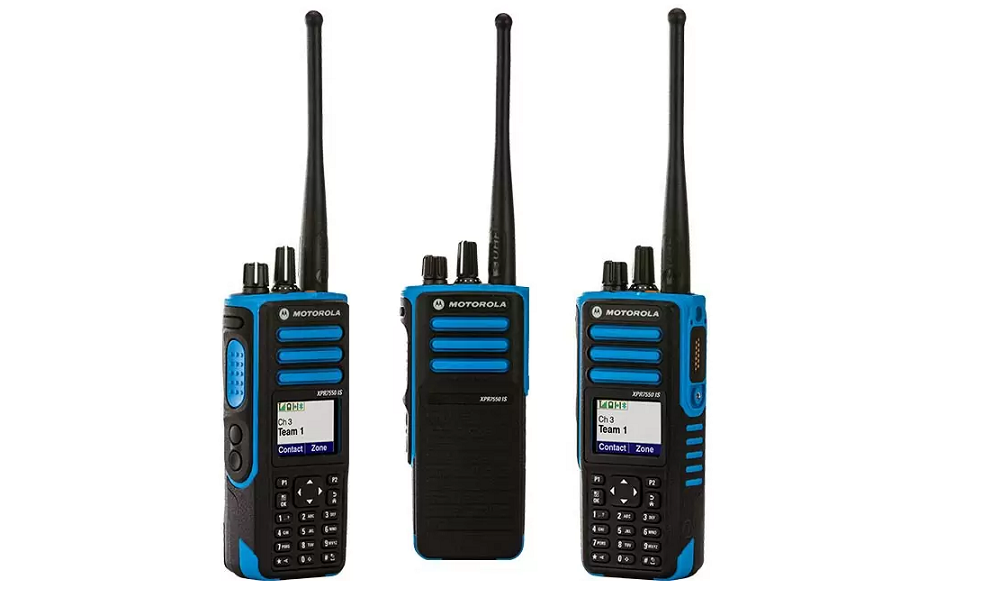
No. Color may aid identification, but it does not replace markings and certificates for the exact variant.
Can I use any earpiece with the radio?
Not in a hazardous area. The accessory must be among the permitted options to maintain assembly compliance.
Does Anatel certification replace ATEX or IECEx?
No. Certification addresses telecommunications requirements in Brazil; protection for explosive atmospheres involves specific certifications.
Intrinsically safe radio: information for a responsible assessment
When requesting an intrinsically safe radio, identify the area classification, gas or dust group and applicable temperature.
- ✓ Confirm the exact variant of the intrinsically safe radio on the certificate.
- ✓ Check that the battery, charger and audio accessories form a permitted assembly for the intrinsically safe radio.
- ✓ Record who validated the choice of the intrinsically safe radio for the operation.
This brief allows the assessment of the intrinsically safe radio safely, without treating a color or IP rating as proof of certification.
Sources and references
Need to specify communication for a hazardous area?
Send the area classification and operational requirements. The team organizes the commercial options without replacing validation by the responsible technical professionals.
