
Two-way radio rental for logistics and distribution centers
Two-way radio rental for logistics follows the distribution center’s pace: reinforcement for Black Friday and year-end, warehouse deployment, inventories and temporary operations. ABC Mais Telecom prepares tailored proposals with professional Motorola Solutions and Hytera radios programmed by area (loading dock, storage, picking, dispatch and gatehouse) and the use of Anatel-licensed frequencies already included.
Seasonal peaks
quantity that rises and falls with the operation
Anatel included
use of licensed frequencies already included in the rental
By area
loading dock, storage, picking, dispatch and gatehouse
24-hour shifts
batteries and charging sized by shift

Every idle minute at the loading dock is costly
When the loading dock cannot talk to storage and the gatehouse cannot talk to the yard, the truck waits. Radio shortens that path.
When logistics operations rent radios
Distribution center volumes vary greatly throughout the year. Logistics two-way radio rental provides the right quantity at each stage without buying a fleet sized for the peak. The most common cases:
- Black Friday, Christmas and promotional dates, with extra shifts and temporary workers.
- New warehouse deployment, when operations begin before permanent infrastructure is ready.
- A new client comes on board at a logistics provider, with a dedicated team for a few months.
- Full inventory, with counting and recounting across all areas in a few days.
- Layout change or warehouse move, with stock transferred between sites.
Who talks to whom in a distribution center
Group design is what makes logistics two-way radio work. A model serving as a starting point for most distribution centers:
| Group | Users | Purpose |
|---|---|---|
| Gatehouse and yard | Gatehouse, yard control, security | Clear trucks, assign loading docks and manage queues |
| Receiving | Goods checkers, forklift operators, leader | Unloading, checking and location assignment |
| Storage | Forklift and equipment operators | Movement and replenishment of locations |
| Picking and packing | Pickers, leaders, quality | Picking waves, shortages and priorities |
| Dispatch | Goods checkers, loading, transport | Loading, documents and vehicle departure |
| Supervision and emergency | Supervisors, emergency response team, maintenance | Shift coordination and incidents |
Supervisors usually listen to more than one group, and the emergency channel is kept free for incidents. The table is a starting point: every distribution center has its own workflow. Smaller operations may combine some groups; in larger operations, picking can be divided by wave or client, and maintenance gets its own group to assist teams without occupying the operational channel.
Pallet racking, cold rooms and yards: coverage
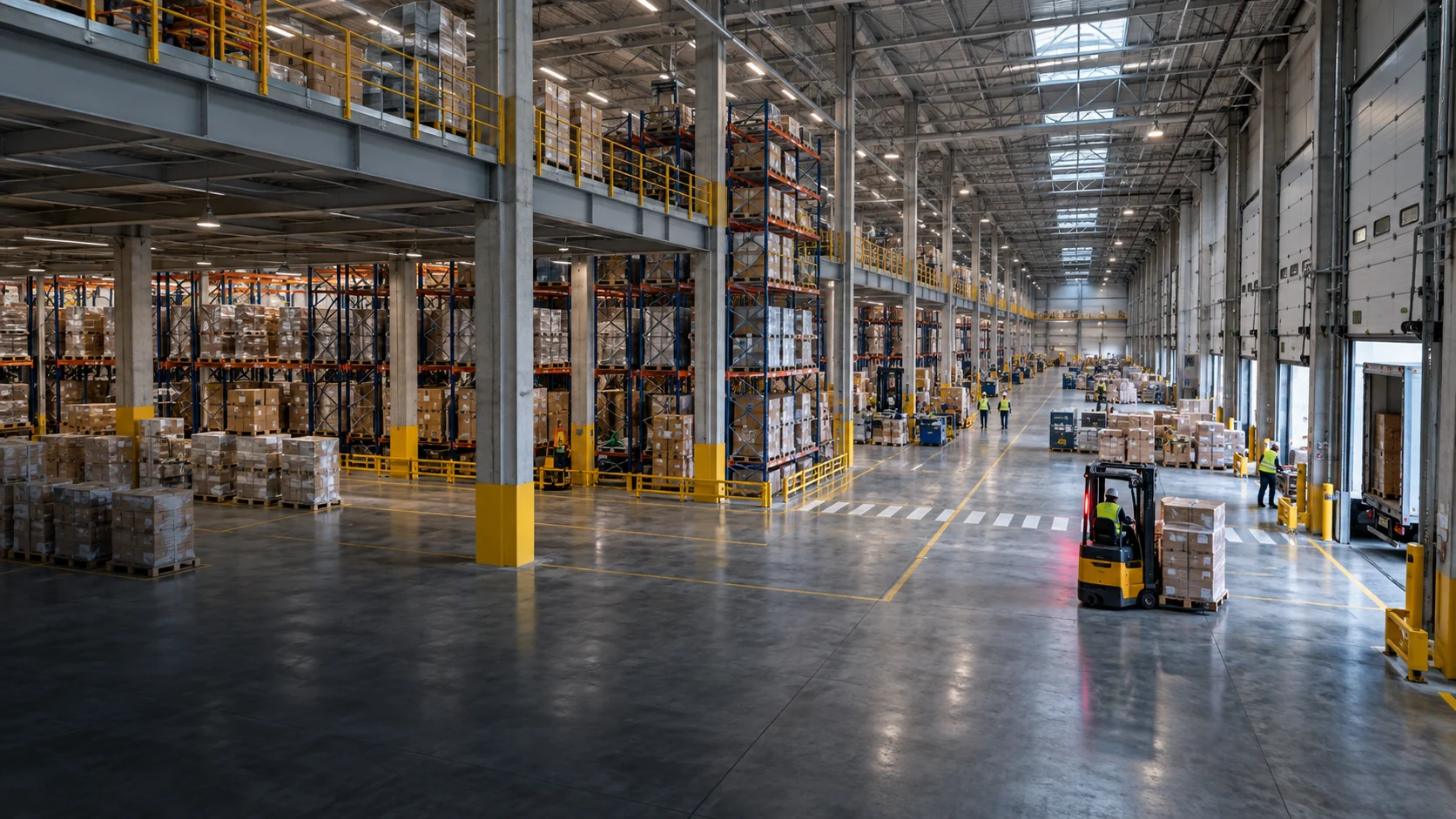
Logistics warehouses combine very large areas with loaded metal structures that block signals between aisles. Cold rooms have insulated walls and low temperatures that affect signals and batteries. The truck yard may be hundreds of meters from the office, and mezzanines place supervision higher up.
A test with radios at the most distant locations, including the gatehouse, cold room and back of the warehouse, shows whether radio-to-radio communication is sufficient.
When choosing a band, UHF usually penetrates walls and slabs better, while VHF tends to reach farther in open terrain; the guide UHF or VHF explains the difference. Where direct mode cannot reach, use the repeater, and a coverage test before use prevents surprises.
Scheduled loading docks: gatehouse, yard and dock in the same conversation
At distribution centers with scheduled receiving, a late truck changes the sequence for every dock. When the gatehouse announces it over radio, the yard reorganizes the queue and the dock prepares the right team, without a chain of phone calls. This is one of the clearest gains from logistics two-way radio: information reaches everyone involved simultaneously and vehicle waiting time falls.
Battery, charging and radio control by shift
In a 24-hour operation, each radio passes through three shifts. Three precautions are included in sizing so distribution center radios work without failures:
- Spare batteries for those talking throughout the shift: gatehouse, leaders and loading dock.
- Charging room with multi-unit chargers, a dedicated outlet and controlled access.
- Collection and return list by shift, with each radio’s number, to reduce losses.
Accessories for the warehouse
Noise from forklifts, conveyors, reversing alarms and truck engines requires suitable accessories. The most used for logistics two-way radio rental are lapel microphones (hands free for cargo), noise-isolating headsets (automation areas and yard), reinforced clips (people climbing on and off equipment) and discreet earpieces for supervision and offices. Compatibility is checked in the proposal.
What the proposal can include
Items logistics two-way radio rental may include according to the operation:
- Use of frequenciesAnatel licensing already arranged for rented radios.
- TalkgroupsOrganized according to who needs to talk to whom.
- Batteries and charging basesPlanned so radios are available at shift changes.
- Technical serviceMaintenance and replacement during the contract, according to the proposal.
- AccessoriesSelected for the environment: noise, discretion or hands-free use.
- RepeaterOptional, to extend range where direct radio-to-radio communication does not reach.
Items, quantities and terms apply according to the approved proposal.
From request to working radios
No model knowledge is needed to request logistics two-way radio rental. Simply describe the operation: how many people, where, for how long and in what type of environment (at the distribution center (city and address)). The technical team turns this into talk groups, radio quantities, batteries and accessories, and advises whether any site location needs a test or repeater. The proposal is in writing, with period, items and terms; once approved, radios are sent programmed, and support accompanies the contract through to return.
Example: Black Friday with twice as many people
For Black Friday, an e-commerce distribution center doubles the number of people per shift for a few weeks. Regular operations retain their groups, and rental adds radios and groups for temporary picking and packing, with a supervision channel listening to everyone and the emergency channel kept free.
Additional radios arrive programmed before the peak and are returned when volumes normalize. Temporary workers receive brief guidance on their first shift: how to change groups, when to press the talk button and where to return the radio. For radio terminology, it is worth sharing the guide to Q code with the most commonly used expressions.
Example: new warehouse deployment
During deployment, automation integrators, moving crews, temporary workers and the permanent team work together before the permanent infrastructure is ready. Rental covers this period with groups for deployment coordination, receiving, storage and gatehouse. Once operations stabilize, quantity is reviewed under the contract terms.
Example: full inventory in two days
During a full inventory, the distribution center stops dispatch and mobilizes in-house teams, temporary workers and sometimes external auditors. A common setup creates a group for each block of aisles, a recount group and a coordination group that receives discrepancies and immediately decides who checks them. Gatehouse and security retain their normal groups.
Because inventory often runs overnight, spare batteries and chargers are kept in a room near coordination. Distribution center radios arrive programmed and labeled by block and are returned together at the end.
Logistics provider with multiple clients
At a logistics provider, the same warehouse may serve different clients in separate areas, each with its own team and priorities. Logistics two-way radio rental allows groups to be programmed by client while gatehouse, yard and security remain shared. When a new client joins, radios for its operation can be contracted separately for that client’s contract term and returned if operations change.
Property security at the distribution center
Gatehouse, patrols and monitoring also use radio, but in their own group separate from operations, so incidents do not mix with loading dock conversations. During quieter night shifts, security can take over the general channel. When security requires video recording, a body camera can be included in the same proposal; see two-way radio rental for security.
Planning: when to request the proposal
For seasonal peaks, request a proposal as soon as forecast volumes and temporary staffing are defined; for inventories and moves, as soon as a date is set. In continuous operations, monthly rental can start with the current quantity and be reviewed as the distribution center grows, under the contract terms.
Radio, data collector, mobile phone or app-based PTT?
At the distribution center, the data collector records the operation; radio coordinates people. Mobile phones depend on the carrier’s network, fail in aisles and cold rooms and talk to one person at a time. Logistics two-way radio talks to the whole group at the touch of a button, without per-call costs. For drivers and fleets traveling between cities, PoC radios can complement the solution; see PoC two-way radio: how it works and when to use it.
Owned fleet and rented radios together
If the distribution center already has radios, send the brand and model: where band, operating mode and programming are compatible, rented radios join the fleet’s groups. Otherwise, the proposal specifies separate groups with supervision as the contact point.
Cross-docking and operations without stock
In cross-docking, freight enters through one loading dock and leaves through another within hours, without storage. Communication between receiving, checking and dispatch must be continuous because any discrepancy blocks vehicle departure. One group for the transshipment area, also heard by supervision, usually works better than separate groups for each stage.
Cross-docking operations often peak in the early morning, with volumes changing by day of the week. Logistics two-way radio rental allows contract-based quantity adjustments without keeping radios idle on quieter days.
Occupational safety at the loading dock
At the loading dock, communication also protects: the forklift operator needs to know when the truck is secured, the goods checker must announce when leaving the trailer and the driver cannot depart before clearance. A simple radio confirmation procedure with standard phrases reduces accident risk at the dock-vehicle interface. Phrases such as “trailer clear”, “wheel chock in place” and “vehicle cleared for departure”, always spoken by the same role, make confirmation unambiguous and easy to teach temporary teams.
Daily, weekly, monthly or long-term contracts
There is no standard minimum period: logistics two-way radio rental may last one day or several years. What changes is the organization: short projects focus on arriving programmed and returning without loss; long contracts include periodic maintenance, replacement and possible quantity adjustments, always according to the proposal. Compare on the page for two-way radio rental.
Where we serve distribution centers
ABC Mais Telecom primarily serves the State of São Paulo, with other regions served according to the project. There are specific pages for the main logistics hubs: Guarulhos, Jundiaí, Barueri and Osasco, Campinas and ABC Paulista.
For permanent day-to-day use, the page two-way radios for logistics and distribution centers brings together equipment selection criteria for continuous use.
Checklist for requesting a proposal
To get the first version of your logistics two-way radio rental proposal right, have the following ready:
- Distribution center operating address and dates, including setup and teardown.
- Number of radio users and how they are divided.
- Site type and difficult locations (basement, warehouse, open area).
- Shifts and charging location.
- Any radios already in operation.
Experience and credentials
Behind every logistics two-way radio rental is a company with more than 10 years in radio communications, an authorized Motorola Solutions reseller (PartnerEmpower Silver 2026) and Hytera reseller (Hytera Wings recognition from 2023 to 2025). The details are gathered on the page for ABC Mais Telecom facts.
Frequently asked questions
Can we rent radios just for Black Friday and year-end?
Yes. Logistics two-way radio rental can be weekly or monthly, following the peak. Request a proposal as soon as temporary staffing forecasts are defined so radios arrive programmed.
Can contractor drivers use radios in the yard?
They can, with radios issued at the gatehouse and returned on exit, programmed only for the yard group. Drivers then receive loading dock calls without a mobile phone or hearing the operation’s internal groups.
How many talk groups does a distribution center need?
It depends on workflow. A medium-sized distribution center usually uses four to six groups (gatehouse and yard, receiving, storage, picking, dispatch and supervision), plus an emergency channel. In cross-docking, a single transshipment group may work better.
Do I need an Anatel license to use the rented radios?
The license is not your responsibility. ABC Mais Telecom includes the use of Anatel-licensed frequencies in rented radios. Your own radios or a repeater in the same operation must be mentioned to confirm the applicable arrangement.
Does the radio work inside a cold room?
It may work, but insulated walls and low temperatures affect signal and battery life. Mention cold rooms and how long the team stays inside.
How many radios does a distribution center usually use?
It depends on people per shift and how many need to speak simultaneously. Leaders, gatehouse staff, goods checkers and forklift operators generally use radios; sizing is defined in the proposal.
How much does logistics two-way radio rental cost?
The price depends on quantity, rental period, accessories, whether a repeater is needed and logistics. The terms are negotiable and are set out in the proposal.
Do rented radios communicate with those we already use?
They can communicate if band, operating mode and programming are compatible. Send the brand and model of existing radios.
Do radios arrive programmed by distribution center area?
Yes. Groups agreed in the proposal (gatehouse and yard, receiving, storage, picking, dispatch, supervision and emergency) are already programmed. Radios can be labeled by area to simplify shift control.
Can a body camera be included for distribution center security?
Yes. Rental may include a body camera for the property security team when the project calls for it. Provide the number of guards and shifts.
What happens if a radio fails during the rental?
If a radio fails, replacement and maintenance can be part of the contract. The proposal explains how to request support.
Motorola Solutions and Hytera radios for rental
Logistics rental radios come from the professional Motorola Solutions and Hytera ranges, for which ABC Mais Telecom is an authorized reseller. The model is defined by the operation.


Official manufacturer ranges. Equipment, availability and composition are confirmed in each proposal.
Request your logistics two-way radio rental proposal
Provide the distribution center address, dates, shifts and approximate number of people. You do not need to know the radio model.
Tell us what your operation needs
Fill in the details to receive technical and commercial guidance.
Response by email and WhatsApp. No obligation · price on request.
